 Indietro
Chapter 2: Chemistry and Measurements – GOB Chemistry Study Notes
Guida di studio - Note intelligenti
 Appunti personalizzati basati sui tuoi materiali, ampliati con definizioni chiave, esempi e contesto.
Chemistry and Measurements
Introduction
Chemistry relies on precise measurements to describe and understand the properties of matter. This chapter introduces the systems of measurement used in chemistry, the concept of significant figures, and the application of conversion factors in problem solving. These foundational skills are essential for accurate scientific communication and calculations.
Units of Measurement
Metric and SI Units
The International System of Units (SI) is the global standard for scientific measurement. The metric system is widely used in chemistry and health sciences. Key units include:
Volume: Liter (L), Milliliter (mL). 1 L = 1000 mL; 1 L ≈ 1.06 qt; 946 mL = 1 qt.
Length: Meter (m), Centimeter (cm). 1 m = 100 cm; 1 m ≈ 39.4 in; 2.54 cm = 1 in.
Mass: Kilogram (kg), Gram (g). 1 kg = 1000 g; 1 kg ≈ 2.20 lb; 454 g = 1 lb.
Temperature: Celsius (°C), Kelvin (K). Water freezes at 0°C (273 K).
Time: Second (s). Other units: minutes (min), hours (h), days, years (yr).
Measurement tools include graduated cylinders for volume, rulers for length, balances for mass, thermometers for temperature, and stopwatches for time.
Measured Numbers and Significant Figures
Measured vs. Exact Numbers
Measured numbers are obtained by measurement and include an estimated digit. Exact numbers are obtained by counting or definition and have no uncertainty.
Measured Example: Height, weight, temperature.
Exact Example: 8 cookies, 1 kg = 1000 g.
Significant Figures (SFs)
Significant figures represent the precision of a measured value. Rules for identifying SFs:
All nonzero digits are significant.
Zeros between nonzero digits are significant.
Zeros at the end of a decimal number are significant.
Zeros at the beginning of a decimal number are not significant.
Zeros at the end of a whole number without a decimal point are not significant.
Scientific notation clarifies which zeros are significant.
Significant Figures in Calculations
Rounding Off
Calculated answers are rounded to the correct number of significant figures:
If the first digit to be dropped is 4 or less, drop it and all following digits.
If the first digit to be dropped is 5 or greater, increase the last retained digit by 1.
Multiplication and Division
In multiplication or division, the answer has the same number of SFs as the measurement with the fewest SFs.
Addition and Subtraction
In addition or subtraction, the answer has the same number of decimal places as the measurement with the fewest decimal places.
Prefixes and Equalities
Metric Prefixes
Prefixes modify the size of units by powers of ten. Common prefixes include:
Kilo- (1000)
Centi- (0.01)
Milli- (0.001)
Micro- (0.000001)
Equalities express relationships between units, e.g., 1 km = 1000 m.
Writing Conversion Factors
Conversion Factors
Conversion factors are fractions derived from equalities, used to convert between units. For example:
From 1 m = 100 cm: or
From 60 min = 1 h: or
Numbers from definitions are exact; measured numbers count toward SFs.
Problem Solving Using Unit Conversion
Steps for Unit Conversion
To solve unit conversion problems:
Identify the given quantity and units.
Determine the needed units.
Identify conversion factors connecting the units.
Set up the calculation to cancel units and solve.
Multiple conversion factors may be needed for complex conversions.
Chemistry Link to Health: Toxicology
Lethal Dose (LD50)
Toxicology assesses the risk of substances by determining the lethal dose (LD50), the concentration causing death in 50% of test animals. Dosages are measured in mg/kg or μg/kg of body mass. Lower LD50 values indicate higher toxicity.
Density
Definition and Calculation
Density is the ratio of mass to volume:
Units: g/mL (liquids), g/cm3 (solids). Density determines whether an object sinks or floats in water.
Bone Density and Health
Bone density is a measure of mineral content in bone. Low bone density, as seen in osteoporosis, increases fracture risk. X-rays are used to assess bone density in clinical settings.


Density Using Volume Displacement
For irregular solids, volume is determined by water displacement. The density is then calculated using the displaced volume.
Problem Solving with Density
Density can be used as a conversion factor to find mass or volume:
Given mass and density, find volume:
Given volume and density, find mass:
Specific Gravity
Definition and Clinical Application
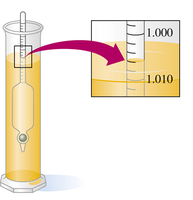
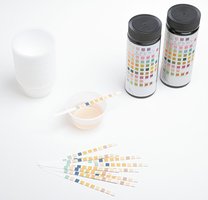
Specific gravity is the ratio of the density of a substance to the density of water (1.00 g/mL at 4°C). It is unitless and used in clinical settings to assess urine concentration.
Normal urine specific gravity: 1.003–1.030. Deviations may indicate dehydration, kidney disease, or other health issues.
Summary Table: Common Units and Prefixes
Quantity | SI Unit | Metric Unit | Common Prefixes |
|---|---|---|---|
Length | meter (m) | meter (m), centimeter (cm) | kilo-, centi-, milli-, micro- |
Mass | kilogram (kg) | gram (g), milligram (mg) | kilo-, milli-, micro- |
Volume | cubic meter (m3) | liter (L), milliliter (mL) | kilo-, milli-, micro- |
Temperature | kelvin (K) | Celsius (°C) | — |
Time | second (s) | second (s), minute (min) | — |
Additional info: This study guide expands on brief points from the original material, providing definitions, examples, and formulas for clarity and completeness. Images included are directly relevant to the explanation of rounding off, bone density, and specific gravity as described in the paragraphs.
