 Indietro
Chapter 4: Molecular Compounds – Structure, Bonding, and Properties
Guida di studio - Note intelligenti
 Appunti personalizzati basati sui tuoi materiali, ampliati con definizioni chiave, esempi e contesto.
Overview of Molecular Compounds
Introduction to Molecular Compounds
Molecular compounds are chemical substances formed by the sharing of electrons between nonmetal atoms, resulting in the formation of covalent bonds. Unlike ionic compounds, which are composed of ions, molecular compounds consist of discrete molecules held together by these shared electron pairs.
Covalent bonds are the primary force holding molecular compounds together.
Molecular compounds are typically gases, liquids, or low-melting-point solids.
They do not conduct electricity in the solid or liquid state.
Covalent Bonding
Nature and Formation of Covalent Bonds
A covalent bond is formed when two atoms share one or more pairs of electrons. This sharing allows each atom to achieve a stable electron configuration, often resembling that of the nearest noble gas (the octet rule).
Atoms share electrons to complete their valence shells (8 electrons for most, 2 for hydrogen).
The resulting group of atoms is called a molecule.
Examples: H2O (water), O2 (oxygen), N2 (nitrogen).
Forces in Covalent Bond Formation
When two atoms approach each other, both attractive and repulsive forces act between their nuclei and electrons. A covalent bond forms when the attractive forces (nucleus-electron) outweigh the repulsive forces (nucleus-nucleus and electron-electron).
The bond length is the optimal distance between nuclei where energy is minimized.
The Octet Rule and Exceptions
Application of the Octet Rule
The octet rule states that atoms tend to form bonds until they are surrounded by eight valence electrons. This rule helps predict the number of bonds an atom will form:
H forms 1 bond
C forms 4 bonds
N forms 3 bonds (plus 1 lone pair)
O forms 2 bonds (plus 2 lone pairs)
Halogens form 1 bond (plus 3 lone pairs)
Exceptions to the Octet Rule
Incomplete octet: Some atoms (e.g., B, Be) have fewer than 8 electrons.
Expanded octet: Atoms in period 3 or below can have more than 8 electrons due to available d orbitals.
Odd-electron species: Molecules with an odd number of electrons (radicals).
Multiple Covalent Bonds
Single, Double, and Triple Bonds
Atoms can share more than one pair of electrons, resulting in multiple bonds:
Single bond: One pair of shared electrons (e.g., H–H).
Double bond: Two pairs of shared electrons (e.g., O=O).
Triple bond: Three pairs of shared electrons (e.g., N≡N).
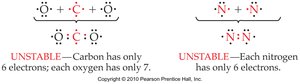
Multiple bonds are necessary when single bonds do not satisfy the octet rule for all atoms involved.
Coordinate Covalent Bonds
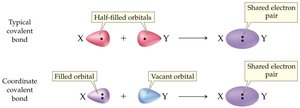
A coordinate covalent bond forms when both electrons in a shared pair come from the same atom. This typically occurs when a lone pair from one atom is donated to an empty orbital of another atom.
Representing Molecular Compounds
Molecular and Structural Formulas
Molecular formula: Indicates the number and type of atoms (e.g., H2O).
Structural formula: Shows how atoms are connected (lines represent bonds).
Condensed formula: A compact version omitting some bonds (e.g., CH3CH2OH).
Ball-and-stick model: Atoms as spheres, bonds as sticks.
Space-filling model: Shows the actual size and shape of the molecule.
Lewis Structures
Lewis structures show both the bonding pairs and lone pairs of electrons in a molecule. The steps for drawing Lewis structures are:
Count total valence electrons.
Draw single bonds between the central atom and surrounding atoms.
Complete octets for surrounding atoms.
Place remaining electrons on the central atom as lone pairs.
If the central atom lacks an octet, form multiple bonds as needed.
Molecular Shape and the VSEPR Model
Valence-Shell Electron-Pair Repulsion (VSEPR) Theory
The VSEPR model predicts molecular shapes based on the repulsion between electron pairs (bonding and lone pairs) around a central atom. Electron pairs arrange themselves as far apart as possible to minimize repulsion.
Linear: 2 charge clouds, 180° bond angle
Trigonal planar: 3 charge clouds, 120° bond angle
Tetrahedral: 4 charge clouds, 109.5° bond angle
Bond Polarity and Electronegativity
Polar and Nonpolar Covalent Bonds
Bond polarity arises when electrons are shared unequally between two atoms due to differences in electronegativity (the ability of an atom to attract electrons in a bond).
Nonpolar covalent bond: Electrons shared equally (e.g., H2).
Polar covalent bond: Electrons shared unequally (e.g., HCl).
Partial charges (δ+ and δ–) develop on the atoms in polar bonds.
Electronegativity increases across a period and decreases down a group. Fluorine is the most electronegative element.
Determining Bond Type by Electronegativity Difference
Difference < 0.5: Nonpolar covalent
0.5 ≤ Difference < 2.0: Polar covalent
Difference ≥ 2.0: Ionic
Molecular Polarity
Polarity of Molecules
A molecule is polar if it has a net dipole moment, resulting from the vector sum of all bond dipoles and lone pair contributions. Molecular polarity affects physical properties such as melting point, boiling point, and solubility.
Symmetrical molecules (e.g., CO2) may be nonpolar even if they contain polar bonds.
Asymmetrical molecules (e.g., H2O) are often polar.
Naming Binary Molecular Compounds
Naming Rules
The less electronegative element is named first.
Prefixes indicate the number of atoms (mono-, di-, tri-, etc.).
The second element ends with -ide.
The prefix mono- is omitted for the first element.
Comparison of Ionic and Molecular Compounds
Key Differences
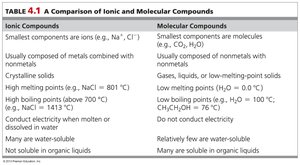
Ionic and molecular compounds differ in their composition, structure, and physical properties. The following table summarizes these differences:
Ionic Compounds | Molecular Compounds |
|---|---|
Smallest components are ions (e.g., Na+, Cl–) | Smallest components are molecules (e.g., CO2, H2O) |
Usually composed of metals with nonmetals | Usually composed of nonmetals with nonmetals |
Crystalline solids | Gases, liquids, or low-melting solids |
High melting points (e.g., NaCl = 801°C) | Low melting points (e.g., H2O = 0°C) |
High boiling points (e.g., NaCl = 1413°C) | Low boiling points (e.g., CH3CH2OH = 100°C) |
Conduct electricity when molten or dissolved in water | Do not conduct electricity |
Many are water-soluble | Relatively few are water-soluble |
Not soluble in organic liquids | Many are soluble in organic liquids |
Summary
Covalent bonds involve the sharing of electrons between nonmetal atoms to form molecules.
The octet rule guides the formation of stable molecules, but exceptions exist.
Lewis structures and VSEPR theory help predict molecular structure and shape.
Bond polarity and molecular polarity are determined by electronegativity differences and molecular geometry.
Molecular compounds differ from ionic compounds in composition, structure, and physical properties.
