 Indietro
Chemistry in Our Lives: Introduction and Key Concepts
Guida di studio - Note intelligenti
 Appunti personalizzati basati sui tuoi materiali, ampliati con definizioni chiave, esempi e contesto.
1. Chemistry in Our Lives
1.1 Chemistry and Chemicals
Chemistry is the study of the composition, structure, and reactions of matter. It helps us understand the substances that make up our world and how they interact. Chemicals are substances with the same composition and properties wherever they are found. Chemistry provides insight into everyday phenomena, such as how hemoglobin transports oxygen in the blood or how aspirin relieves pain.
Chemicals: Substances with consistent composition and properties.
Chemistry: The science that investigates matter, its changes, and the energy involved.
Applications: Chemistry explains biological processes (e.g., hemoglobin function), medical treatments (e.g., aspirin), and societal issues (e.g., disease, nutrition).
Example: Hemoglobin is a protein in blood that transports oxygen to tissues and carbon dioxide to the lungs.
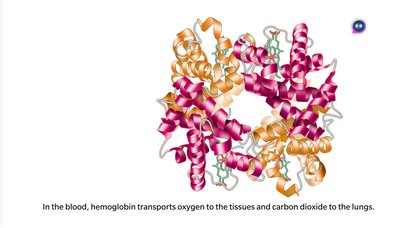
In the blood, hemoglobin transports oxygen to the tissues and carbon dioxide to the lungs.
1.2 The Importance of Chemistry
Chemistry is central to understanding health, disease, and the environment. It helps answer questions about how substances interact in the body and in nature. For example, knowing how aspirin works can help us understand pain relief, while studying hemoglobin reveals how oxygen is delivered throughout the body.
Medical Relevance: Chemistry is used to develop drugs, understand diseases, and improve nutrition.
Everyday Life: Chemistry explains phenomena such as cooking, cleaning, and environmental changes.
1.3 Learning Chemistry: Skills and Methods
Studying chemistry involves developing problem-solving skills, using the scientific method, and applying mathematical concepts. The scientific method is a systematic approach to investigating questions and solving problems in chemistry.
Scientific Method: Involves making observations, forming hypotheses, conducting experiments, and drawing conclusions/theories.
Key Math Skills: Identifying place values, using positive and negative numbers, calculating percentages, solving equations, interpreting graphs, and writing numbers in scientific notation.
Study Strategies: Reading the text, practicing problem solving, self-testing, working with a group, engaging, and trying it first.
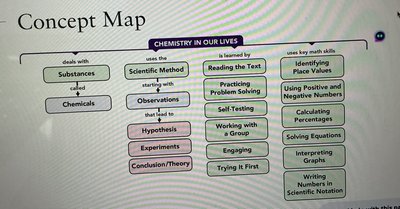
Concept map showing the connections between substances, scientific method, study strategies, and key math skills in chemistry.
Table: Steps of the Scientific Method
Step | Description |
|---|---|
Observation | Gathering information about a phenomenon |
Hypothesis | Proposing a possible explanation |
Experiment | Testing the hypothesis through controlled investigation |
Conclusion/Theory | Analyzing results and forming a general explanation |
1.4 Example: Hemoglobin and Aspirin
Hemoglobin is a protein made of four polypeptide chains that binds oxygen in the lungs and releases it in tissues. It also carries carbon dioxide from tissues to the lungs. Aspirin relieves pain by inhibiting the production of prostaglandins, which are chemicals involved in pain and inflammation.
Hemoglobin: Essential for oxygen transport in blood.
Aspirin: Used to reduce pain and inflammation by affecting chemical pathways in the body.
1.5 Summary
Chemistry is a foundational science that explains the properties and interactions of substances. It is essential for understanding biological processes, medical treatments, and everyday phenomena. Mastery of chemistry requires both scientific reasoning and mathematical skills.
