 Indietro
Compounds and Chemical Bonding: Electron Arrangements, Ions, and Molecular Structure
Guida di studio - Note intelligenti
 Appunti personalizzati basati sui tuoi materiali, ampliati con definizioni chiave, esempi e contesto.
Electron Arrangements in Atoms
Energy Levels and Electron Distribution
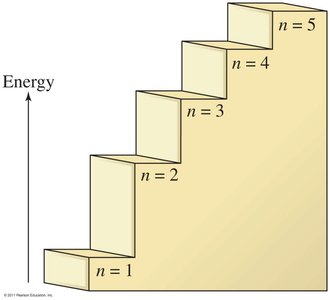
Electrons in an atom are arranged in specific energy levels, or shells, around the nucleus. These energy levels are designated by the principal quantum number n (n = 1, 2, 3, ...), with each higher number corresponding to a higher energy and a greater average distance from the nucleus.
Lowest energy level (n = 1) is closest to the nucleus and can hold up to 2 electrons.
The maximum number of electrons in an energy level is given by the formula:
Electrons fill the lowest available energy levels first (Aufbau principle).
Example: For n = 3, the maximum number of electrons is .
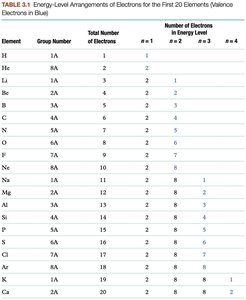
Electron Arrangements for the First 20 Elements
The arrangement of electrons in energy levels determines the chemical properties of elements. The outermost electrons (valence electrons) are especially important for chemical reactivity.
Element | Group Number | Total Number of Electrons | n=1 | n=2 | n=3 | n=4 |
|---|---|---|---|---|---|---|
H | 1A | 1 | 1 | |||
He | 8A | 2 | 2 | |||
Li | 1A | 3 | 2 | 1 | ||
Be | 2A | 4 | 2 | 2 | ||
B | 3A | 5 | 2 | 3 | ||
C | 4A | 6 | 2 | 4 | ||
N | 5A | 7 | 2 | 5 | ||
O | 6A | 8 | 2 | 6 | ||
F | 7A | 9 | 2 | 7 | ||
Ne | 8A | 10 | 2 | 8 | ||
Na | 1A | 11 | 2 | 8 | 1 | |
Mg | 2A | 12 | 2 | 8 | 2 | |
Al | 3A | 13 | 2 | 8 | 3 | |
Si | 4A | 14 | 2 | 8 | 4 | |
P | 5A | 15 | 2 | 8 | 5 | |
S | 6A | 16 | 2 | 8 | 6 | |
Cl | 7A | 17 | 2 | 8 | 7 | |
Ar | 8A | 18 | 2 | 8 | 8 | |
K | 1A | 19 | 2 | 8 | 8 | 1 |
Ca | 2A | 20 | 2 | 8 | 8 | 2 |
Periodic Table and Electron Configuration
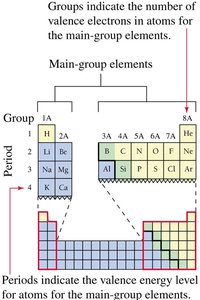
The periodic table is organized so that elements in the same group (vertical columns) have the same number of valence electrons, which determines their chemical properties. The period number (horizontal rows) indicates the highest energy level that contains electrons for those elements.
Group number = number of valence electrons for main-group elements.
Period number = highest occupied energy level.
Chemical Bonds: Ionic and Covalent
Types of Chemical Bonds
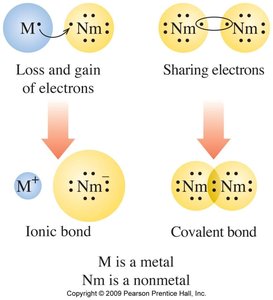
Atoms combine to achieve a stable electron configuration, often an octet (8 valence electrons), by forming chemical bonds. There are two main types of bonds:
Ionic bonds: Formed by the transfer of electrons from a metal to a nonmetal, resulting in the formation of oppositely charged ions.
Covalent bonds: Formed by the sharing of electrons between two nonmetals.
Formation of Ions
Atoms become ions by gaining or losing electrons to achieve a noble gas configuration.
Cations: Positively charged ions formed when metals lose electrons.
Anions: Negatively charged ions formed when nonmetals gain electrons.
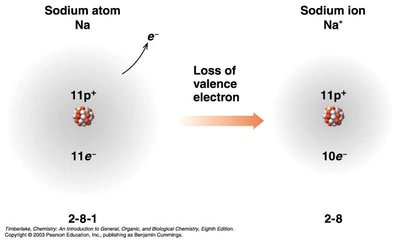
Example: Sodium atom loses one electron to form Na+ ion.
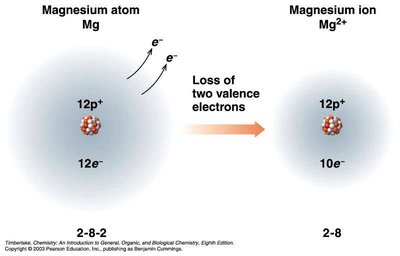
Example: Magnesium atom loses two electrons to form Mg2+ ion.
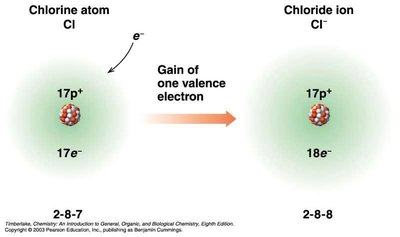
Example: Chlorine atom gains one electron to form Cl- ion.
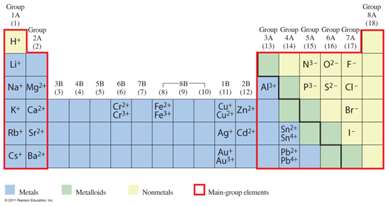
Common Charges of Ions
The charge on an ion is determined by the group number for main-group elements. Transition metals may have variable charges.
Polyatomic Ions
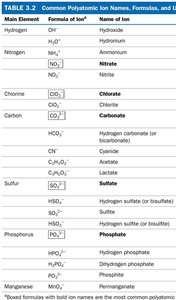
Polyatomic ions are ions composed of two or more atoms covalently bonded, carrying a net charge. These ions participate in ionic compounds as single units.
Name | Formula |
|---|---|
Ammonium | NH4+ |
Nitrate | NO3- |
Sulfate | SO42- |
Hydroxide | OH- |
Carbonate | CO32- |
Naming Ionic and Covalent Compounds
Naming Ionic Compounds
Name the cation (metal or polyatomic ion) first, then the anion (nonmetal or polyatomic ion).
For transition metals with variable charge, indicate the charge with a Roman numeral.
For monatomic anions, change the ending to -ide.
Example: NaCl is sodium chloride; FeCl2 is iron(II) chloride.
Naming Covalent Compounds
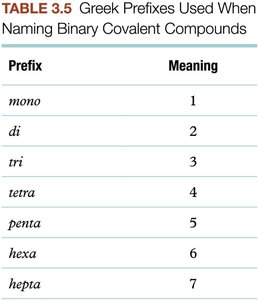
Use prefixes to indicate the number of each type of atom (mono-, di-, tri-, etc.).
The more metallic element (to the left on the periodic table) is named first.
The second element's name ends with -ide.
Example: CO2 is carbon dioxide; N2O is dinitrogen monoxide.
Covalent Bonding and Molecular Structure
Lewis Structures and Bond Types
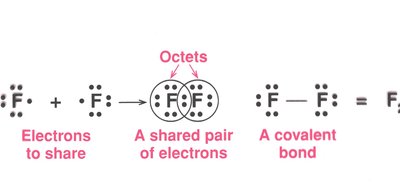
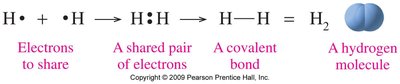
Lewis structures use dots to represent valence electrons and lines to represent shared pairs (bonds). Covalent bonds can be single, double, or triple, depending on the number of shared electron pairs.
Single bond: One pair of shared electrons (e.g., H2).
Double bond: Two pairs of shared electrons (e.g., O2).
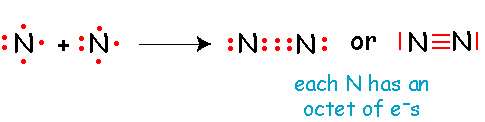
Triple bond: Three pairs of shared electrons (e.g., N2).
Electron-Dot Structures of Main Elements in Living Things
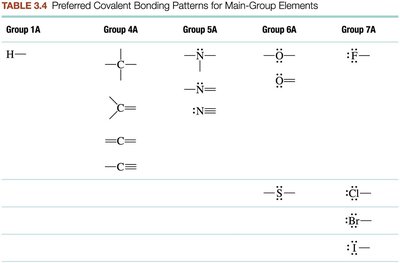
The main elements in living systems (H, C, N, O, F) have characteristic numbers of valence electrons, which determine their bonding patterns.

Bonding Patterns of Carbon
Carbon can form four single bonds, two double bonds, or one triple and one single bond, allowing for a variety of molecular structures.
Lewis Structures for Covalent Compounds
To draw a Lewis structure:
Count total valence electrons.
Arrange atoms (central atom is usually the least electronegative, except H).
Connect atoms with single bonds.
Distribute remaining electrons as lone pairs to satisfy the octet rule.
Form double or triple bonds if necessary to complete octets.
Molecular Shape and Polarity
VSEPR Theory and Molecular Geometry
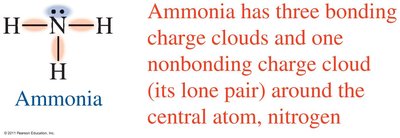
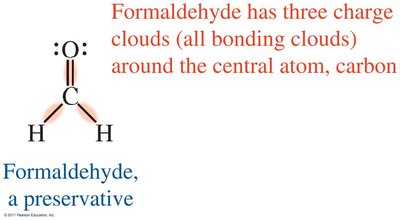
The Valence Shell Electron Pair Repulsion (VSEPR) theory predicts the three-dimensional shape of molecules based on the repulsion between electron pairs around a central atom.
Linear: 180° bond angle (2 charge clouds)
Trigonal planar: 120° bond angle (3 charge clouds)
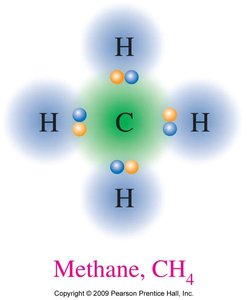
Tetrahedral: 109.5° bond angle (4 charge clouds)
Pyramidal and bent: Result from lone pairs affecting the shape
Electronegativity and Bond Polarity
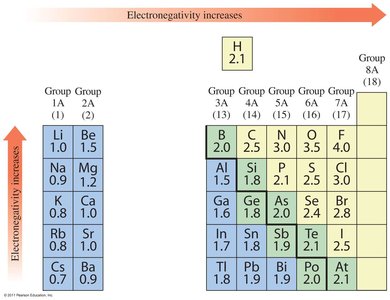
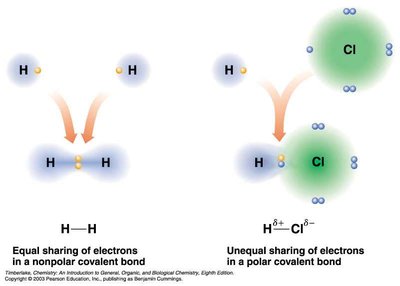
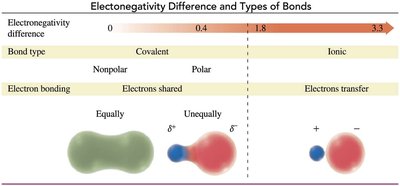
Electronegativity is the ability of an atom to attract electrons in a bond. The difference in electronegativity between two atoms determines the bond type:
Nonpolar covalent: Electrons shared equally (ΔEN < 0.4)
Polar covalent: Electrons shared unequally (0.4 ≤ ΔEN < 1.8)
Ionic: Electrons transferred (ΔEN ≥ 1.8)
Determining Molecular Polarity
A molecule is polar if it contains polar bonds and its shape does not allow the bond dipoles to cancel out. Lone pairs on the central atom often result in a polar molecule.
If the central atom has lone pairs, the molecule is usually polar.
If all terminal atoms are identical and there are no lone pairs, the molecule is nonpolar.
If terminal atoms are different, the molecule is polar.
Counting Atoms: The Mole Concept
The Mole and Avogadro's Number
The mole is a counting unit in chemistry, analogous to a dozen. One mole contains Avogadro's number of particles: .
1 mole of atoms = atoms
1 mole of molecules = molecules
Example: 1 mole of H2O contains molecules of water.
Molar Mass
The molar mass is the mass in grams of one mole of a substance. For elements, it is numerically equal to the atomic mass in amu.
Formula:
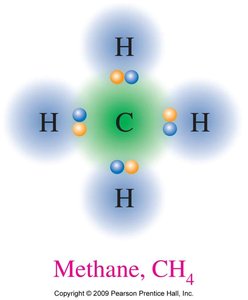
Example: Molar mass of CH4 = 12.01 + 4(1.01) = 16.05 g/mol
Conversions Using the Mole
To convert grams to moles:
To convert moles to grams:
To convert moles to particles:
