 Indietro
Functional Groups and Chiral Centers in Organic Molecules
Guida di studio - Note intelligenti
 Appunti personalizzati basati sui tuoi materiali, ampliati con definizioni chiave, esempi e contesto.
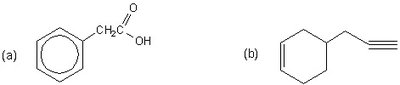
Q25. Circle and name the functional groups in the two molecules shown below. Choose from alkene, alkyne, aromatic, or carboxyl (carboxylic acid).
Background
Topic: Organic Chemistry – Functional Groups
This question tests your ability to recognize and name common functional groups in organic molecules, such as aromatic rings, carboxylic acids, alkenes, and alkynes. Identifying functional groups is essential for understanding chemical reactivity and nomenclature.
Key Terms:
Aromatic: A ring structure with alternating double bonds (e.g., benzene).
Carboxyl (Carboxylic Acid): A functional group with the formula .
Alkene: A carbon-carbon double bond ().
Alkyne: A carbon-carbon triple bond ().
Step-by-Step Guidance
Examine molecule (a): Look for ring structures and attached groups. Identify if the ring is aromatic (benzene) and check for any carboxyl group ().
Circle the aromatic ring and the carboxyl group in molecule (a). Name each functional group you find.
Examine molecule (b): Look for ring structures, double or triple bonds, and any other functional groups. Identify if the ring is aromatic or cycloalkane, and check for alkene or alkyne groups.
Circle the relevant functional groups in molecule (b) and name them (e.g., alkene, alkyne, aromatic).
Try solving on your own before revealing the answer!
Final Answer:
Molecule (a): Contains an aromatic ring (benzene) and a carboxyl (carboxylic acid) group.
Molecule (b): Contains a cyclohexene ring (alkene) and an alkyne group (carbon-carbon triple bond).
These functional groups are circled in the image. Recognizing these groups helps in naming and predicting the reactivity of the molecules.
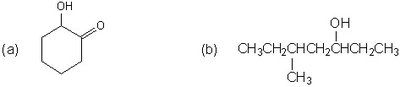
Q26. Mark the chiral centers in the following molecules, if any, with an asterisk (*).
Background
Topic: Organic Chemistry – Chirality
This question tests your ability to identify chiral centers in organic molecules. A chiral center (usually a carbon atom) is attached to four different groups, leading to non-superimposable mirror images (enantiomers).
Key Terms:
Chiral Center: A carbon atom bonded to four distinct groups.
Enantiomers: Molecules that are mirror images of each other but not superimposable.
Step-by-Step Guidance
Examine molecule (a): Look for carbon atoms attached to four different groups. Check each carbon in the ring and any substituents.
For molecule (b), analyze each carbon atom, especially those with substituents (e.g., OH, alkyl groups). Determine if any carbon is bonded to four distinct groups.
Mark any chiral centers you find with an asterisk (*). Remember, a chiral center cannot have two identical groups attached.
Review your markings to ensure each chiral center meets the criteria.
Try solving on your own before revealing the answer!
Final Answer:
Molecule (a): The carbon atom with the OH group and the ring is a chiral center (marked with *).
Molecule (b): The carbon atom with the OH group and four different substituents is a chiral center (marked with *).
Chiral centers are important for understanding stereochemistry and biological activity.
