 Indietro
GOB Chemistry Exam Study Guide: Concepts, Formulas, and Step-by-Step Guidance
Guida di studio - Note intelligenti
 Appunti personalizzati basati sui tuoi materiali, ampliati con definizioni chiave, esempi e contesto.
Q1. A student is 175 cm tall. This corresponds to 1.75 m.
Background
Topic: Unit Conversion (Metric System)
This question tests your understanding of converting between centimeters and meters, a fundamental skill in chemistry for working with SI units.
Key Terms:
Centimeter (cm): 1/100 of a meter
Meter (m): Base unit of length in the metric system
Key formula:
Step-by-Step Guidance
Identify the given value: 175 cm.
Recall the conversion factor between centimeters and meters.
Set up the conversion:
Plug in the value for centimeters and simplify, but do not calculate the final answer yet.
Try solving on your own before revealing the answer!
Final Answer: True
The conversion is correct: 175 cm equals 1.75 m.
Q2. (8.50 × 10³) – (7.61 × 10²) = 7.739 × 10³ to the correct number of significant figures.
Background
Topic: Significant Figures in Calculations
This question tests your ability to apply rules for significant figures when performing subtraction with numbers in scientific notation.
Key Terms:
Significant Figures: Digits that carry meaning contributing to a measurement's precision.
Scientific Notation: A way to express very large or small numbers.
Key formula:
When subtracting, the answer should have the same decimal place as the least precise measurement.
Step-by-Step Guidance
Write both numbers with the same exponent for easier subtraction: and .
Subtract the numbers: .
Determine the correct number of significant figures based on the original values.
Express the result in scientific notation, rounding to the correct number of significant figures.
Try solving on your own before revealing the answer!
Final Answer: False
The answer should be rounded to two decimal places, not four significant figures. The correct result is .
Q3. One kg is equal to 2.205 pounds. I wish to convert a patient’s weight from pounds to kg. I would use the conversion factor .
Background
Topic: Unit Conversion (Mass)
This question tests your understanding of how to use conversion factors to convert between pounds and kilograms.
Key Terms:
Kilogram (kg): SI unit of mass
Pound (lb): Common unit of mass in the US
Conversion Factor: Ratio used to convert from one unit to another
Key formula:
Step-by-Step Guidance
Identify the direction of conversion: pounds to kilograms.
Recall the conversion factor: .
Set up the conversion so that pounds cancel and kilograms remain.
Check if the given conversion factor is set up correctly for this direction.
Try solving on your own before revealing the answer!
Final Answer: False
To convert from pounds to kilograms, you should use as the conversion factor.
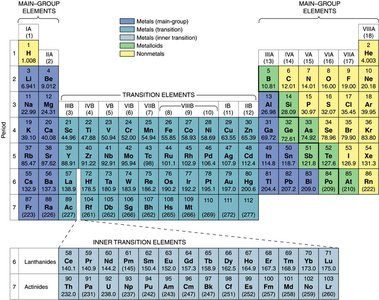
Q4. The element carbon is in Period 2, group IVA (14).
Background
Topic: Periodic Table Organization
This question tests your ability to locate elements on the periodic table and understand their period and group assignments.
Key Terms:
Period: Horizontal row in the periodic table
Group: Vertical column in the periodic table
Step-by-Step Guidance
Locate carbon (C) on the periodic table.
Identify the period number (row) for carbon.
Identify the group number (column) for carbon.
Check if carbon is in Period 2 and Group 14 (IVA).
Try solving on your own before revealing the answer!
Final Answer: True
Carbon is located in Period 2, Group 14 (IVA) on the periodic table.
Q5. The atomic number for an atom is different from that of its ion. For example, sodium has 11 protons while the sodium ion has only 10 protons.
Background
Topic: Atomic Number and Ions
This question tests your understanding of atomic number and the difference between atoms and ions.
Key Terms:
Atomic Number: Number of protons in the nucleus
Ion: Atom that has gained or lost electrons
Step-by-Step Guidance
Recall that atomic number is defined by the number of protons.
Consider what happens when an atom becomes an ion (gains or loses electrons).
Check if the number of protons changes when forming an ion.
Compare the atomic number of sodium atom and sodium ion.
Try solving on your own before revealing the answer!
Final Answer: False
The atomic number is always the number of protons, which does not change when an atom becomes an ion. Sodium ion still has 11 protons.
Q6. Based on their position in the periodic table we would predict that atomic radius increases from P to S to Cl.
Background
Topic: Periodic Trends (Atomic Radius)
This question tests your understanding of how atomic radius changes across a period in the periodic table.
Key Terms:
Atomic Radius: Distance from nucleus to outermost electron
Periodic Trend: Predictable change in properties across the table
Step-by-Step Guidance
Recall the trend for atomic radius across a period: it generally decreases from left to right.
Locate P, S, and Cl in the same period (Period 3).
Compare their positions and predict the trend in atomic radius.
Determine if the statement matches the expected trend.
Try solving on your own before revealing the answer!
Final Answer: False
Atomic radius decreases from P to S to Cl as you move across a period.
Q7. Nonmetals tend to gain electrons to become anions.
Background
Topic: Chemical Properties of Nonmetals
This question tests your understanding of how nonmetals form ions.
Key Terms:
Anion: Negatively charged ion
Nonmetal: Element that tends to gain electrons
Step-by-Step Guidance
Recall the general behavior of nonmetals in chemical reactions.
Consider how nonmetals achieve a stable electron configuration.
Determine if gaining electrons to form anions is typical for nonmetals.
Try solving on your own before revealing the answer!
Final Answer: True
Nonmetals typically gain electrons to become negatively charged anions.
Q8. The polyatomic ion chlorite has the formula ClO2−. Based on rules for naming polyatomic ions, chlorate would have the formula ClO3−.
Background
Topic: Polyatomic Ion Naming
This question tests your understanding of the naming conventions for polyatomic ions containing oxygen.
Key Terms:
Chlorite: ClO2−
Chlorate: ClO3−
Polyatomic Ion: Ion composed of more than one atom
Step-by-Step Guidance
Recall the naming pattern for oxyanions: "-ite" has fewer oxygens than "-ate".
Compare the formulas for chlorite and chlorate.
Determine if the formula for chlorate is correct based on the rules.
Try solving on your own before revealing the answer!
Final Answer: True
Chlorate is ClO3−, which follows the naming rules for polyatomic ions.
Q9. An acceptable Lewis structure for the polyatomic ion carbonate is shown to the right.
Background
Topic: Lewis Structures for Polyatomic Ions
This question tests your ability to recognize correct Lewis structures for polyatomic ions.
Key Terms:
Lewis Structure: Diagram showing bonding and lone pairs
Polyatomic Ion: Ion with multiple atoms
Carbonate: CO32−
Step-by-Step Guidance
Recall the correct Lewis structure for carbonate ion.
Check for correct number of bonds and lone pairs.
Verify the charge and arrangement of atoms.
Compare the given structure to the accepted structure.
Try solving on your own before revealing the answer!
Final Answer: True
The structure shown matches the accepted Lewis structure for carbonate ion.
Q10. Electronegativity tends to decrease as you go down a group.
Background
Topic: Periodic Trends (Electronegativity)
This question tests your understanding of how electronegativity changes within a group in the periodic table.
Key Terms:
Electronegativity: Ability of an atom to attract electrons
Group: Vertical column in the periodic table
Step-by-Step Guidance
Recall the trend for electronegativity down a group.
Consider why electronegativity changes as atomic size increases.
Determine if the statement matches the expected trend.
Try solving on your own before revealing the answer!
Final Answer: True
Electronegativity decreases as you move down a group due to increased atomic size and shielding.
