 Indietro
Hydrocarbons and Their Properties: GOB Chemistry Study Notes
Guida di studio - Note intelligenti
 Appunti personalizzati basati sui tuoi materiali, ampliati con definizioni chiave, esempi e contesto.
Hydrocarbons: Introduction to Organic Molecules
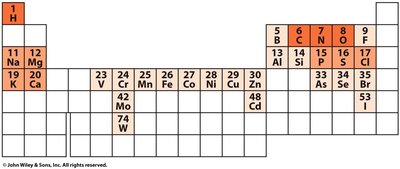
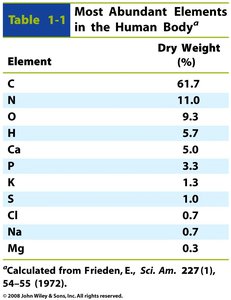
Elements Found in Cells
Organic molecules in biological systems are primarily composed of a select group of elements. The most abundant elements in cells include carbon, hydrogen, nitrogen, oxygen, phosphorus, and sulfur. These elements are essential for the structure and function of biomolecules.
Carbon (C): The backbone of organic molecules, capable of forming four covalent bonds.
Hydrogen (H): Commonly bonded to carbon, contributing to the hydrophobic character of hydrocarbons.
Nitrogen (N), Oxygen (O), Phosphorus (P), Sulfur (S): Often found in functional groups that impart specific chemical properties.
Carbon Bonding and Geometry
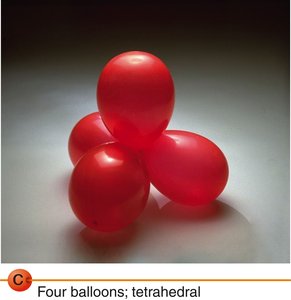
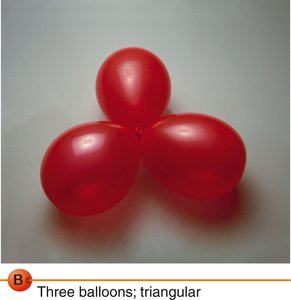
Carbon is tetravalent, meaning it forms four covalent bonds. The geometry of these bonds depends on the type of bonding:
Single Bonds: Tetrahedral geometry, bond angle ≈ 109.5°
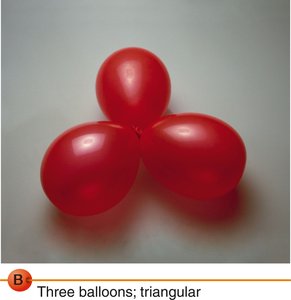
Double Bonds: Trigonal planar geometry, bond angle ≈ 120°
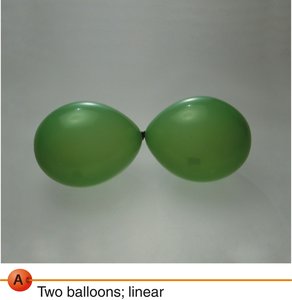
Triple Bonds: Linear geometry, bond angle ≈ 180°
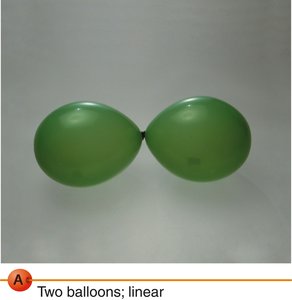
Types of Carbon Bonding
Carbon can form single, double, or triple bonds, which determine the shape and reactivity of the molecule.
Tetrahedral (single bonds): Example: Ethane (C2H6)
Trigonal planar (double bond): Example: Ethene (C2H4)
Linear (triple bond): Example: Ethyne (C2H2)
Saturated Hydrocarbons (Alkanes)
Definition and Structure
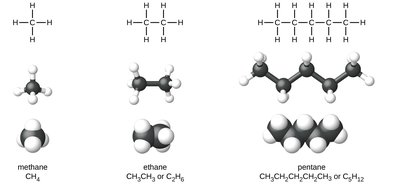
Alkanes are saturated hydrocarbons containing only carbon and hydrogen atoms with single bonds. Their general formula is CnH2n+2.
Line-angle structures: Carbons are represented by vertices; hydrogens are often omitted for simplicity.
Condensed structures: Show all atoms explicitly.
Classification of Carbon Atoms
Carbons in alkanes are classified based on the number of other carbons they are bonded to:
Primary (1°): Bound to one other carbon
Secondary (2°): Bound to two other carbons
Tertiary (3°): Bound to three other carbons
Quaternary (4°): Bound to four other carbons
Physical Properties of Hydrocarbons
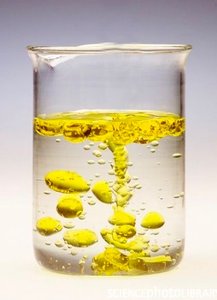
Hydrocarbons are non-polar and hydrophobic, meaning they do not dissolve in water. Their intermolecular forces are London dispersion forces, and their melting/boiling points increase with molecular size.
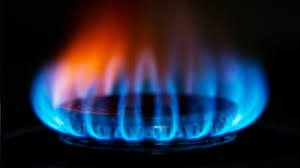
Combustion Reaction
Alkanes undergo combustion, reacting with oxygen to produce carbon dioxide and water:
General equation:
Isomers
Structural Isomers and Conformers
Isomers have the same molecular formula but different structures:
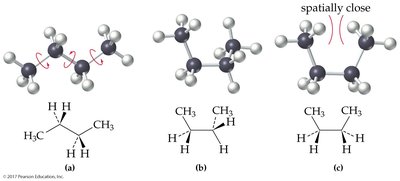
Structural (constitutional) isomers: Differ in the connectivity of atoms.
Conformers: Same connectivity, differ by rotation around single bonds.
Cycloalkanes
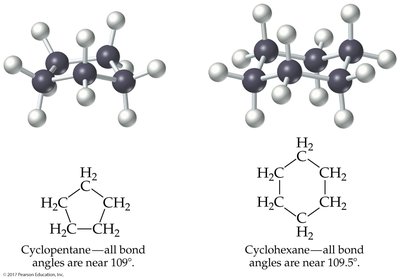
Cycloalkanes are saturated hydrocarbons with carbon atoms arranged in a ring. Rings of 5 or 6 atoms are most stable due to bond angles close to tetrahedral geometry.
Cis-Trans Isomers
Cis-trans isomers (geometrical isomers) occur when atoms are arranged differently in space due to limited bond rotation, especially in cycloalkanes and alkenes.
Cis: Groups on the same face
Trans: Groups on opposite faces
Stereoisomers and Chiral Carbons
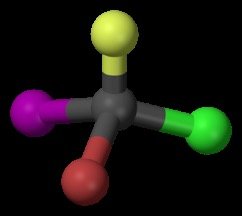
Stereoisomers have the same connectivity but differ in the spatial arrangement around a chiral carbon (a carbon with four different groups attached).
Properties of Unsaturated Hydrocarbons
Alkenes, Alkynes, and Aromatics
Unsaturated hydrocarbons contain double or triple bonds, making them more oxidized and reactive than alkanes.
Alkenes: At least one double bond
Alkynes: At least one triple bond
Aromatics: Benzene-like rings with alternating double and single bonds
Bond Rotation and Geometry
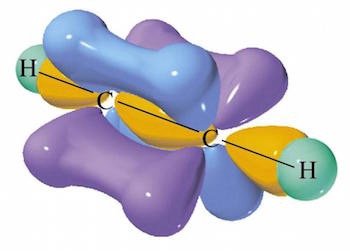
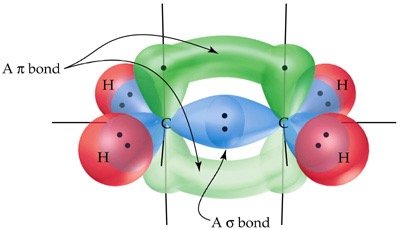
Double and triple bonds do not rotate due to the nature of pi bonds, which restrict movement and define the geometry of the molecule.
Cis-Trans Isomerism in Alkenes
Alkenes can exhibit cis-trans isomerism when each carbon of the double bond is attached to two different groups.
Reactions of Unsaturated Hydrocarbons
Addition Reactions
Unsaturated hydrocarbons undergo addition reactions, where atoms or groups are added across double or triple bonds.
Hydrogenation: Addition of H2 to convert alkenes/alkynes to alkanes
Hydration: Addition of H2O to convert alkenes to alcohols

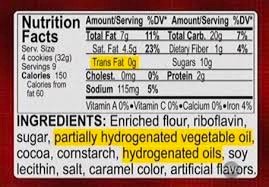
Trans Fats
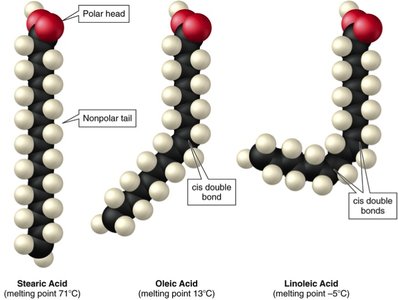
Partial hydrogenation can convert cis double bonds to trans, creating trans fats, which have properties similar to saturated fats.
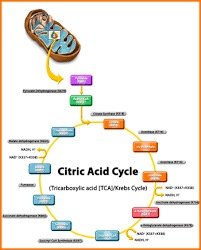
Biological Examples: Hydration in Metabolic Pathways
Hydration reactions are important in biological processes such as the citric acid cycle and beta-oxidation of fatty acids.
Aromatics and Conjugation
Aromatic Compounds
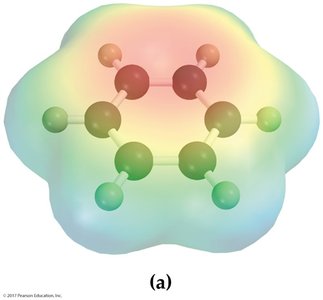
Aromatic compounds contain benzene-like rings with alternating double and single bonds. These rings are planar, and the electron density is delocalized above and below the plane, making them less reactive.
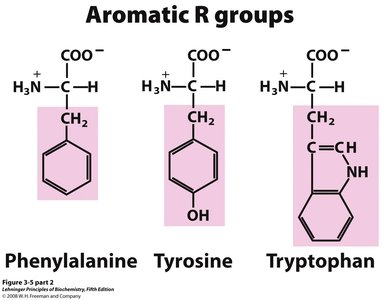
Biological Importance of Aromatics
Aromatic rings are found in amino acids (phenylalanine, tyrosine, tryptophan) and nucleotide bases in DNA and RNA, contributing to their planar structure and stability.
Conjugated Systems
Conjugated systems have alternating double and single bonds in a non-ring structure. These systems are planar and less reactive due to electron delocalization. Many colored molecules, such as beta-carotene, have conjugated structures.
Hydrocarbon Formulas
Type | General Formula |
|---|---|
Alkane | CnH2n+2 |
Cycloalkane | CnH2n |
Alkene | CnH2n |
Alkyne | CnH2n-2 |
Benzene | CnHn |
Summary
Hydrocarbons are classified as alkanes, alkenes, alkynes, cycloalkanes, and aromatics based on their bonding and structure.
Carbon's tetravalency allows for diverse molecular geometries and reactivities.
Isomerism (structural, conformational, cis-trans, stereoisomerism) is fundamental to organic chemistry.
Unsaturated hydrocarbons are more reactive and can undergo addition reactions.
Aromatic and conjugated systems are planar and less reactive due to electron delocalization.
