 Indietro
Ionic Compounds: Structure, Formation, and Properties
Guida di studio - Note intelligenti
 Appunti personalizzati basati sui tuoi materiali, ampliati con definizioni chiave, esempi e contesto.
Chapter Three: Ionic Compounds
What are Ionic Compounds?
Ionic compounds are chemical substances formed by the combination of positively charged ions (cations) and negatively charged ions (anions). These compounds are typically formed when a metal reacts with a nonmetal, resulting in the transfer of electrons from the metal to the nonmetal. The resulting electrostatic attraction between oppositely charged ions holds the compound together.
Made of: Metal cations and nonmetal anions
Characteristics: Electrically neutral overall, crystalline solids, high melting and boiling points, conduct electricity when molten or dissolved in water
Formation of Ions
Atoms can lose or gain electrons to form charged particles called ions. The loss of electrons produces a cation (positively charged), while the gain of electrons produces an anion (negatively charged). The tendency to lose or gain electrons is explained by the octet rule, which states that atoms tend to achieve eight electrons in their valence shell for stability.
Cation Example: Lithium (Li) loses one electron to form Li+
Anion Example: Chlorine (Cl) gains one electron to form Cl-
Classification of Ionic Compounds
Ionic compounds are classified based on the types of ions involved. Main group elements typically follow the octet rule, while transition metals may form ions with variable charges. Polyatomic ions, which are composed of more than one atom, also participate in forming ionic compounds.
Electron Configurations and Ion Formation
The general electron configurations for main group elements help predict their ion formation:
Group IA: (lose 1 electron)
Group IIA: (lose 2 electrons)
Group VIA: (gain 2 electrons)
Group VIIA: (gain 1 electron)
Group VIIIA (Noble Gases): (filled shell, stable)
Periodic Trends in Ionization Energy and Electron Affinity
Ionization energy is the energy required to remove an electron from an atom, while electron affinity is the energy released when an atom gains an electron. Metals have low ionization energies and electron affinities, making them likely to form cations. Nonmetals have high values, favoring anion formation. These trends increase across a period (left to right) on the periodic table.
Ionic Bonds and Lattice Structure
An ionic bond is the electrostatic attraction between oppositely charged ions in a crystal lattice. The resulting ionic compound is a stable, electrically neutral structure. For example, sodium chloride (NaCl) forms a cubic lattice where each Na+ is surrounded by six Cl- ions and vice versa.
Properties of Ionic Compounds
Usually crystalline solids
High melting and boiling points (e.g., NaCl melts at 801°C)
Conduct electricity when molten or dissolved in water
Brittle and not malleable
Solubility in water varies depending on the compound
Writing Formulas of Ionic Compounds
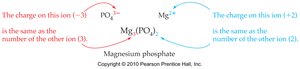
The chemical formula of an ionic compound shows the simplest ratio of cations to anions that results in electrical neutrality. The subscript of each ion is often equal to the charge of the other ion (cross-over method), but common factors should be reduced.
List the cation first, then the anion (e.g., NaCl, not ClNa)
Do not write charges in the formula
Use parentheses for polyatomic ions with subscripts (e.g., Al2(SO4)3)
Naming Ions and Ionic Compounds
Main group metal cations: Name the metal followed by "ion" (e.g., K+ is potassium ion)
Transition metals: Use Roman numerals to indicate charge (e.g., Fe2+ is iron(II) ion)
Anions: Replace the ending with "-ide" (e.g., Cl- is chloride ion)
Polyatomic ions: Memorize common names and formulas (e.g., SO42- is sulfate ion)
Naming compounds: Name the cation first, then the anion (e.g., MgSO4 is magnesium sulfate)
Polyatomic Ions
Polyatomic ions are ions composed of two or more atoms covalently bonded, acting as a single charged unit. Most contain oxygen and another element. For example, the sulfate ion (SO42-) consists of one sulfur atom and four oxygen atoms, carrying a -2 charge.
Acids and Bases: Introduction
Acids are substances that provide H+ ions in water, while bases provide OH- ions. For example, hydrochloric acid (HCl) dissociates in water to give H+ and Cl-, and sodium hydroxide (NaOH) gives Na+ and OH-. Acids and bases can be classified as strong (fully dissociate) or weak (partially dissociate).
Strong acid example: HCl
Weak acid example: CH3COOH (acetic acid)
Strong base example: NaOH
Acids can also be classified by the number of acidic hydrogens (e.g., monoprotic, diprotic).
Summary and Review
Ionic compounds are formed from metals and nonmetals via electron transfer.
They are held together by ionic bonds and have characteristic physical properties.
Correct naming and formula writing are essential for communication in chemistry.
