 Indietro
Mole and Mass Calculations in Chemical Reactions
Guida di studio - Note intelligenti
 Appunti personalizzati basati sui tuoi materiali, ampliati con definizioni chiave, esempi e contesto.
Mole and Mass Calculations in Chemical Reactions
Law of Conservation of Mass
The Law of Conservation of Mass states that in a chemical reaction, the total mass of the reactants is equal to the total mass of the products. This means that matter is neither created nor destroyed during a chemical reaction; it simply changes form. This principle is fundamental to all chemical calculations and ensures that equations are balanced in terms of both mass and atoms.
Definition: The mass of substances present before a chemical reaction must equal the mass of substances after the reaction.
Application: Used to verify chemical equations and in stoichiometric calculations.
Example: When 2 moles of silver (Ag) react with 1 mole of sulfur (S), the combined mass of Ag and S equals the mass of the product, silver sulfide (Ag2S).
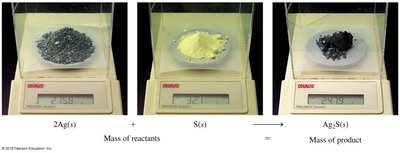
Mole-Mole Relationships in Balanced Chemical Equations
Balanced chemical equations provide the mole ratios (also called mole-mole factors) between reactants and products. These ratios are derived from the coefficients in the equation and are essential for converting between amounts of substances in a reaction.
Definition: A mole-mole factor is a conversion factor derived from the coefficients of a balanced chemical equation, relating the moles of one substance to the moles of another.
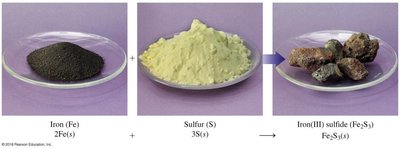
Example: For the reaction: 2Fe(s) + 3S(s) → Fe2S3(s), the following mole-mole factors can be written:
2 moles Fe / 3 moles S (and vice versa)
1 mole Fe2S3 / 2 moles Fe (and vice versa)
1 mole Fe2S3 / 3 moles S (and vice versa)
Steps for Calculating Moles in Chemical Reactions
To solve stoichiometric problems involving moles, follow these steps:
State the given and needed quantities.
Write a plan to convert the given quantity to the needed quantity (in moles).
Use coefficients to write mole-mole factors.
Set up the calculation to solve for the needed quantity.
Example: For the reaction 3H2(g) + N2(g) → 2NH3(g):
Mole-mole factor for H2 and N2: 3 moles H2 / 1 mole N2
Mole-mole factor for NH3 and H2: 2 moles NH3 / 3 moles H2
Mass Calculations in Chemical Reactions
When given the mass of one substance in a reaction, you can calculate the mass of another substance by following a systematic approach. This involves converting mass to moles, using the mole-mole factor, and then converting back to mass.
Step 1: Convert the given mass to moles using the molar mass.
Step 2: Use the mole-mole factor from the balanced equation to find moles of the desired substance.
Step 3: Convert the moles of the desired substance to mass using its molar mass.

Example: How many grams of O2 are needed to produce 45.8 g of Fe2O3 in the reaction 4Fe(s) + 3O2(g) → 2Fe2O3(s)?
Linking Moles, Mass, and Molar Mass
The relationship between mass, moles, and molar mass is fundamental in chemistry. The following equation is used to interconvert these quantities:
Formula:
To find mass:
To find molar mass:
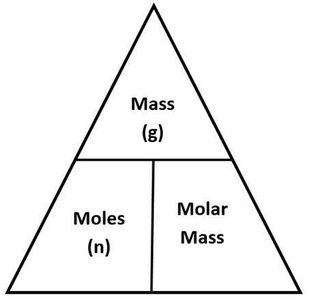
Example: The reaction 2H2(g) + O2(g) → 2H2O(g) produces 13.1 g of water. To find the grams of O2 reacted, use the above relationships and the balanced equation.
Summary Table: Steps for Mass-Mass Calculations
Step | Description |
|---|---|
1 | Convert given mass to moles (using molar mass) |
2 | Use mole-mole factor from balanced equation |
3 | Convert moles of desired substance to mass (using molar mass) |
Additional info: These concepts are foundational for all stoichiometric calculations in general, organic, and biological chemistry, and are essential for quantitative problem-solving in laboratory and clinical settings.
