 Indietro
Molecular Compounds: Structure, Naming, Bonding, and Polarity
Guida di studio - Note intelligenti
 Appunti personalizzati basati sui tuoi materiali, ampliati con definizioni chiave, esempi e contesto.
6.5 Molecular Compounds: Sharing Electrons
Introduction to Molecular Compounds
Molecular compounds are formed when two or more nonmetal atoms share electrons, resulting in covalent bonds. These compounds are distinct from ionic compounds, which involve the transfer of electrons between metals and nonmetals. The sharing of electrons allows each atom to achieve a stable electron configuration, often resembling that of the nearest noble gas.
Covalent bond: A chemical bond formed by the sharing of one or more pairs of electrons between atoms.
Molecule: A discrete group of atoms held together by covalent bonds in a definite proportion.
Naming Molecular Compounds
The names of molecular compounds require prefixes to indicate the number of each type of atom present, as several different compounds can be formed from the same two nonmetals.
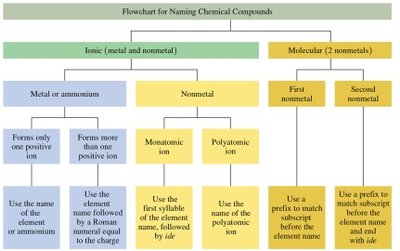
The first nonmetal is named by its element name.
The second nonmetal is named using the first syllable of its name followed by ide.
Prefixes are used to indicate the number of atoms (except 'mono' is never used for the first atom).
Number | Prefix |
|---|---|
1 | mono |
2 | di |
3 | tri |
4 | tetra |
5 | penta |
6 | hexa |
7 | hepta |
8 | octa |
9 | nona |
10 | deca |
When vowels 'o' and 'o' or 'a' and 'o' appear together, the first vowel is omitted (e.g., monoxide, not monooxide).
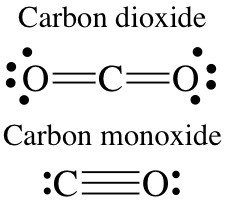
Example: CO2 is carbon dioxide; CO is carbon monoxide.
Flowchart for Naming Compounds
To determine whether a compound is ionic or molecular and how to name it, use the following flowchart:
6.6 Lewis Structures for Molecules and Polyatomic Ions
Lewis Structures
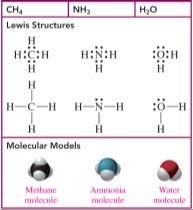
A Lewis structure represents the arrangement of valence electrons among atoms in a molecule. Shared pairs (bonding pairs) are shown as lines or pairs of dots, while lone pairs (nonbonding pairs) are shown as dots on individual atoms.
Atoms tend to achieve an octet (eight valence electrons) for stability (the octet rule).
Hydrogen is an exception, requiring only two electrons.
Steps for Drawing Lewis Structures:
Sum the valence electrons for all atoms (adjust for ions).
Arrange atoms (most metallic or least electronegative in the center; H is always terminal).
Connect atoms with single bonds.
Complete octets for outer atoms, then central atom.
If needed, form double or triple bonds to complete octets.
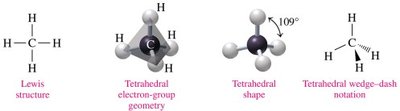
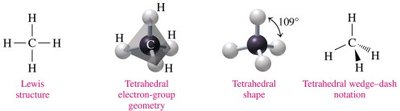
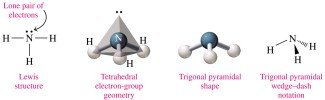
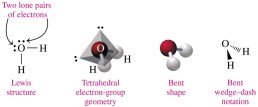
Example: Lewis structures for CH4, NH3, and H2O:
Diatomic Molecules
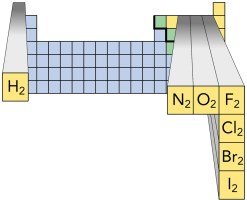
Certain elements exist naturally as diatomic molecules (two atoms bonded together): H2, N2, O2, F2, Cl2, Br2, I2.
Bond Types: Single, Double, and Triple Bonds
Single bond: One pair of shared electrons.
Double bond: Two pairs of shared electrons (e.g., O2, CO2).
Triple bond: Three pairs of shared electrons (e.g., N2, CO).
Exceptions to the Octet Rule
Hydrogen requires only two electrons.
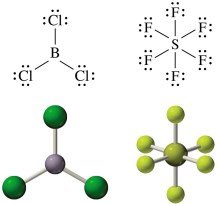
Elements like P, S, Cl, Br, and I can have expanded octets (10 or 12 electrons).
6.7 Electronegativity and Bond Polarity
Electronegativity
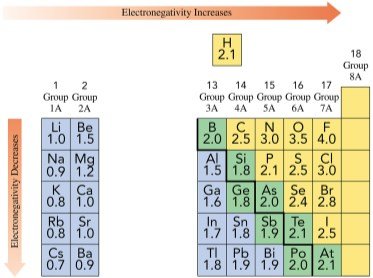
Electronegativity is the ability of an atom to attract shared electrons in a chemical bond. It increases across a period and decreases down a group in the periodic table. Fluorine is the most electronegative element.
Bond Polarity
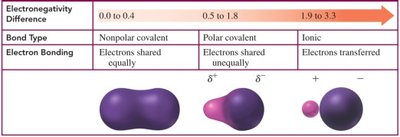
The difference in electronegativity between two atoms determines the type of bond:
Electronegativity Difference | Bond Type | Electron Bonding |
|---|---|---|
0.0 – 0.4 | Nonpolar covalent | Electrons shared equally |
0.5 – 1.8 | Polar covalent | Electrons shared unequally |
1.9 – 3.3 | Ionic | Electrons transferred |
6.8 Shapes and Polarity of Molecules
VSEPR Theory and Molecular Geometry
Valence Shell Electron-Pair Repulsion (VSEPR) theory predicts the shapes of molecules based on the repulsion between electron groups around a central atom. Electron groups are arranged as far apart as possible to minimize repulsion.
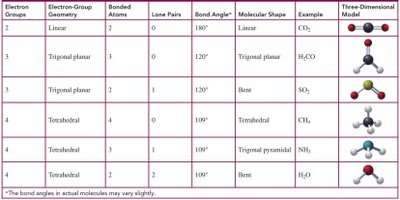
Linear: 2 electron groups, 180° bond angle (e.g., CO2).
Trigonal planar: 3 electron groups, 120° bond angle (e.g., H2CO).
Bent: 3 electron groups (1 lone pair), 120° bond angle (e.g., SO2); or 4 electron groups (2 lone pairs), 109° bond angle (e.g., H2O).
Tetrahedral: 4 electron groups, 109° bond angle (e.g., CH4).
Trigonal pyramidal: 4 electron groups (1 lone pair), 109° bond angle (e.g., NH3).
Electron Groups | Electron-Group Geometry | Bonded Atoms | Lone Pairs | Bond Angle | Molecular Shape | Example |
|---|---|---|---|---|---|---|
2 | Linear | 2 | 0 | 180° | Linear | CO2 |
3 | Trigonal planar | 3 | 0 | 120° | Trigonal planar | H2CO |
3 | Trigonal planar | 2 | 1 | 120° | Bent | SO2 |
4 | Tetrahedral | 4 | 0 | 109° | Tetrahedral | CH4 |
4 | Tetrahedral | 3 | 1 | 109° | Trigonal pyramidal | NH3 |
4 | Tetrahedral | 2 | 2 | 109° | Bent | H2O |
Examples of Molecular Shapes
CH4 (Methane): Tetrahedral shape, 109° bond angles.
NH3 (Ammonia): Trigonal pyramidal shape, 109° bond angles.
H2O (Water): Bent shape, 109° bond angles.
Polarity of Molecules
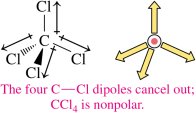
A molecule is nonpolar if it contains only nonpolar bonds or if the dipoles in polar bonds cancel due to symmetry (e.g., CO2, CCl4). A molecule is polar if it contains polar bonds that do not cancel, resulting in a partial negative and partial positive end (e.g., H2O, NH3).
Summary Table: Molecular Shape and Polarity
Molecule | Shape | Polarity |
|---|---|---|
CO2 | Linear | Nonpolar |
H2O | Bent | Polar |
NH3 | Trigonal pyramidal | Polar |
CH4 | Tetrahedral | Nonpolar |
Key Points:
Use prefixes to name molecular compounds and indicate the number of each atom.
Draw Lewis structures to visualize bonding and lone pairs.
Apply VSEPR theory to predict molecular shapes and bond angles.
Determine bond polarity using electronegativity differences.
Assess molecular polarity by considering both bond polarity and molecular geometry.
