 Indietro
Molecular Geometry and Bonding Theories: VSEPR, Hybridization, and Molecular Polarity
Guida di studio - Note intelligenti
 Appunti personalizzati basati sui tuoi materiali, ampliati con definizioni chiave, esempi e contesto.
Molecular Geometry and Bonding Theories
Introduction to Molecular Geometry
Molecular geometry describes the three-dimensional arrangement of atoms within a molecule. Understanding molecular geometry is essential for predicting the physical and chemical properties of substances, such as polarity, reactivity, and phase of matter.
Determining Molecular Shape: The VSEPR Model
Lewis Structures and Molecular Shape
Lewis structures show the connectivity of atoms and the arrangement of bonding and lone pairs but do not directly indicate the three-dimensional shape.
Lewis structures are the starting point for predicting molecular geometry using the VSEPR model.
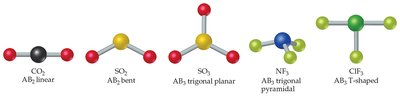
What Determines the Shape of a Molecule?
Bond angles and bond lengths define the shape and size of molecules.
Electron pairs (bonding and nonbonding) repel each other and arrange themselves as far apart as possible.
This principle is the basis of the Valence-Shell Electron-Pair Repulsion (VSEPR) model.
Electron Domains
An electron domain is a region where electrons are likely to be found, including bonds (single, double, triple) and lone pairs.
The number of electron domains around a central atom determines the electron-domain geometry.
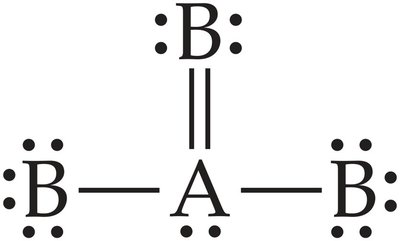
VSEPR Model: Minimizing Electron Pair Repulsions
The best arrangement of electron domains is the one that minimizes repulsions among them.
This can be visualized using the balloon analogy, where balloons (representing electron domains) arrange themselves to maximize separation.

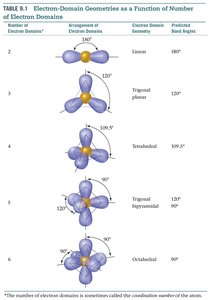
Electron-Domain Geometries
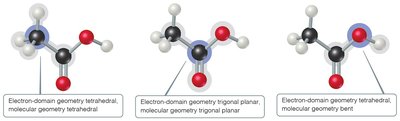
Electron-domain geometry depends on the number of electron domains (regions of electron density) around the central atom.
To determine the geometry, count all lone pairs and bonds (single, double, triple) on the central atom.
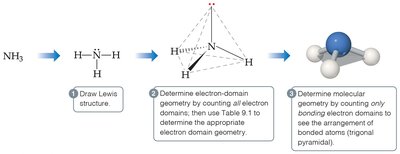
Steps to Determine Molecular Geometry
Draw the best Lewis structure.
Determine the electron-domain geometry by counting all electron domains.
Determine the molecular geometry by considering only the arrangement of bonded atoms (ignore lone pairs for this step).
Common Electron-Domain and Molecular Geometries
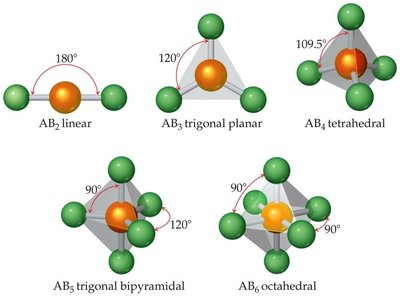
Linear (2 domains): 180° bond angle. Example: CO2.
Trigonal planar (3 domains): 120° bond angle. Example: SO3.
Tetrahedral (4 domains): 109.5° bond angle. Example: CH4.
Trigonal bipyramidal (5 domains): 90°, 120°, and 180° bond angles. Example: PCl5.
Octahedral (6 domains): 90° and 180° bond angles. Example: SF6.
Effect of Nonbonding Pairs and Multiple Bonds on Bond Angles
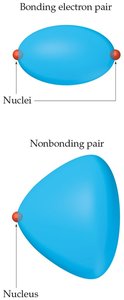
Nonbonding (lone) pairs are larger than bonding pairs, causing greater repulsion and compressing bond angles.
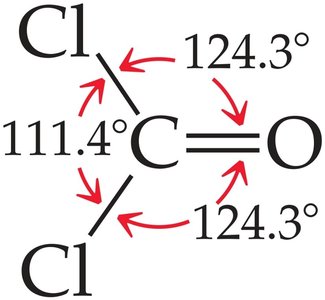
Double and triple bonds have larger electron domains than single bonds, increasing bond angles adjacent to them.

Expanding Beyond the Octet Rule
Some elements (especially in period 3 and beyond) can have more than four electron domains, leading to trigonal bipyramidal (5 domains) and octahedral (6 domains) geometries.
Trigonal Bipyramidal and Octahedral Electron Domains
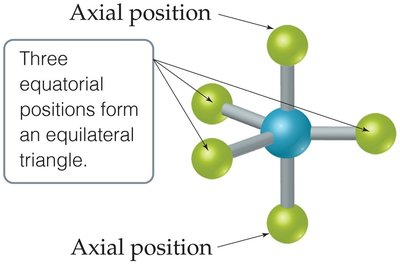
Trigonal bipyramidal geometry has two types of positions: axial and equatorial. Lone pairs preferentially occupy equatorial positions to minimize repulsion.
Octahedral geometry has all positions equivalent.
Shapes of Larger Molecules
For larger molecules, determine the geometry around each atom rather than the molecule as a whole.
Polarity of Molecules
Determining Molecular Polarity
First, determine if the molecule is covalent or ionic.
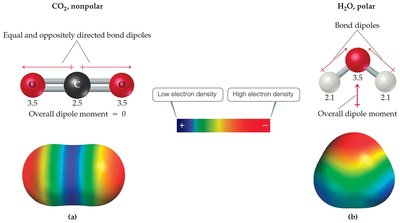
For covalent molecules, check if the bonds are polar (difference in electronegativity).
If bond dipoles cancel (overall dipole moment is zero), the molecule is nonpolar; otherwise, it is polar.
Different atoms attached to the central atom can result in different bond polarities.
Valence-Bond Theory and Hybridization
Valence-Bond Theory
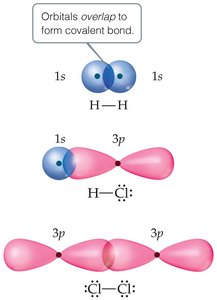
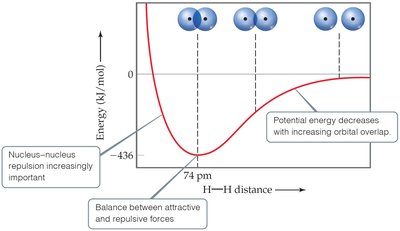
Covalent bonds form when atomic orbitals from two atoms overlap and share electrons of opposite spin.
Increased overlap brings atoms together until a balance is reached between attractive and repulsive forces.
Hybrid Orbitals and VSEPR
VSEPR predicts molecular shapes, but atomic orbitals must be combined (hybridized) to explain observed bond angles.
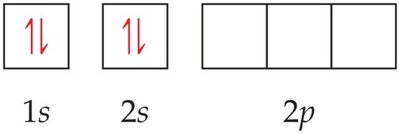
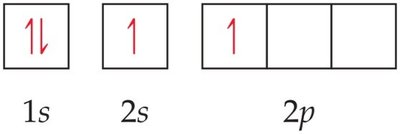
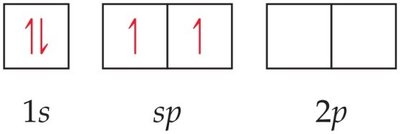
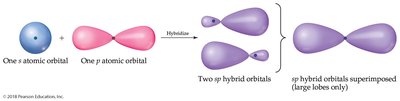
Hybridization is the mixing of atomic orbitals to form new, degenerate orbitals suitable for bonding.
sp, sp2, and sp3 Hybridization
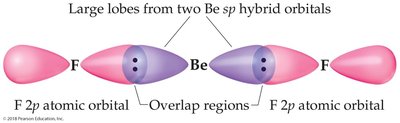
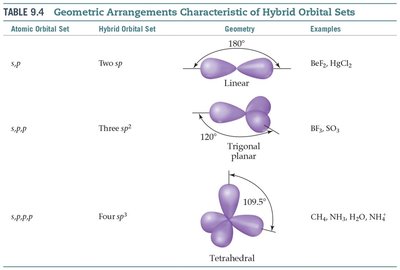
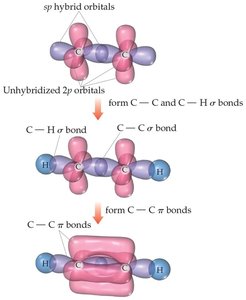
sp hybridization: Mixing one s and one p orbital forms two sp hybrid orbitals (linear geometry, 180° bond angle).
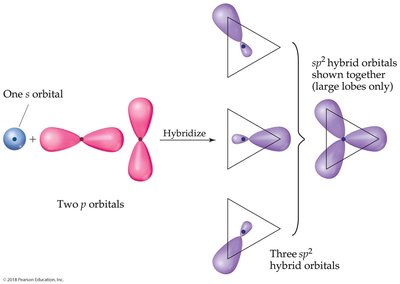
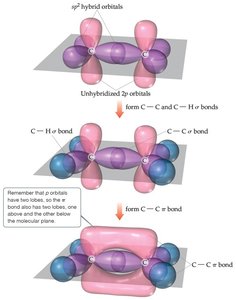
sp2 hybridization: Mixing one s and two p orbitals forms three sp2 hybrid orbitals (trigonal planar geometry, 120° bond angle).
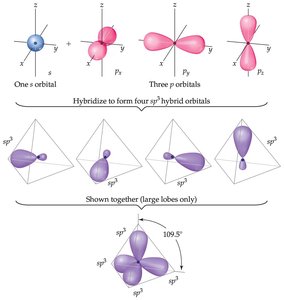
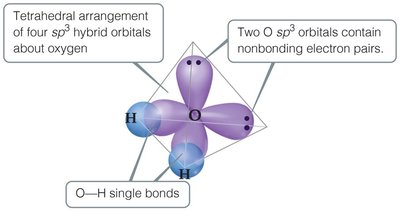
sp3 hybridization: Mixing one s and three p orbitals forms four sp3 hybrid orbitals (tetrahedral geometry, 109.5° bond angle).
Summary Table: Geometric Arrangements of Hybrid Orbitals
Atomic Orbital Set | Hybrid Orbital Set | Geometry | Examples |
|---|---|---|---|
s, p | Two sp | Linear (180°) | BeF2, HgCl2 |
s, p, p | Three sp2 | Trigonal planar (120°) | BF3, SO3 |
s, p, p, p | Four sp3 | Tetrahedral (109.5°) | CH4, NH3, H2O |
Sigma (σ) and Pi (π) Bonds
Types of Covalent Bonds
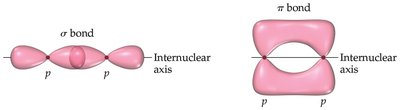
Sigma (σ) bonds: Formed by head-to-head overlap of orbitals; electron density is concentrated along the internuclear axis. All single bonds are σ bonds.
Pi (π) bonds: Formed by sideways overlap of unhybridized p orbitals; electron density is above and below the internuclear axis. Present in double and triple bonds.
Double bonds consist of one σ and one π bond; triple bonds consist of one σ and two π bonds.
Conclusion
Understanding molecular geometry and bonding theories is essential for predicting molecular properties and reactivity. The VSEPR model, hybridization, and the distinction between sigma and pi bonds provide a comprehensive framework for describing the structure and bonding in molecules.
