 Indietro
Step-by-Step Study Guide for Nuclear Chemistry (GOB Chemistry)
Guida di studio - Note intelligenti
 Appunti personalizzati basati sui tuoi materiali, ampliati con definizioni chiave, esempi e contesto.
Q1. It is a nuclear process that releases heat and light when occurring in the stars, including the Sun. Does this describe nuclear fusion, nuclear fission, or both?
Background
Topic: Nuclear Fusion vs. Nuclear Fission
This question tests your understanding of the differences between nuclear fusion and nuclear fission, especially in the context of energy production in stars.
Key Terms:
Nuclear Fusion: The process where two light atomic nuclei combine to form a heavier nucleus, releasing energy.
Nuclear Fission: The process where a heavy atomic nucleus splits into two lighter nuclei, also releasing energy.
Step-by-Step Guidance
Recall that stars, including the Sun, produce energy through nuclear reactions.
Think about which process is responsible for the energy output in stars: fusion or fission?
Consider the products of these reactions—do they release heat and light?
Review the definitions and typical locations where fusion and fission occur.
Try solving on your own before revealing the answer!
Final Answer: a. Nuclear Fusion
Stars, including the Sun, release heat and light primarily through nuclear fusion, where hydrogen nuclei combine to form helium.
Q2. Californium is a transuranium element prepared by bombarding berkelium-249 with neutrons to produce a californium atom and a beta particle. What is the complete bombardment reaction?
Background
Topic: Nuclear Reactions and Transuranium Elements
This question tests your ability to write and balance nuclear equations, especially for the synthesis of transuranium elements.
Key Terms and Formulas:
Transuranium Elements: Elements with atomic numbers greater than uranium (92).
Bombardment Reaction: A nuclear reaction where a nucleus is struck by a particle, resulting in a new element and other products.
Beta Particle: (electron emitted during beta decay).
Step-by-Step Guidance
Write the reactants: and .
Determine the sum of mass numbers and atomic numbers on the left side.
Identify the products: californium and a beta particle.
Balance the mass and atomic numbers to find the correct californium isotope and beta particle.
Try solving on your own before revealing the answer!
Final Answer: a.
The mass and atomic numbers are balanced, and the reaction produces californium-254 and a beta particle.
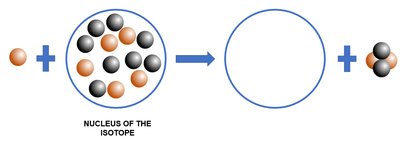
Q3. The figure below illustrates the nucleus of a specific isotope, which contains both protons and neutrons. If the isotope undergoes the following bombardment reaction, illustrate the nucleus of the new isotope produced.
Background
Topic: Nuclear Bombardment Reactions and Isotope Representation
This question tests your ability to interpret visual representations of nuclei and predict changes after a nuclear reaction.
Key Terms:
Proton: Positively charged particle in the nucleus.
Neutron: Neutral particle in the nucleus.
Isotope: Atoms of the same element with different numbers of neutrons.


Step-by-Step Guidance
Examine the initial nucleus and count the protons (orange) and neutrons (gray).
Consider the bombardment reaction: a neutron is added to the nucleus.
Predict how the nucleus changes—does the number of protons or neutrons increase?
Review the possible answer choices and match the new nucleus to the correct diagram.
Try solving on your own before revealing the answer!
Final Answer: b. The new nucleus will have one additional neutron compared to the original.
After the bombardment, the nucleus diagram should show the same number of protons and one more neutron.
Q4. Provide the balanced nuclear reaction: an alpha particle is one of the products formed from the collision of two rhodium-115 atoms.
Background
Topic: Alpha Decay and Nuclear Reactions
This question tests your ability to write and balance nuclear equations involving alpha particle production.
Key Terms and Formulas:
Alpha Particle: (two protons and two neutrons).
Balanced Nuclear Equation: The sum of mass numbers and atomic numbers must be equal on both sides.
Step-by-Step Guidance
Write the reactants: two rhodium-115 atoms ().
Determine the total mass and atomic numbers for the reactants.
Identify the products: an alpha particle () and another nucleus.
Balance the equation by matching mass and atomic numbers on both sides.
Try solving on your own before revealing the answer!
Final Answer: a.
The equation is balanced for both mass and atomic numbers, and an alpha particle is produced.
Q5. Write the name and symbol of the daughter nucleus produced when bismuth-211 (211Bi) undergoes α-decay.
Background
Topic: Alpha Decay and Daughter Nucleus Identification
This question tests your ability to identify the product of alpha decay and name the resulting nucleus.
Key Terms and Formulas:
Alpha Decay: Loss of an alpha particle () from the nucleus.
Daughter Nucleus: The new nucleus formed after decay.
Alpha Decay Formula:
Step-by-Step Guidance
Start with bismuth-211 ().
Subtract 4 from the mass number and 2 from the atomic number to find the daughter nucleus.
Identify the element with the new atomic number.
Write the name and symbol for the daughter nucleus.
Try solving on your own before revealing the answer!
Final Answer: a. Polonium;
Alpha decay reduces the mass number by 4 and the atomic number by 2, resulting in polonium-209.
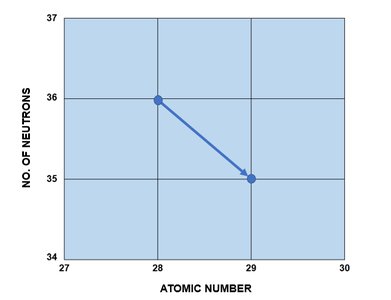
Q6. The changes in an atom's nucleus during a nuclear reaction are depicted in the graph below. Identify the isotopes involved as the original element and the decay product, and determine the type of decay process.
Background
Topic: Nuclear Decay Processes and Isotope Identification
This question tests your ability to interpret nuclear decay graphs and identify the type of decay and the elements involved.
Key Terms:
Beta Decay (β emission): A neutron converts to a proton, increasing atomic number by 1.
Alpha Decay (α emission): Loss of an alpha particle, decreasing atomic number by 2 and mass number by 4.
Step-by-Step Guidance
Examine the graph: the atomic number increases by 1, and the number of neutrons decreases by 1.
Recall that beta decay increases atomic number by 1 (neutron to proton conversion).
Identify the original element and the decay product based on atomic numbers.
Match the process and elements to the answer choices.
Try solving on your own before revealing the answer!
Final Answer: a. Decay process: β emission; Original element: Nickel; Decay product: Copper
The graph shows beta emission, where nickel becomes copper as the atomic number increases by 1.
Q7. At a distance of 5.65 m, a source of β emission radiation releases 295 units of radiation. Calculate the distance at which the radiation intensity is reduced to one-fifth of its original value.
Background
Topic: Radiation Intensity and Inverse Square Law
This question tests your ability to apply the inverse square law to calculate changes in radiation intensity with distance.
Key Formula:
Step-by-Step Guidance
Identify the initial intensity ( units) and distance ( m).
Set up the relationship: .
Use the inverse square law to relate the distances and intensities.
Set up the equation: and solve for .
Try solving on your own before revealing the answer!
Final Answer: a. 12.6 m
Using the inverse square law, the distance at which the intensity is one-fifth is approximately 12.6 m.
Q8. Give the gamma emission products of the metastable state of protactinium (Pa-234m).
Background
Topic: Gamma Emission and Nuclear States
This question tests your understanding of gamma emission and the notation for metastable nuclear states.
Key Terms:
Gamma Emission: Release of a gamma photon () from a nucleus in a metastable state.
Metastable State: An excited nuclear state, denoted by "m".
Step-by-Step Guidance
Start with Pa-234m ().
Gamma emission does not change mass or atomic number, only the energy state.
Identify the daughter nucleus and the gamma photon product.
Write the balanced nuclear equation for gamma emission.
Try solving on your own before revealing the answer!
Final Answer: a. and
Gamma emission from Pa-234m produces thorium-234 and a gamma photon.
Q9. Bone imaging uses strontium-85. There is a concern that Sr-85, a radioisotope, would negatively affect the growing bones of children. Which does not explain this?
Background
Topic: Radioisotopes in Medicine and Biological Effects
This question tests your understanding of how radioisotopes interact with biological tissues, especially bone.
Key Terms:
Strontium-85: A radioisotope used in bone imaging.
Radioisotope Effects: Can displace calcium, damage tissues, and weaken bones.
Step-by-Step Guidance
Review how strontium-85 interacts with bone tissue.
Consider which statements accurately describe the risks of Sr-85 exposure.
Identify the statement that does not explain the negative effects on bones.
Think about the chemistry of bone absorption and radioisotope behavior.
Try solving on your own before revealing the answer!
Final Answer: b. The bone cells of children will not absorb Sr-85 because bones contain calcium, not strontium.
This statement is incorrect; bones can absorb strontium because it behaves similarly to calcium.
