 Indietro
Functional Groups and Reactivity in Organic Molecules: Foundations for Drug Synthesis
Guida di studio - Note intelligenti
 Appunti personalizzati basati sui tuoi materiali, ampliati con definizioni chiave, esempi e contesto.
Functional Groups in Organic Chemistry
Definition and Importance
Functional groups are specific atoms or groups of atoms within molecules that impart characteristic chemical behaviors and reactivity. They are considered the 'reactive hotspots' of molecules, largely independent of the rest of the molecular scaffold. Recognizing functional groups in drug molecules is essential for predicting their chemical properties, biological activity, and synthetic pathways.
Functional groups determine reactivity, polarity, solubility, and intermolecular interactions.
They are crucial in drug action and synthesis, as reactions often occur at or near these groups.
Understanding functional groups is foundational for organic chemistry and drug development.
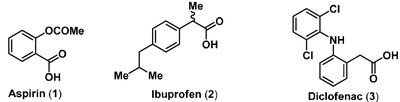
Example: Aspirin, Ibuprofen, and Diclofenac contain multiple functional groups that define their pharmacological properties.
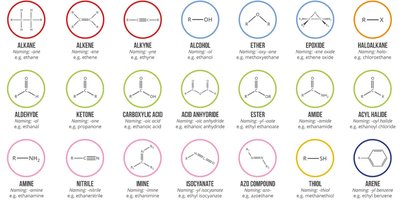
Classification of Functional Groups
Hydrocarbons (Non-Polar)
Hydrocarbons are composed solely of carbon and hydrogen atoms. Their non-polar nature makes them generally unreactive, except under specific conditions.
Alkanes: Saturated hydrocarbons (C–C, C–H bonds); inert, undergo combustion and free-radical substitution.
Alkenes: Unsaturated hydrocarbons (C=C bonds); more reactive, undergo electrophilic addition.
Alkynes: Unsaturated hydrocarbons (C≡C bonds); highly reactive, undergo addition and reduction.
Aromatic compounds: Benzene rings; undergo electrophilic aromatic substitution.
Oxygen-Containing Groups (Polar)
Alcohols (–OH): Polar; undergo nucleophilic substitution and oxidation.
Ethers (R–O–R): Relatively unreactive; act as solvents.
Aldehydes (–CHO): Highly reactive; undergo nucleophilic addition.
Ketones (C=O): Less reactive than aldehydes; undergo nucleophilic addition.
Carboxylic acids (–COOH): Acidic; undergo nucleophilic substitution.
Esters (–COOR): Undergo hydrolysis and transesterification.
Nitrogen-Containing Groups
Amines (–NH₂): Basic; undergo nucleophilic substitution.
Amides (–CONH₂): Resonance-stabilized; less reactive than esters.
Reactivity Patterns of Functional Groups
Key Reaction Types
Functional Group | Key Reaction Type | Example Reaction |
|---|---|---|
Alkenes | Electrophilic addition | Br2 addition to form dibromoalkanes |
Alcohols | Oxidation, substitution | Oxidation of 1° alcohol → aldehyde/acid |
Aldehydes & Ketones | Nucleophilic addition | Addition of HCN or reduction to alcohol |
Carboxylic Acids | Acid-base & nucleophilic substitution | Esterification with alcohols |
Amines | Nucleophilic substitution, acid–base | Alkylation or acylation |
Esters | Hydrolysis (acidic or basic) | Saponification → carboxylate + alcohol |
Alkanes: Structure and Reactivity
Physical and Chemical Properties
Alkanes are saturated hydrocarbons with only strong sigma bonds (C–C and C–H). They are exceptionally inert and do not react with ionic or polar substances, acids, or bases. Their main reactions are combustion and halogenation.
Combustion: Alkanes react with oxygen at high temperatures to produce water and carbon dioxide. This exothermic reaction makes alkanes valuable fuels.
Halogenation: Alkanes react with halogens (Cl2, Br2) under UV light or high temperature via a free radical mechanism, forming haloalkanes.
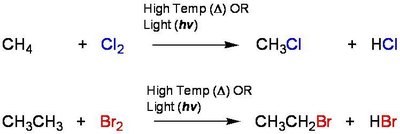
Example: Methane reacts with chlorine to form chloromethane and hydrochloric acid.
Alkenes: Structure and Reactivity
Physical Properties
Alkenes are unsaturated hydrocarbons with a C=C double bond. They are hydrophobic and have high lipid solubility due to strong van der Waals forces. The double bond does not form hydrogen or ion-dipole bonds.
Main Reactions of Alkenes
Electrophilic addition
Reduction
Oxidation
Free radical addition
Polymerisation
Photoisomerisation
Electrophilic Addition Mechanism
Alkenes act as electron-rich centers, with pi electrons above and below the sigma bond. Electrophiles are attracted to these electrons, forming a carbocation intermediate. The double bond acts as a nucleophile, donating electrons to the electrophile.
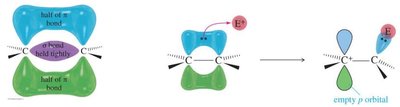
Example: Addition of halogens (Br2) or halogen acids (HBr) across C=C bonds.
Regioselectivity: Markovnikov's Rule
In addition of HX to unsymmetrical alkenes, the hydrogen attaches to the carbon with fewer alkyl substituents, and the halide attaches to the carbon with more alkyl substituents. This regioselectivity is known as Markovnikov's rule.
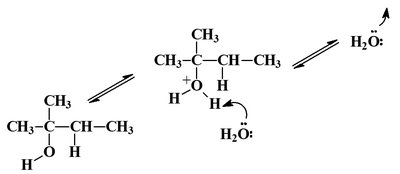
Hydration of Alkenes
Alkenes can be converted to alcohols by reaction with dilute aqueous acid. The hydration is regiospecific, forming the Markovnikov product.

Catalytic Hydrogenation
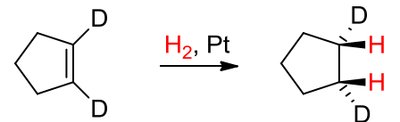
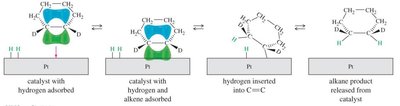
Catalytic hydrogenation is the addition of hydrogen to a compound, reducing alkenes to alkanes. This reaction uses a transition metal catalyst (Ni, Pt, Pd/C). Hydrogen is adsorbed to the metal surface, and the pi-system binds to the catalyst, allowing hydrogen insertion into the double bond.
Epoxidation of Alkenes
Epoxidation introduces an oxygen atom, forming a three-membered ring (epoxide). The most common reagent is a peroxyacid, such as mCPBA. The stereochemistry of the starting material is conserved in this one-step reaction.

Example: Conversion of cis/trans alkenes to cis/trans epoxides.
Alkynes: Structure and Reactivity
Reduction to Alkanes
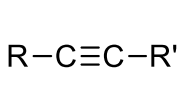
Alkynes contain a carbon–carbon triple bond and can be reduced to alkanes using hydrogen gas and a nickel or platinum catalyst. The reaction proceeds via an alkene intermediate.

Selective Reduction to Cis-Alkenes
Lindlar’s catalyst (palladium, barium sulfate, quinoline) allows selective reduction of alkynes to cis-alkenes via syn addition.
Reduction to Trans-Alkenes
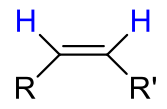
Trans-alkenes can be synthesized from alkynes using sodium metal in liquid ammonia. The mechanism involves electron addition, radical formation, and anti stereochemistry.



Alkylation of Terminal Alkynes
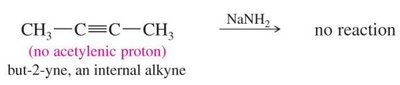
Terminal alkynes have acidic hydrogens that can be removed by a strong base, allowing for carbon chain extension via alkylation.
Summary
Functional groups are the reactive centers of molecules, defining their chemical behavior.
Alkanes are relatively unreactive, with key reactions including combustion and free-radical substitution.
Alkenes are electron-rich and undergo electrophilic addition, enabling conversion to alkyl halides, alcohols, alkanes, and epoxides.
Alkynes can be reduced to alkanes or selectively to cis- or trans-alkenes; terminal alkynes are useful for C–C bond formation.
Oxygen and nitrogen-containing groups will be discussed in further detail in subsequent lectures.
