 Indietro
The Immune System: Lines of Defense
Guida di studio - Note intelligenti
 Appunti personalizzati basati sui tuoi materiali, ampliati con definizioni chiave, esempi e contesto.
The Immune System: Lines of Defense
Overview
The human immune system protects the body from pathogens through a series of defense mechanisms organized into three main lines of defense. These include physical and chemical barriers, nonspecific (innate) defenses, and specific (adaptive) immune responses. Each line of defense plays a distinct role in maintaining health and preventing infection.
First Line of Defense: Physical and Chemical Barriers
Skin and Associated Structures
The skin acts as the primary barrier against pathogens, utilizing structural, chemical, and biological mechanisms to prevent infection.
Keratinized Structure: The tough, elastic keratin layer makes it difficult for pathogens to penetrate.
Constant Replacement: Dead skin cells are shed, removing attached pathogens.
Acidic pH: Skin maintains a pH of 5-6, creating a hostile environment for many microorganisms.
Antibiotic Production: Sweat glands secrete dermicidin, an antimicrobial peptide.
Other Physical and Chemical Barriers
Tears, Saliva, and Earwax: Contain lysozyme, an enzyme that destroys bacteria; tears and saliva also lubricate tissues and wash away particles.
Mucous Membranes: Mucus traps microorganisms, preventing access to underlying cells.
Digestive and Vaginal Acids: Stomach acid (pH ~2) and vaginal acids inhibit pathogen survival.
Expulsion Mechanisms: Vomiting, urination, and defecation remove pathogens from the body; urine is slightly acidic.
Resident Beneficial Bacteria: Microbiota in mucous membranes compete with pathogenic bacteria, reducing infection risk.
Second Line of Defense: Nonspecific (Innate) Mechanisms
Complement System
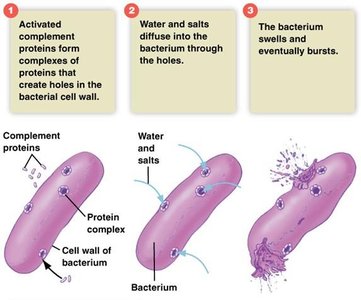
The complement system consists of plasma proteins that enhance immune responses and directly attack pathogens.
Activation: Complement proteins are activated by infection and form complexes that create holes in bacterial cell walls.
Effects: Water and salts enter bacteria, causing them to swell and burst; some proteins mark bacteria for destruction or promote inflammation.
Phagocytes
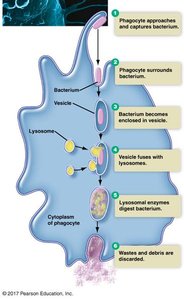
Phagocytes are white blood cells that engulf and digest foreign cells through phagocytosis.
Types: Includes neutrophils, eosinophils, and basophils.
Mechanism: Phagocytes enclose pathogens in vesicles, which fuse with lysosomes containing digestive enzymes.
Inflammatory Response
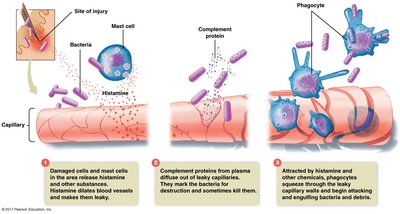
The inflammatory response is triggered by tissue injury and promotes healing.
Signs: Warmth, redness, swelling, and pain.
Process: Damaged cells release chemicals (e.g., histamine) that cause vasodilation, attract complement proteins, and recruit phagocytes.
Other Nonspecific Defenses
Natural Killer (NK) Cells: Lymphocytes that target and destroy tumor and virus-infected cells.
Interferons: Proteins released by virus-infected cells that protect neighboring cells by interfering with viral replication.
Fever: Elevated body temperature makes the environment less hospitable to pathogens and accelerates immune responses.
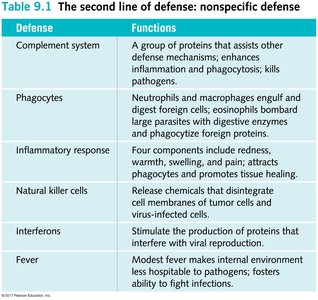
Summary Table: Second Line of Defense
Defense | Functions |
|---|---|
Complement system | Assists other defense mechanisms; enhances inflammation and phagocytosis; kills pathogens |
Phagocytes | Engulf and digest foreign cells; eosinophils attack large parasites |
Inflammatory response | Redness, warmth, swelling, pain; attracts phagocytes and promotes tissue healing |
Natural killer cells | Disintegrate cell membranes of tumor and virus-infected cells |
Interferons | Stimulate production of proteins that interfere with viral reproduction |
Fever | Raises internal temperature; fosters ability to fight infections |
Third Line of Defense: Specific (Adaptive) Immune Response
Characteristics of Adaptive Immunity
The adaptive immune response targets specific pathogens and possesses memory, allowing for a faster response upon re-exposure.
Recognition: Distinguishes "self" from "non-self" proteins.
Specificity: Can recognize millions of different pathogens.
Memory: Responds more rapidly to previously encountered antigens.
Antigens and Antibodies
Antigens are molecules (usually proteins or polysaccharides) that trigger an immune response. Antibodies are proteins produced by the immune system to bind and neutralize antigens.
B-Lymphocytes (B-cells)
B-cells mature in the bone marrow and are responsible for antibody-mediated immunity. Upon encountering an antigen, B-cells replicate and differentiate into memory cells and plasma cells, which secrete antibodies.
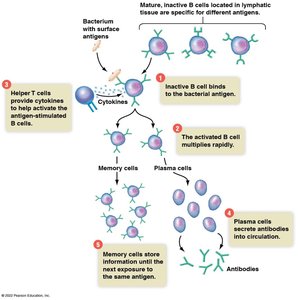
Antibody-Mediated Immune Response
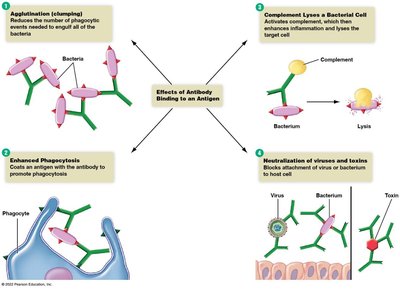
Antibodies bind to antigens, forming antigen-antibody complexes that neutralize pathogens through several mechanisms:
Agglutination: Clumping pathogens together for easier removal.
Phagocyte Recruitment: Marking pathogens for destruction.
Complement Activation: Enhancing pathogen lysis.
Blocking Attachment: Preventing pathogens from binding to host cells.
Structure of Antibodies
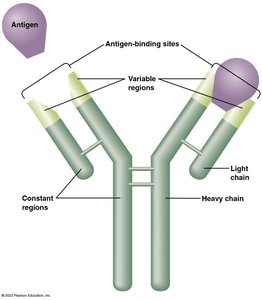
All antibodies share a basic Y-shaped structure composed of four polypeptide chains (two heavy and two light chains). The variable region binds specific antigens, while the constant region determines the antibody class.
T-Lymphocytes (T-cells)
T-cells mature in the thymus and are responsible for cell-mediated immunity. They directly attack infected or abnormal cells and coordinate immune responses.
Antigen-Presenting Cells (APCs): Macrophages and B-cells process and display antigens for T-cell recognition.
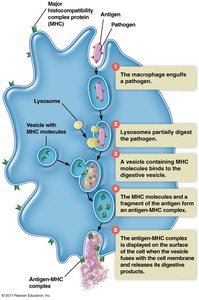
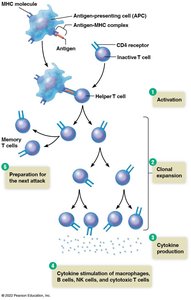
Helper T-Cells
Helper T-cells (with CD4 receptors) are activated by APCs displaying antigen-MHC complexes. They produce cytokines to stimulate other immune cells and enhance both antibody and cell-mediated responses.
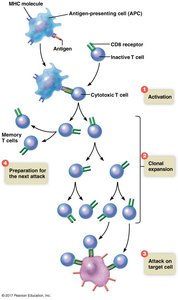
Cytotoxic T-Cells
Cytotoxic T-cells (with CD8 receptors) are activated by APCs and directly attack and destroy infected or abnormal cells by releasing perforin and granzymes.
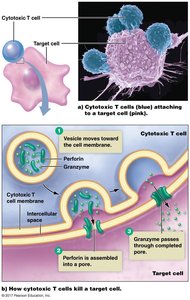
Memory and Suppressor T-Cells
Memory T-Cells: Store information for rapid response upon re-exposure to the same antigen.
Suppressor T-Cells: Regulate and suppress immune responses to prevent overactivity and autoimmunity.
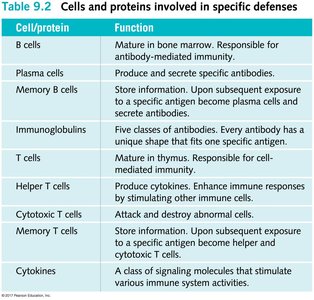
Summary Table: Cells and Proteins in Specific Defenses
Cell/protein | Function |
|---|---|
B cells | Mature in bone marrow; responsible for antibody-mediated immunity |
Plasma cells | Produce and secrete specific antibodies |
Memory B cells | Store information for rapid response upon re-exposure |
Immunoglobulins | Five classes of antibodies; each fits one specific antigen |
T cells | Mature in thymus; responsible for cell-mediated immunity |
Helper T cells | Produce cytokines; enhance immune responses |
Cytotoxic T cells | Attack and destroy abnormal cells |
Memory T cells | Store information for rapid response |
Cytokines | Signaling molecules that stimulate various immune system activities |
Additional info: These notes summarize the mechanisms and cellular components of the immune system's three lines of defense, providing a comprehensive overview suitable for Human Biology students.
