 Indietro
Composite Functions and Inverse Functions: Intermediate Algebra Study Guide
Guida di studio - Note intelligenti
 Appunti personalizzati basati sui tuoi materiali, ampliati con definizioni chiave, esempi e contesto.
Section 9.1: Composite Functions and Inverse Functions
Composite Functions
Composite functions allow us to combine two functions so that the output of one function becomes the input of another. This is a fundamental concept in algebra, especially when modeling real-world situations where one quantity depends on another.
Definition: A composite function is "a function of a function." The composite function \( f \circ g \) is defined as \( (f \circ g)(x) = f(g(x)) \).
Notation: \( f \circ g \) means "f composed with g."
Non-Commutativity: Composition is not commutative; \( f \circ g \neq g \circ f \) in general.
Example: If \( f(x) = 3x \) and \( g(x) = 1 + x^2 \), then:
\( (f \circ g)(x) = f(g(x)) = 3(1 + x^2) = 3 + 3x^2 \)
\( (g \circ f)(x) = g(f(x)) = 1 + (3x)^2 = 1 + 9x^2 \)
Application: Composite functions are used to model situations where one process depends on the outcome of another.
One-to-One Functions
A function is one-to-one if each input corresponds to a unique output, and vice versa. This property is essential for a function to have an inverse.
Definition: A function is one-to-one if for every \( a \neq b \), \( f(a) \neq f(b) \).
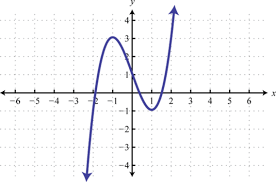
Horizontal Line Test: A function is one-to-one if no horizontal line intersects its graph more than once.
Example: Consider the function \( f = \{(2, 3), (1, 5), (4, 5)\} \). Since both 1 and 4 map to 5, this function is not one-to-one.
Inverse Functions
The inverse of a function reverses the correspondence between inputs and outputs. If a function is one-to-one, its inverse is also a function.
Definition: The inverse of a function \( f \) is written as \( f^{-1} \). The notation does not mean exponentiation.
Ordered Pairs: If \( (a, b) \) is in \( f \), then \( (b, a) \) is in \( f^{-1} \).
Finding the Inverse:
Replace \( f(x) \) with \( y \).
Interchange \( x \) and \( y \).
Solve for \( y \).
Replace \( y \) with \( f^{-1}(x) \).
Example: If \( f(x) = x + 3 \), then:
\( y = x + 3 \)
Interchange: \( x = y + 3 \)
Solve: \( y = x - 3 \)
So, \( f^{-1}(x) = x - 3 \)
Graphing Functions and Their Inverses
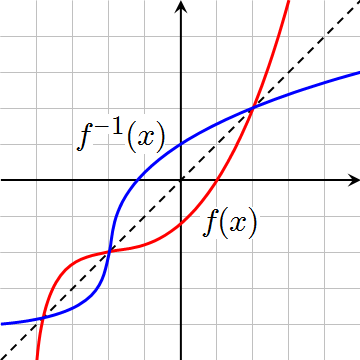
The graph of an inverse function is a reflection of the original function across the line \( y = x \). This visual relationship helps confirm the correctness of an inverse.
Reflection: The graph of \( f^{-1}(x) \) is the mirror image of \( f(x) \) across \( y = x \).
Example: If \( f(x) \) is a curve, \( f^{-1}(x) \) will be its reflection.
Inverse Functions and Composition
When a function is one-to-one, its inverse function undoes the effect of the original function. Composing a function with its inverse returns the original input.
Key Properties:
\( (f \circ f^{-1})(x) = f(f^{-1}(x)) = x \)
\( (f^{-1} \circ f)(x) = f^{-1}(f(x)) = x \)
Example: If \( f(x) = 2x - 1 \), then \( f^{-1}(x) = \frac{x + 1}{2} \). Composing these functions returns \( x \).
Summary Table: Composite and Inverse Functions
Concept | Definition | Key Property | Example |
|---|---|---|---|
Composite Function | \( (f \circ g)(x) = f(g(x)) \) | Not commutative | \( f(x) = 3x, g(x) = 1 + x^2 \) |
One-to-One Function | Each input has a unique output | Horizontal line test | \( f(x) = x + 3 \) |
Inverse Function | Reverses the correspondence | \( f^{-1}(f(x)) = x \) | \( f(x) = x + 3, f^{-1}(x) = x - 3 \) |
Things to Remember and Mistakes to Avoid
Always check if a function is one-to-one before finding its inverse.
Remember that \( f^{-1} \) is not exponentiation.
Composition order matters: \( f \circ g \neq g \circ f \).
Use the horizontal line test to determine if a function has an inverse.
Practice Problems
Find \( (f \circ g)(x) \) and \( (g \circ f)(x) \) for \( f(x) = x^2 - 1 \) and \( g(x) = 2x + 3 \).
Find \( (f \circ g)(1) \) and \( (g \circ f)(1) \) for \( f(x) = x + 15 \) and \( g(x) = \sqrt{x} \).
Determine if \( f(x) = x + 15 \) is one-to-one and find its inverse if it is.
Determine if \( f(x) = 6x - 7 \) is one-to-one and find its inverse if it is.
Determine if \( f(x) = x^3 + 15 \) is one-to-one and find its inverse if it is.
