 Indietro
Radical Expressions and Functions: Study Notes for Intermediate Algebra
Guida di studio - Note intelligenti
 Appunti personalizzati basati sui tuoi materiali, ampliati con definizioni chiave, esempi e contesto.
Section 7.1: Radical Expressions and Functions
Introduction
This section introduces radical expressions and functions, focusing on simplifying roots, evaluating radical functions, and understanding their domains. Mastery of these concepts is essential for solving equations involving radicals and for further study in algebra.
Square Roots and Square Root Functions
Square roots are fundamental in algebra. The square root of a number a is a value c such that . Every positive number has two square roots: a positive (principal) root and a negative root. The principal square root is denoted by the radical sign .
Radical Sign: indicates the principal square root.
Radicand: The expression under the radical sign.
Example: (principal root), (negative root).
Every positive number: Has two square roots, e.g., for $25$.
Evaluating Square Roots
Example: Find the square roots of $49\sqrt{49} = 7-\sqrt{49} = -7$.
Example: Find the principal square root of : .
Example: .
Simplifying Radical Expressions
Radical expressions can sometimes involve negative radicands or negative signs outside the radical.
Example: is not a real number.
Example: .
Radical Functions: Domain and Range
Radical functions are functions where the variable is under a radical. The domain is the set of input values for which the function is defined. For square root functions, the radicand must be non-negative.
Function:
Domain:
Range:
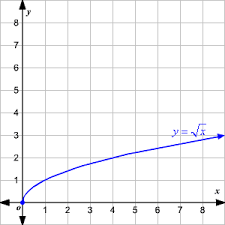
Example:
(not a real number)
Domain: Values of such that (i.e., )
Expressions of the Form
For any real number , equals the absolute value of $a$.
Example:
General Rule:
a | a^2 | \sqrt{a^2} |
|---|---|---|
5 | 25 | 5 |
-5 | 25 | 5 |
3 | 9 | 3 |
-3 | 9 | 3 |
10 | 100 | 10 |
-10 | 100 | 10 |
Cube Roots
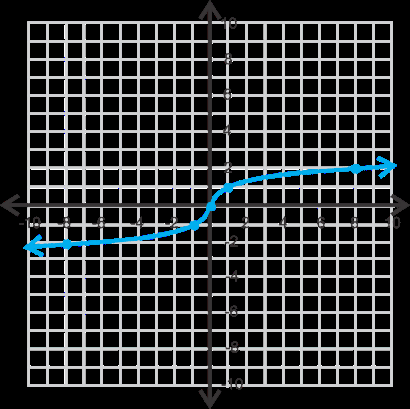
The cube root of a number a is a value c such that . Every real number has one cube root, which can be positive or negative.
Notation:
Example: ,
Domain: All real numbers
Range: All real numbers
Odd and Even nth Roots
The nth root of a number a is a value c such that . The index n determines whether the root is odd or even.
Odd Roots: Every real number has one odd root.
Even Roots: Every positive real number has two even roots (principal and negative).
Notation:
Example: ,
Domains of Radical Functions
To determine the domain of a radical function, consider whether the nth root of a negative number exists. For even roots, the radicand must be non-negative; for odd roots, all real numbers are allowed.
Example: : Domain is
Example: : Domain is
Example: : Domain is all real numbers
Summary: Key Points and Mistakes to Avoid
Radical Sign: indicates the principal root.
Radicand: The expression under the radical.
Square Roots: is a square root of if .
Odd and Even Roots: is the nth root of if .
Domain of Radical Functions: Set of all inputs for which the function is defined.
Absolute Value:
Practice Problems
Find all the square roots of $144$.
Simplify: .
Simplify: (use absolute-value notation).
Simplify: .
Simplify: .
