 Indietro
Cell Cycle, Mitosis, and Meiosis: Structure, Function, and Regulation
Guida di studio - Note intelligenti
 Appunti personalizzati basati sui tuoi materiali, ampliati con definizioni chiave, esempi e contesto.
Biological Hierarchies and the Cell Cycle
Levels of Biological Organization
Biological systems are organized into a hierarchy, from the smallest chemical units to the complexity of ecosystems. Understanding these levels is foundational for studying cell division and genetics.
Atoms: Basic units of matter.
Molecules: Combinations of atoms, such as DNA and proteins.
Cells: Fundamental units of life.
Tissues & Organs: Groups of cells with specific functions.
Organism: An individual living entity.
Population: Group of organisms of the same species.
Community: Different populations living together.
Ecosystem: Community plus the physical environment.
Chromosomes, Chromatin, and DNA Structure
Key Terms and Concepts
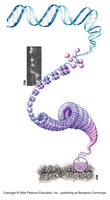
Genetic information is organized within the cell nucleus as chromosomes, which are composed of chromatin (DNA and proteins). The structure of DNA is central to understanding inheritance and cell division.
Chromosome: A single, long DNA molecule wrapped around proteins (histones), carrying genetic information.
Chromatin: The complex of DNA and proteins that forms chromosomes within the nucleus.
DNA (Deoxyribonucleic Acid): The molecule that stores genetic instructions for the development and function of living things.
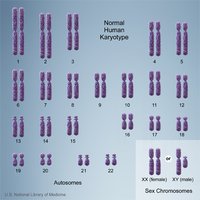
Homologous pairs: Pairs of chromosomes (one from each parent) that are similar in shape, size, and genetic content.
Sister chromatids: Identical copies of a chromosome, connected by a centromere, formed during DNA replication.
Sex chromosomes: Chromosomes that determine the sex of an organism (X and Y in humans).
Autosomes: Non-sex chromosomes; humans have 22 pairs.
Example: Humans have 46 chromosomes (23 pairs): 22 pairs of autosomes and 1 pair of sex chromosomes (XX or XY).
The Cell Cycle
Phases of the Cell Cycle
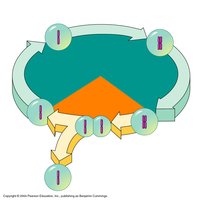
The cell cycle is the series of events that cells go through as they grow and divide. It consists of interphase (cell growth and DNA replication) and the mitotic (M) phase (cell division).
Interphase: Period of cell growth and DNA replication, subdivided into:
G1 phase: Cell grows and carries out normal functions.
S phase: DNA is replicated (synthesis of sister chromatids).
G2 phase: Cell prepares for division.
M phase (Mitosis): Division of the nucleus and cytoplasm, resulting in two identical daughter cells.
Key Point: Most cells in the human body are in interphase. Cells that divide frequently include skin, gut lining, and bone marrow cells.
Cancer: Cancer results from uncontrolled cell division due to failures in cell cycle regulation.
Mitosis: Mechanism and Phases
Overview of Mitosis
Mitosis is the process by which a eukaryotic cell separates its duplicated chromosomes into two identical sets, resulting in two genetically identical daughter cells. It is essential for growth, repair, and asexual reproduction.
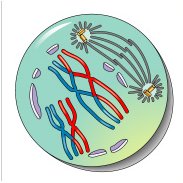
Prophase: Chromosomes condense, nuclear envelope dissolves, spindle apparatus forms.
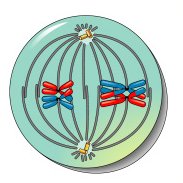
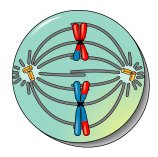
Metaphase: Chromosomes align at the cell's equator.
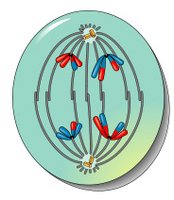
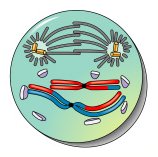
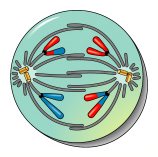
Anaphase: Sister chromatids separate and move toward opposite poles.
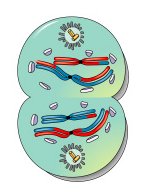
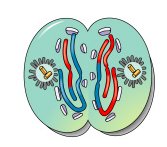
Telophase: Nuclear envelopes reform, chromosomes decondense, cytokinesis divides the cytoplasm.
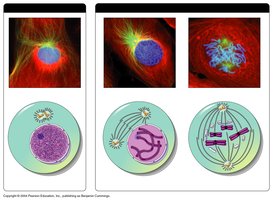
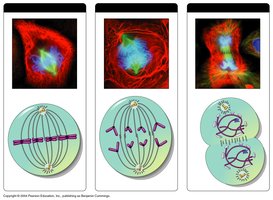
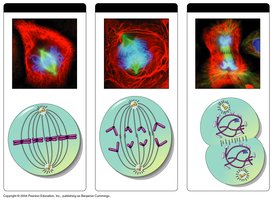
Example: In metaphase, a human cell has 46 chromosomes aligned at the metaphase plate, each consisting of two sister chromatids.
Regulation of the Cell Cycle and Cancer
Control Mechanisms
The cell cycle is tightly regulated by proteins that signal when to start or stop division. Disruption of these controls can lead to cancer.
"Go" signals: Promote progression from G1 to S phase.
"Stop" signals: Prevent cell cycle progression if conditions are not favorable.
Cancer cells: Ignore regulatory signals and divide uncontrollably.
Example: Tumors are masses of cells that divide when they should not, often due to mutations in genes controlling the cell cycle.
Meiosis: Mechanism and Significance
Overview of Meiosis
Meiosis is a specialized form of cell division that reduces the chromosome number by half, producing four genetically unique haploid cells (gametes). It is essential for sexual reproduction and genetic diversity.
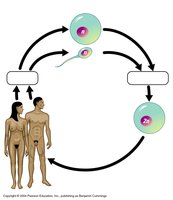
Diploid (2n): Cells with two sets of chromosomes (homologous pairs), e.g., somatic cells.
Haploid (n): Cells with one set of chromosomes, e.g., gametes (egg and sperm).
Gamete: A haploid reproductive cell (egg or sperm).
Fertilization: Fusion of two gametes to form a diploid zygote.
Zygote: The first diploid cell of a new organism.
Phases of Meiosis
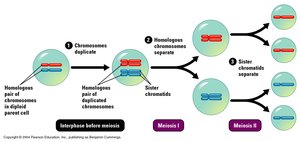
Meiosis consists of two sequential divisions: Meiosis I and Meiosis II.
Meiosis I: Homologous chromosomes separate, reducing chromosome number by half.
Meiosis II: Sister chromatids separate, similar to mitosis.
Key Phases:
Prophase I: Chromosomes condense, homologous chromosomes pair up (synapsis), crossing over may occur.
Metaphase I: Homologous pairs align at the metaphase plate.
Anaphase I: Homologous chromosomes separate to opposite poles.
Telophase I: Two haploid cells form; chromosomes are still duplicated.
Prophase II: Chromosomes recondense in each haploid cell.
Metaphase II: Chromosomes align at the metaphase plate.
Anaphase II: Sister chromatids separate.
Telophase II: Four genetically unique haploid cells are produced.
Comparison Table: Mitosis vs. Meiosis
Feature | Mitosis | Meiosis |
|---|---|---|
Number of divisions | 1 | 2 |
Number of daughter cells | 2 | 4 |
Genetic identity | Identical | Unique |
Chromosome number | Diploid (2n) | Haploid (n) |
Role | Growth, repair | Gamete production |
Summary and Key Questions
During the S phase of interphase, chromosomes are copied.
In metaphase of mitosis, a human cell has 46 pairs of sister chromatids aligned.
Most human cells are diploid; gametes (egg and sperm) are haploid.
Mitosis produces two identical diploid cells; meiosis produces four unique haploid cells.
Additional info: The process of crossing over during Prophase I of meiosis increases genetic diversity by exchanging genetic material between homologous chromosomes.
