 Indietro
DNA Structure, Replication, and the Flow of Genetic Information
Guida di studio - Note intelligenti
 Appunti personalizzati basati sui tuoi materiali, ampliati con definizioni chiave, esempi e contesto.
DNA: The Molecule of Life
Structure of DNA
DNA (deoxyribonucleic acid) is the fundamental molecule of heredity in all living organisms. Its structure is a double helix, composed of two intertwined polynucleotide strands. Each strand is a long chain of nucleotides, which are the basic building blocks of DNA.
Chromosomes: Every living cell contains one or more chromosomes, which are long molecules of DNA associated with proteins for organization and compaction.
Double Helix: The DNA double helix consists of two strands wrapped around each other, held together by hydrogen bonds between paired bases.
Universality: The chemical structure of DNA is common to all life on Earth.
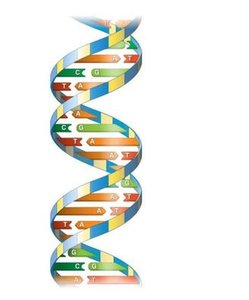
Nucleotides: The Building Blocks of DNA
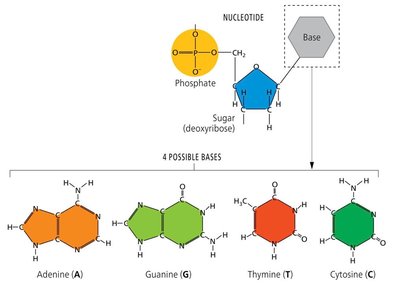
Each DNA molecule is made from individual subunits called nucleotides. A nucleotide consists of three parts: a five-carbon sugar (deoxyribose), a phosphate group, and a nitrogenous base.
Sugar and Phosphate: These components are identical in all DNA nucleotides.
Bases: The four types of bases are adenine (A), guanine (G), thymine (T), and cytosine (C). All genetic information is encoded using this four-letter alphabet.
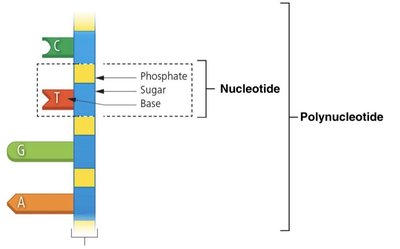
Polynucleotide Chains
A polynucleotide is a long strand of nucleotides. DNA consists of two polynucleotide chains, forming the double helix. Each chain can have any combination of the four bases along its length.
Definition: "Poly" means "many," so a polynucleotide is a chain of many nucleotides.
Variability: The sequence of bases along a polynucleotide encodes genetic information.
Base Pairing in DNA
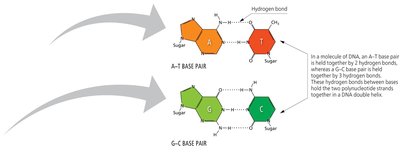
Each nucleotide contains one of four bases. Due to their chemical properties, bases pair specifically: A pairs with T, and G pairs with C. Hydrogen bonds between base pairs hold the two strands of the double helix together.
Base-Pairing Rules: The sequence of nucleotides on one strand determines the sequence on the other strand.
Hydrogen Bonds: A-T pairs are held together by two hydrogen bonds; G-C pairs by three hydrogen bonds.
DNA Replication
Semi-Conservative Replication
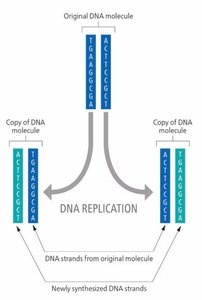
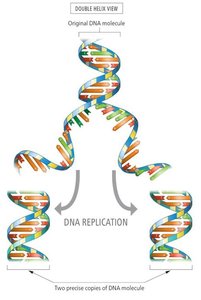
DNA replication is the process by which a cell duplicates its chromosomes before cell division. The double helix is peeled apart, and each strand serves as a template for building a new complementary strand, following the base-pairing rules.
Strand Separation: The two strands of the original DNA molecule separate.
Template Function: Each separated strand guides the synthesis of a new strand.
Semi-Conservative: Each new DNA molecule contains one old strand and one newly synthesized strand.
The Process of DNA Replication
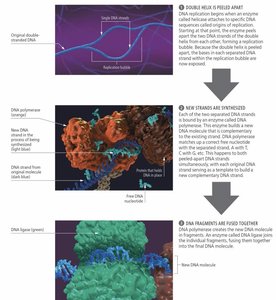
DNA replication involves several steps and specialized enzymes. The double helix is unwound, new strands are synthesized, and fragments are joined together.
Initiation: The double helix is peeled apart at specific sites called replication bubbles.
Elongation: DNA polymerase synthesizes new DNA strands by adding nucleotides complementary to the template strand.
Joining: DNA ligase joins DNA fragments to form a continuous strand.
DNA and the Flow of Genetic Information
DNA and RNA: Nucleic Acids
Both DNA and RNA are nucleic acids, polymers of nucleotides. While they share structural similarities, they also have important differences.
DNA: Contains deoxyribose sugar and the bases A, G, T, and C.
RNA: Contains ribose sugar and the bases A, G, C, and U (uracil replaces thymine).
Function: DNA acts as the molecule of heredity, while RNA is involved in protein synthesis.
The Flow of Genetic Information: Central Dogma
Genetic information flows from DNA to RNA to protein. This process is described by the central dogma of molecular biology.
Transcription: DNA is transcribed into messenger RNA (mRNA) in the nucleus.
Translation: mRNA is translated into a sequence of amino acids at the ribosome, forming a polypeptide (protein).
Proteins: Proteins perform most cellular functions and determine physical traits.
Transcription: DNA to RNA
Transcription is the process by which the information in a DNA gene is converted to an RNA molecule. In eukaryotic cells, this occurs in the nucleus.
Base-Pairing: Transcription follows base-pairing rules, except uracil (U) replaces thymine (T) in RNA.
mRNA: The resulting RNA molecule is called messenger RNA (mRNA), which exits the nucleus for translation.
Translation: RNA to Protein
Translation is the process by which the sequence of RNA nucleotides in mRNA provides instructions to build a sequence of amino acids, forming a polypeptide.
Codons: mRNA contains codons, sequences of three nucleotides, each specifying one amino acid.
Ribosomes: Ribosomes read codons and attach the proper amino acid to the growing chain.
Polypeptide: The resulting molecule is a polypeptide, which can be modified to become a functional protein.
Summary Table: DNA vs. RNA
Feature | DNA | RNA |
|---|---|---|
Sugar | Deoxyribose | Ribose |
Bases | A, G, T, C | A, G, C, U |
Structure | Double helix | Single strand |
Function | Heredity | Protein synthesis |
Key Equations
Base Pairing:
Central Dogma:
Additional info: The notes have been expanded to include definitions, examples, and a summary table for clarity and completeness. Images included are directly relevant to the explanation of DNA structure, nucleotide composition, polynucleotide chains, base pairing, and DNA replication.
