 Indietro
Transport Into and Out of the Cell: Diffusion, Osmosis, and Active Transport
Guida di studio - Note intelligenti
 Appunti personalizzati basati sui tuoi materiali, ampliati con definizioni chiave, esempi e contesto.
Transport Across Cell Membranes
Overview of Cellular Transport
Cells must regulate the movement of substances into and out of their membranes to maintain homeostasis. Transport mechanisms are classified as either passive (requiring no energy) or active (requiring energy in the form of ATP). The main types include diffusion, facilitated diffusion, osmosis, and active transport.
Passive Transport
Diffusion
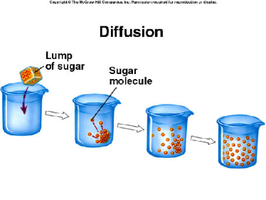
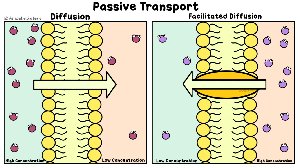
Diffusion is the movement of molecules from an area of high concentration to an area of low concentration, driven by the random motion of particles. This process does not require cellular energy (ATP) and continues until equilibrium is reached.
Key Point 1: Diffusion occurs directly through the phospholipid bilayer for small, nonpolar molecules (e.g., oxygen, carbon dioxide).
Key Point 2: The rate of diffusion depends on factors such as temperature, concentration gradient, and the nature of the molecules involved.
Example: The dispersal of a lump of sugar in water demonstrates diffusion as sugar molecules move from high to low concentration.
Facilitated Diffusion
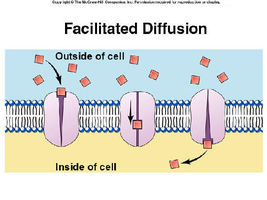
Facilitated diffusion is a type of passive transport where molecules move down their concentration gradient with the help of membrane proteins. This process is essential for substances that cannot easily cross the lipid bilayer, such as ions and polar molecules.
Key Point 1: Channel proteins and carrier proteins provide passageways for specific molecules.
Key Point 2: No energy is required, but transport is selective for certain substances.
Example: Glucose and ions like Na+ and K+ often use facilitated diffusion to enter or exit cells.
Osmosis
Definition and Mechanism
Osmosis is the diffusion of water across a selectively permeable membrane from an area of lower solute concentration (more water) to an area of higher solute concentration (less water). Osmosis is crucial for maintaining cell volume and internal conditions.
Key Point 1: Water moves to balance solute concentrations on both sides of the membrane.
Key Point 2: The direction of water movement depends on the relative concentrations of solutes inside and outside the cell.
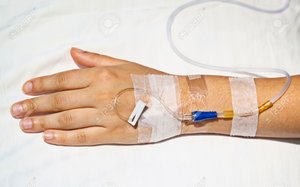
Example: In medical settings, intravenous (IV) solutions must be isotonic to prevent cell damage due to osmosis.
Osmosis in Model Systems
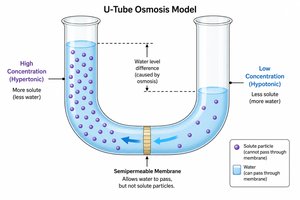
Osmosis can be demonstrated using a U-tube with a semipermeable membrane separating solutions of different concentrations. Water moves from the hypotonic (less solute) side to the hypertonic (more solute) side, causing the water level to rise on the hypertonic side.
Key Point: The semipermeable membrane allows water but not solute particles to pass through.
Tonicity: Hypertonic, Hypotonic, and Isotonic Solutions
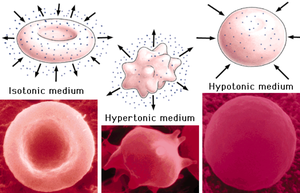
Tonicity describes the relative concentration of solutes in solutions separated by a membrane:
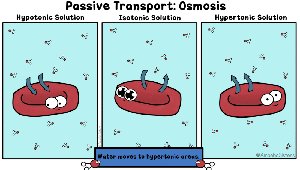
Hypertonic solution: Higher solute concentration outside the cell; water leaves the cell, causing it to shrink (crenate).
Hypotonic solution: Lower solute concentration outside the cell; water enters the cell, causing it to swell or burst (lyse).
Isotonic solution: Equal solute concentration; no net movement of water, and the cell remains stable.
Mnemonic: "Salt sucks"—water moves toward higher salt (solute) concentration.
Applications and Examples
Understanding tonicity is essential in medicine and biology. For example, pure water is never used in IV bags because it is hypotonic relative to blood plasma, which would cause red blood cells to swell and burst.
Experimental Models of Osmosis
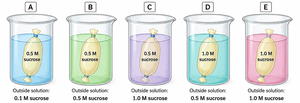
Experiments using dialysis bags or artificial cells in solutions of varying molarity demonstrate osmosis and the effects of tonicity. The direction of water movement and the resulting changes in cell or bag volume can be observed and measured.
Red Blood Cells and Osmosis
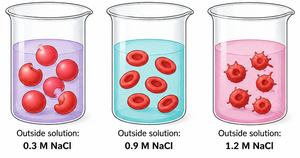
Red blood cells placed in solutions of different NaCl concentrations illustrate the effects of osmosis:
In hypotonic solutions (e.g., 0.3 M NaCl), cells swell and may burst.
In isotonic solutions (e.g., 0.9 M NaCl), cells retain their normal shape.
In hypertonic solutions (e.g., 1.2 M NaCl), cells shrink.
Active Transport
Definition and Mechanism
Active transport is the movement of molecules against their concentration gradient, from low to high concentration, using energy from ATP. This process is essential for maintaining concentration differences across membranes.
Key Point 1: Active transport requires specific transport proteins (pumps).
Key Point 2: The sodium-potassium pump is a classic example, moving Na+ out of and K+ into the cell.
Additional info: The sodium-potassium pump is vital for nerve impulse transmission and muscle contraction.
Bulk Transport: Endocytosis and Exocytosis
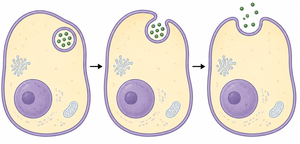
Large particles and macromolecules are transported across membranes via vesicles in processes called endocytosis and exocytosis.
Endocytosis: The cell engulfs material by folding the membrane inward, forming a vesicle. Types include phagocytosis ("cell eating") and pinocytosis ("cell drinking").
Exocytosis: Vesicles fuse with the plasma membrane to release contents outside the cell (e.g., secretion of hormones or neurotransmitters).

Summary Table: Types of Membrane Transport
Type | Energy Required? | Direction | Example |
|---|---|---|---|
Simple Diffusion | No | High to Low | O2, CO2 |
Facilitated Diffusion | No | High to Low | Glucose, Ions |
Osmosis | No | Water: Low to High Solute | Water movement in/out of cells |
Active Transport | Yes (ATP) | Low to High | Sodium-Potassium Pump |
Endocytosis/Exocytosis | Yes (ATP) | Bulk movement | Uptake of large particles, secretion |
