 Indietro
Atoms and Elements: Foundations of Atomic Theory and the Periodic Table
Guida di studio - Note intelligenti
 Appunti personalizzati basati sui tuoi materiali, ampliati con definizioni chiave, esempi e contesto.
Atoms and Elements
Atomic Theory of Matter
The concept of atomic theory proposes that all matter is composed of discrete units called atoms. This foundational idea has evolved through scientific investigation and experimentation.
Definition: Atoms are the smallest units of matter that retain the properties of an element.
Historical Context: Early models suggested atoms were indivisible and indestructible.
Importance: Understanding atomic structure is essential for explaining chemical reactions and properties of substances.
Models of Atoms
Several scientists contributed to the development of atomic models, each refining our understanding of atomic structure.
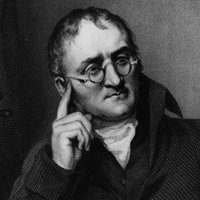
John Dalton: Proposed the first modern atomic theory, stating that atoms are indivisible and that all atoms of a given element are identical.
Key Points:
Matter is neither created nor destroyed (Law of Conservation of Matter).
Compounds are formed by atoms in fixed ratios (Law of Constant Composition).
Dalton's Postulates:
All matter is composed of atoms.
Atoms of a given element are identical.
Atoms of different elements have different masses and properties.
Compounds are formed by combinations of atoms in simple ratios.
Chemical reactions involve rearrangement of atoms.
Thomson Model of the Atom
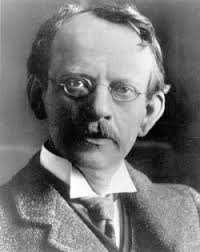
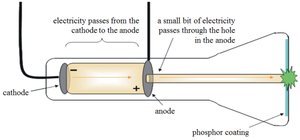
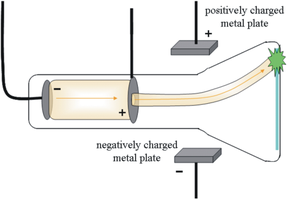
J.J. Thomson's experiments with cathode rays revealed that atoms are divisible and contain smaller particles.
Cathode Ray Experiments: Demonstrated the existence of electrons, negatively charged particles within the atom.
Thomson's Model: Proposed the "plum pudding" model, where electrons are embedded in a positively charged sphere.
Discovery: Atoms are composed of parts; electrons are fundamental subatomic particles.
Rutherford Model of the Atom
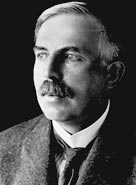
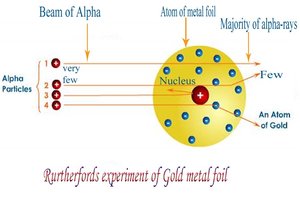
Ernest Rutherford's gold foil experiment provided evidence for a new atomic model, revealing the existence of a dense nucleus.
Gold Foil Experiment: Alpha particles were directed at a thin sheet of gold; most passed through, but some were deflected.
Interpretation: Atoms consist mostly of empty space, with a dense, positively charged nucleus at the center.
Discovery: The nucleus contains protons; electrons orbit the nucleus.
Prediction: The nucleus also contains neutral particles (neutrons, discovered later by James Chadwick).
Comparison of Thomson and Rutherford Models
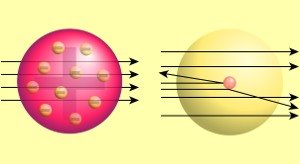
The transition from Thomson's to Rutherford's model marked a significant shift in atomic theory.
Thomson: Atom as a uniform sphere of positive charge with embedded electrons.
Rutherford: Atom with a central nucleus and electrons orbiting around it; most of the atom is empty space.
Subatomic Particles
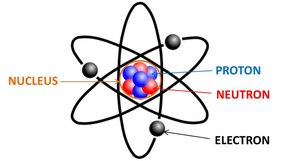
Atoms are composed of three main subatomic particles, each with distinct properties.
Proton (p+): Located in the nucleus, charge +1, mass = 1 amu.
Electron (e-): Located outside the nucleus, charge -1, mass = 1/1867 amu.
Neutron (n0): Located in the nucleus, charge 0, mass = 1 amu.
Basic Definitions in Chemistry
Understanding key terms is essential for beginning chemists.
Quantitative Information: Numerical data, such as melting point or mass.
Qualitative Information: Non-numerical observations, such as color or appearance.
Matter: Anything that has mass and occupies space; composed of atoms.
The Periodic Table: An Introduction
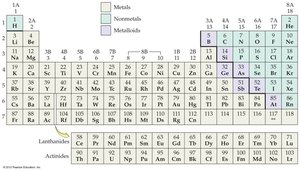
The periodic table organizes elements based on atomic number and properties, serving as a central tool in chemistry.
Rows: Called periods; elements arranged by increasing atomic number.
Columns: Called groups; elements with similar properties.
Atomic Number (Z): Number of protons in the nucleus.
Over 100 elements: 92 occur naturally; 118 known.
Element Names and Symbols: Each element has a unique name and chemical symbol (e.g., Sulfur: S, Boron: B).
Symbol Rules: First letter capitalized, second letter lowercase.
Group Numbering: 1–8 (A or B), international standard 1–18.
Group A: Main group elements; Group B: Transition elements.
Special Groups: Alkali metals (1A), alkaline earth metals (2A), halogens (7A), noble gases (8A).
Inside the Atom: Charges and Structure
Atoms contain charged particles, and their arrangement determines the atom's properties.
Protons: Positive charge (+)
Electrons: Negative charge (-)
Charge Interactions: Like charges repel, unlike charges attract.
Neutral Atom: Number of electrons equals number of protons.
Atomic Number and Mass Number
Atomic number and mass number are fundamental identifiers for elements and their isotopes.
Atomic Number (Z): Number of protons in the nucleus.
Mass Number (A): Sum of protons and neutrons in the nucleus.
Example: Fluorine (F): Z = 9, A = 19; Iron (Fe): Z = 26, A = 56.
Shorthand Notation:
Isotopes
Isotopes are atoms of the same element with different mass numbers due to varying numbers of neutrons.
Definition: Same atomic number, different mass number.
Stability: Most elements have multiple stable isotopes.
Examples: Uranium-238 (), protium, deuterium, tritium.
Atomic Mass (Weight)
The atomic mass of an element is the weighted average of the masses of its naturally occurring isotopes.
Calculation: Multiply each isotope's mass by its relative abundance, then sum the results.
Example: Silicon isotopes:
Si-28: 27.9769 amu, 92.21%
Si-29: 28.9765 amu, 4.69%
Si-30: 29.9737 amu, 3.10%
Calculation:
Electron Dot Structures (Lewis Dot Structures)
Lewis dot structures are used to represent valence electrons, which are crucial for understanding chemical reactivity.
Valence Electrons: Electrons in the outermost shell; determine chemical properties.
Lewis Symbols: Dots placed around element symbols to represent valence electrons.
Group Number: Number of valence electrons equals group number (for main group elements).
Electron Placement: Electrons are placed to maximize distance and are paired after four are drawn.
Periodic Trends
Periodic trends describe how certain properties of elements change across periods and down groups in the periodic table.
Atomic Size: Atomic radii decrease across a period and increase down a group.
Metallic Character: Metals lose electrons easily, are shiny, malleable, and conduct electricity.
Ionization Energy: Energy required to remove an electron; increases across a period, decreases down a group.
Trend | Across Period | Down Group |
|---|---|---|
Atomic Size | Decreases | Increases |
Metallic Character | Decreases | Increases |
Ionization Energy | Increases | Decreases |
