 Indietro
Atoms and Elements: Foundations of Modern Chemistry
Guida di studio - Note intelligenti
 Appunti personalizzati basati sui tuoi materiali, ampliati con definizioni chiave, esempi e contesto.
Atoms and Elements
Experiencing Atoms
Atoms are the fundamental building blocks of matter. Their incredibly small size can be illustrated by imagining that if every atom in a small pebble were enlarged to the size of the pebble itself, the pebble would become larger than Mount Everest. This analogy helps us appreciate the minuscule scale of atoms and their abundance in even the smallest objects.
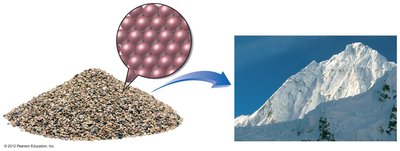
Atoms compose all matter and their properties determine the properties of substances.
An atom is the smallest identifiable unit of an element.
An element is a substance that cannot be broken down into simpler substances by chemical means.
There are about 91 naturally occurring elements, with about 20 more that are synthetic.
The Atomic Theory
Historical Development
The concept of atoms dates back to ancient Greece. Philosophers like Leucippus and Democritus theorized that matter could be divided into tiny, indivisible particles called atomos (atoms). Democritus was the first to propose that matter was composed of these fundamental units.
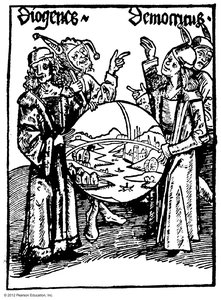
Democritus' ideas were philosophical and not based on experimental evidence.
The term "atom" comes from the Greek word meaning "indivisible."
Dalton's Atomic Theory
In 1808, John Dalton formalized the atomic theory, which became widely accepted due to supporting experimental evidence. Dalton's atomic theory consists of three main postulates:
Each element is composed of tiny, indestructible particles called atoms.
All atoms of a given element have the same mass and properties that distinguish them from atoms of other elements.
Atoms combine in simple, whole-number ratios to form compounds.
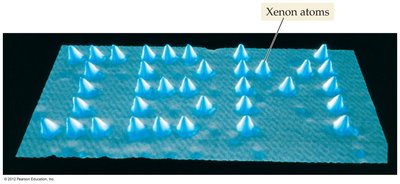
Modern evidence for the atomic theory includes experiments using scanning tunneling microscopes (STM), which can manipulate individual atoms, such as arranging xenon atoms to spell "IBM." This provides direct visualization of atoms.
The Structure of the Atom
Discovery of Subatomic Particles
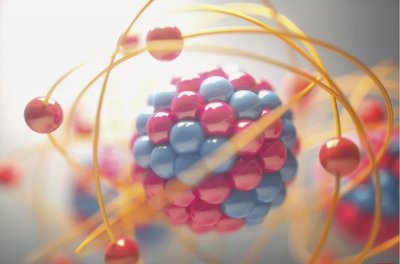
Atoms are not indivisible; they are composed of smaller subatomic particles. J. J. Thomson discovered the electron, a negatively charged particle much smaller than the atom itself. He proposed the "plum pudding" model, where electrons are embedded in a sphere of positive charge.
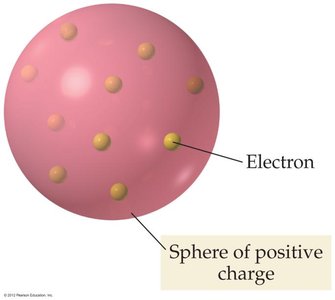
Electrons are negatively charged and present in all atoms.
Atoms must also contain positive charge to balance the electrons.
The Nuclear Model
Ernest Rutherford's gold foil experiment led to the nuclear model of the atom. He concluded that:
Most of the atom's mass and all of its positive charge are concentrated in a small nucleus.
Most of the atom's volume is empty space, with electrons dispersed around the nucleus.
The number of electrons equals the number of protons, making the atom electrically neutral.
Subatomic Particles: Properties
Atoms are composed of three main subatomic particles: protons, neutrons, and electrons. Their properties are summarized below:
Particle | Mass (kg) | Mass (amu) | Charge |
|---|---|---|---|
Proton | 1.67262 × 10⁻²⁷ | 1.0073 | 1+ |
Neutron | 1.67493 × 10⁻²⁷ | 1.0087 | 0 |
Electron | 0.00091 × 10⁻²⁷ | 0.00055 | 1− |
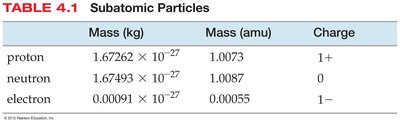
Protons and neutrons have similar masses (about 1 amu), while electrons have much less mass.
Elements and the Periodic Table
Atomic Number and Identity
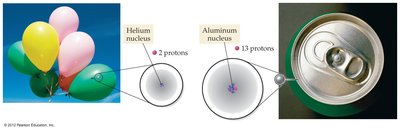
The number of protons in the nucleus of an atom is called the atomic number (Z) and defines the element. For example, helium has 2 protons, and aluminum has 13 protons.
The Periodic Table
The periodic table organizes all known elements by increasing atomic number. Each element's box contains its atomic number, chemical symbol, and atomic mass.
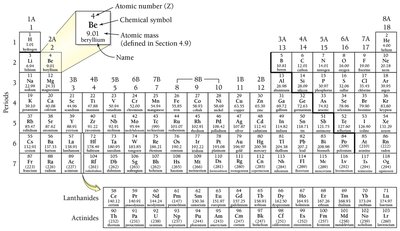
Most chemical symbols are based on English names, but some use Latin or Greek roots (e.g., K for potassium from kalium).
Element names may reflect properties, countries, or scientists.
The Periodic Law and Classification of Elements
Mendeleev and the Periodic Law
Dmitri Mendeleev observed that when elements are arranged by increasing relative mass, certain properties recur periodically. This observation led to the development of the periodic law and the periodic table.
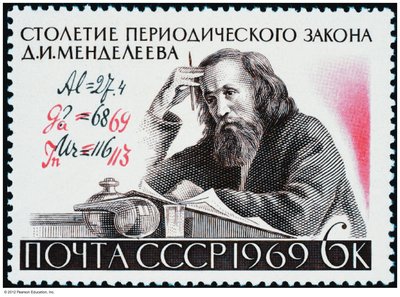
Elements are arranged so that those with similar properties fall into the same columns (groups).
Classification: Metals, Nonmetals, and Metalloids
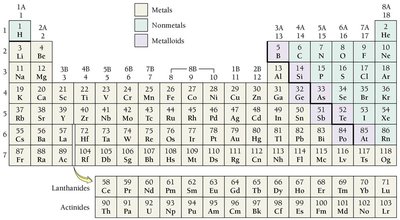
The periodic table can be divided into three broad categories:
Metals: Good conductors, malleable, ductile, shiny, tend to lose electrons.
Nonmetals: Poor conductors, varied states, tend to gain electrons.
Metalloids: Intermediate properties, semiconductors, useful in electronics.
Main Groups and Special Element Families
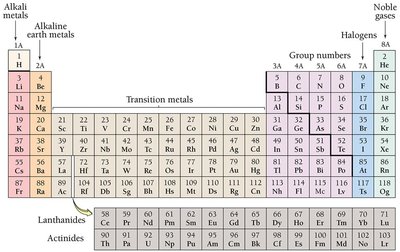
The periodic table highlights several important groups:
Alkali metals (Group 1A): Highly reactive, lose one electron in reactions.
Alkaline earth metals (Group 2A): Reactive, lose two electrons.
Halogens (Group 7A): Very reactive nonmetals, gain one electron.
Noble gases (Group 8A): Inert, rarely form compounds.
Ions and Isotopes
Ions: Losing and Gaining Electrons
Atoms can gain or lose electrons to form ions:
Cations: Positively charged ions formed by losing electrons.
Anions: Negatively charged ions formed by gaining electrons.
The charge of an ion is calculated as:
Isotopes: Atoms with Varying Neutrons
Isotopes are atoms of the same element with different numbers of neutrons. They are represented by their mass number (A), which is the sum of protons and neutrons.
Isotopes are denoted as: or X-A (e.g., Ne-20, Ne-21, Ne-22).
Atomic Mass: Weighted Average
The atomic mass of an element is the weighted average of the masses of its naturally occurring isotopes. It is calculated as:
Summary Table: Subatomic Particles
Particle | Symbol | Relative Mass (amu) | Charge |
|---|---|---|---|
Proton | p+ | 1.0073 | +1 |
Neutron | n0 | 1.0087 | 0 |
Electron | e− | 0.00055 | −1 |
Key Concepts and Skills
Atoms are the smallest units of elements and are composed of protons, neutrons, and electrons.
The periodic table organizes elements by atomic number and groups elements with similar properties.
Metals, nonmetals, and metalloids have distinct physical and chemical properties.
Ions are formed by the loss or gain of electrons; isotopes differ in neutron number.
Atomic mass is a weighted average based on isotopic abundance.
