 Indietro
Atoms, Atomic Theory, and the Periodic Table: Foundations of Chemistry
Guida di studio - Note intelligenti
 Appunti personalizzati basati sui tuoi materiali, ampliati con definizioni chiave, esempi e contesto.
Atoms: The Building Blocks of Matter
What Are Atoms and Why Do We Care?
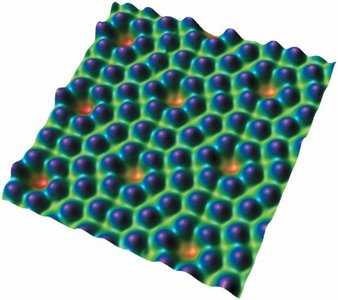
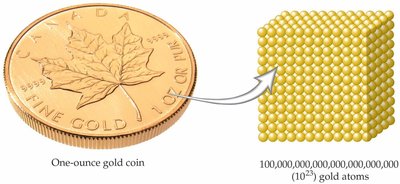
Atoms are the fundamental units of matter, forming the basis for all substances in the universe. Understanding atoms allows us to explain the properties and behaviors of materials, from everyday objects to advanced technologies.
Definition: An atom is the smallest unit of an element that retains the chemical properties of that element.
Importance: The arrangement and interactions of atoms determine the structure and function of all matter.
Example: Silicon atoms are used in integrated circuits, which are essential for modern electronics.
Historical Perspectives on the Nature of Matter
The Greek Philosophers and the Concept of Atoms
Ancient Greek philosophers debated whether matter was continuous or composed of indivisible particles. Their ideas laid the groundwork for modern atomic theory.
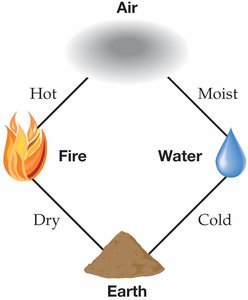
Aristotle (384–322 BCE): Proposed that all matter is continuous and made of four elements: air, water, earth, and fire, connected by four principles (hot, cold, dry, moist).
Leucippus and Democritus (~450 BCE): Introduced the concept of atomos, meaning indivisible particles that make up all matter.
Prevailing View: Aristotle's continuous matter theory dominated for nearly 2000 years due to his influence.
Foundational Laws of Chemistry
The Law of Conservation of Mass
Formulated by Antoine Lavoisier in the 18th century, this law states that matter is neither created nor destroyed during a chemical reaction.
Statement: The total mass of reactants equals the total mass of products in a chemical reaction.
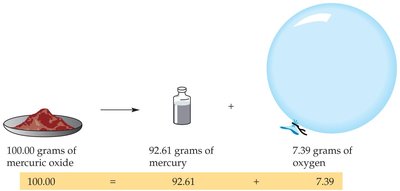
Example: Decomposition of 100.00 g of mercuric oxide yields 92.61 g of mercury and 7.39 g of oxygen, with no loss of mass.
The Law of Definite Proportions
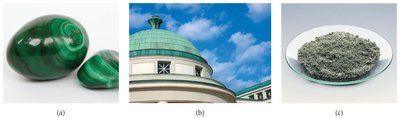
Joseph Proust demonstrated that a chemical compound always contains the same elements in the same proportion by mass, regardless of its source or method of preparation.
Statement: A compound always contains the same elements in fixed, definite proportions by mass.
Example: Basic copper carbonate (Cu2(OH)2CO3) always contains 57.48% copper, 5.43% carbon, 0.91% hydrogen, and 36.18% oxygen.
The Law of Multiple Proportions
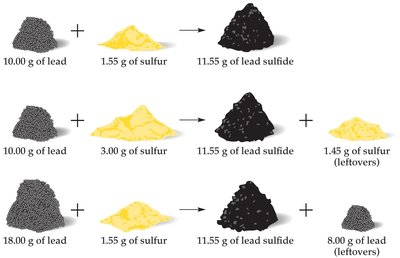
John Dalton observed that elements can combine in different ratios to form different compounds, but the ratios of the masses of one element that combine with a fixed mass of another are simple whole numbers.
Statement: When two elements form more than one compound, the masses of one element that combine with a fixed mass of the other are in ratios of small whole numbers.
Example: Carbon and oxygen form both CO (carbon monoxide) and CO2 (carbon dioxide), with mass ratios of oxygen to carbon of 1.33:1 and 2.66:1, respectively.
Dalton’s Atomic Theory and Its Modifications
Dalton’s Postulates
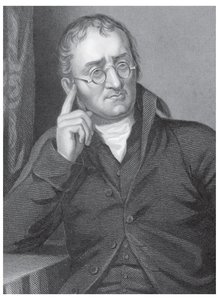
John Dalton’s atomic theory (1803) provided a scientific explanation for the laws of conservation of mass, definite proportions, and multiple proportions.
All matter is composed of extremely small particles called atoms.
All atoms of a given element are identical in mass and properties (later found to be incorrect due to isotopes).
Compounds are formed by the combination of atoms of different elements in fixed ratios.
Chemical reactions involve the rearrangement of atoms; atoms are not created or destroyed in chemical reactions.
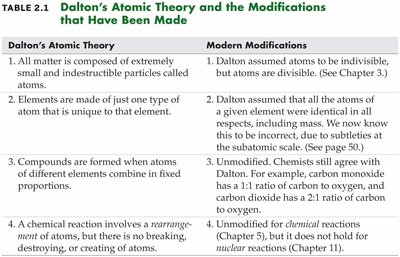
Dalton’s Atomic Theory | Modern Modifications |
|---|---|
Atoms are indivisible and indestructible. | Atoms are divisible into subatomic particles. |
All atoms of an element are identical. | Atoms of an element can have different masses (isotopes). |
Compounds are formed by atoms in fixed ratios. | Still valid for chemical compounds. |
Chemical reactions rearrange atoms. | Valid for chemical, not nuclear, reactions. |
Isotopes
Isotopes are atoms of the same element that have different numbers of neutrons, and thus different masses.
Example: Carbon-12 and Carbon-13 are isotopes of carbon.
Significance: The discovery of isotopes showed that not all atoms of an element are identical.
The Periodic Table: Organization of Elements
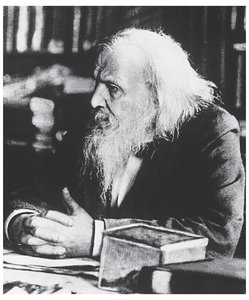
Mendeleev’s Periodic Table
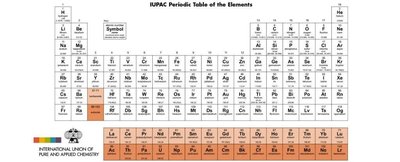
Dmitri Mendeleev arranged elements in order of increasing atomic mass and grouped them by similar chemical properties, leaving gaps for undiscovered elements and predicting their properties.
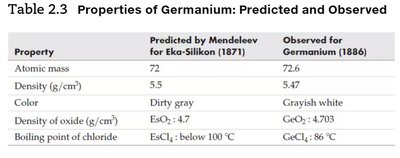
Prediction: Mendeleev accurately predicted the properties of elements such as germanium before they were discovered.
Property | Predicted for Eka-Silicon (1871) | Observed for Germanium (1886) |
|---|---|---|
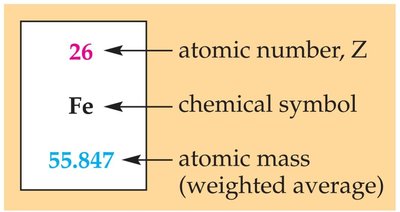
Atomic mass | 72 | 72.6 |
Density (g/cm³) | 5.5 | 5.47 |
Color | Dirty gray | Grayish white |
Density of oxide (g/cm³) | EsO₂: 4.7 | GeO₂: 4.703 |
Boiling point of chloride | EsCl₂: below 100°C | GeCl₂: 86°C |
The Mole and Avogadro’s Number
Definition and Use of the Mole
The mole is a counting unit in chemistry, representing 6.022 × 10²³ particles (Avogadro’s number). It allows chemists to relate the mass of substances to the number of particles present.
Avogadro’s Number: particles per mole.
Molar Mass: The mass in grams of one mole of a substance, numerically equal to the sum of the atomic masses of its elements.
Example: The molar mass of H2O is 18.0 g/mol.
Conversions Involving Moles
Mass to Moles:
Moles to Mass:
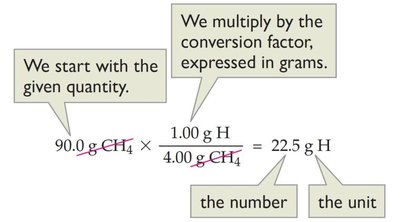
Example Calculation: To find the number of moles in 150.0 g of CO2 (molar mass = 44.01 g/mol):
Atoms vs. Molecules
Distinguishing Atoms from Molecules
An atom is the smallest unit of an element, while a molecule is a group of two or more atoms chemically bonded together. Molecules can be elements (e.g., O2) or compounds (e.g., H2O).
Example: A water molecule (H2O) consists of two hydrogen atoms and one oxygen atom. If separated, the resulting atoms are no longer water.
Green Chemistry
Principles and Applications
Green Chemistry focuses on designing products and processes that minimize the use and generation of hazardous substances. It encourages the replacement of rare or toxic elements with safer, more abundant alternatives.
Example: Replacing mercury-containing fluorescent bulbs with mercury-free alternatives to reduce environmental hazards.
