 Indietro
Chapter 1: The Chemical World – Study Guidance
Guida di studio - Note intelligenti
 Appunti personalizzati basati sui tuoi materiali, ampliati con definizioni chiave, esempi e contesto.
Q1. What are chemicals? Give some examples.
Background
Topic: Matter and Chemicals
This question is testing your understanding of what constitutes a chemical and your ability to recognize examples in everyday life.
Key Terms:
Chemical: A substance with a definite composition, often studied in chemistry.
Matter: Anything that has mass and takes up space.
Step-by-Step Guidance
Think about the definition of a chemical: it is any substance with a specific composition.
Consider examples from daily life, such as water, table salt, or sugar.
Reflect on how these substances are made up of specific molecules or elements.
Try solving on your own before revealing the answer!
Final Answer:
Chemicals are substances with a definite composition. Examples include water (H2O), table salt (NaCl), and carbon dioxide (CO2).
These are all made up of specific molecules and are found throughout our daily lives.
Q2. What do chemists try to do? How do they understand the natural world?
Background
Topic: Goals of Chemistry
This question is testing your understanding of the purpose of chemistry and how chemists approach studying the world.
Key Terms:
Observation: Gathering information about the world.
Experimentation: Testing hypotheses to learn about substances and reactions.
Step-by-Step Guidance
Think about the main goals of chemists: to understand the properties and behaviors of substances.
Consider how chemists use experiments and observations to learn about matter.
Reflect on how chemists use the scientific method to test ideas and develop theories.
Try solving on your own before revealing the answer!
Final Answer:
Chemists try to understand the properties, composition, and changes of matter. They use observation, experimentation, and the scientific method to study the natural world.
This helps them explain how substances interact and why certain reactions occur.
Q3. Define chemistry.
Background
Topic: Definition of Chemistry
This question is testing your ability to provide a clear definition of the science of chemistry.
Key Terms:
Chemistry: The study of matter, its properties, and the changes it undergoes.
Step-by-Step Guidance
Recall the basic definition of chemistry as a science.
Think about what chemistry focuses on: matter, its properties, and transformations.
Consider how chemistry is different from other sciences, such as physics or biology.
Try solving on your own before revealing the answer!
Final Answer:
Chemistry is the study of matter, its properties, how and why substances combine or separate, and how they interact with energy.
It is a central science that helps explain the physical world.
Q4. What are the components of the scientific method?
Background
Topic: Scientific Method
This question is testing your understanding of the steps scientists use to investigate questions and solve problems.
Key Terms:
Scientific Method: A systematic approach to investigation.
Hypothesis: A proposed explanation based on observations.
Experiment: A test to support or refute a hypothesis.
Conclusion: A summary of findings based on data.
Step-by-Step Guidance
Recall the main steps of the scientific method: observation, hypothesis, experiment, analysis, and conclusion.
Think about how each step builds on the previous one to help scientists learn about the world.
Consider how repeating experiments and peer review are important for scientific progress.
Try solving on your own before revealing the answer!
Final Answer:
The components of the scientific method are: observation, hypothesis, experiment, analysis, and conclusion.
Scientists use these steps to systematically investigate questions and solve problems.
Q5. The following graph displays the world population over time. Study the graph and answer the following questions:
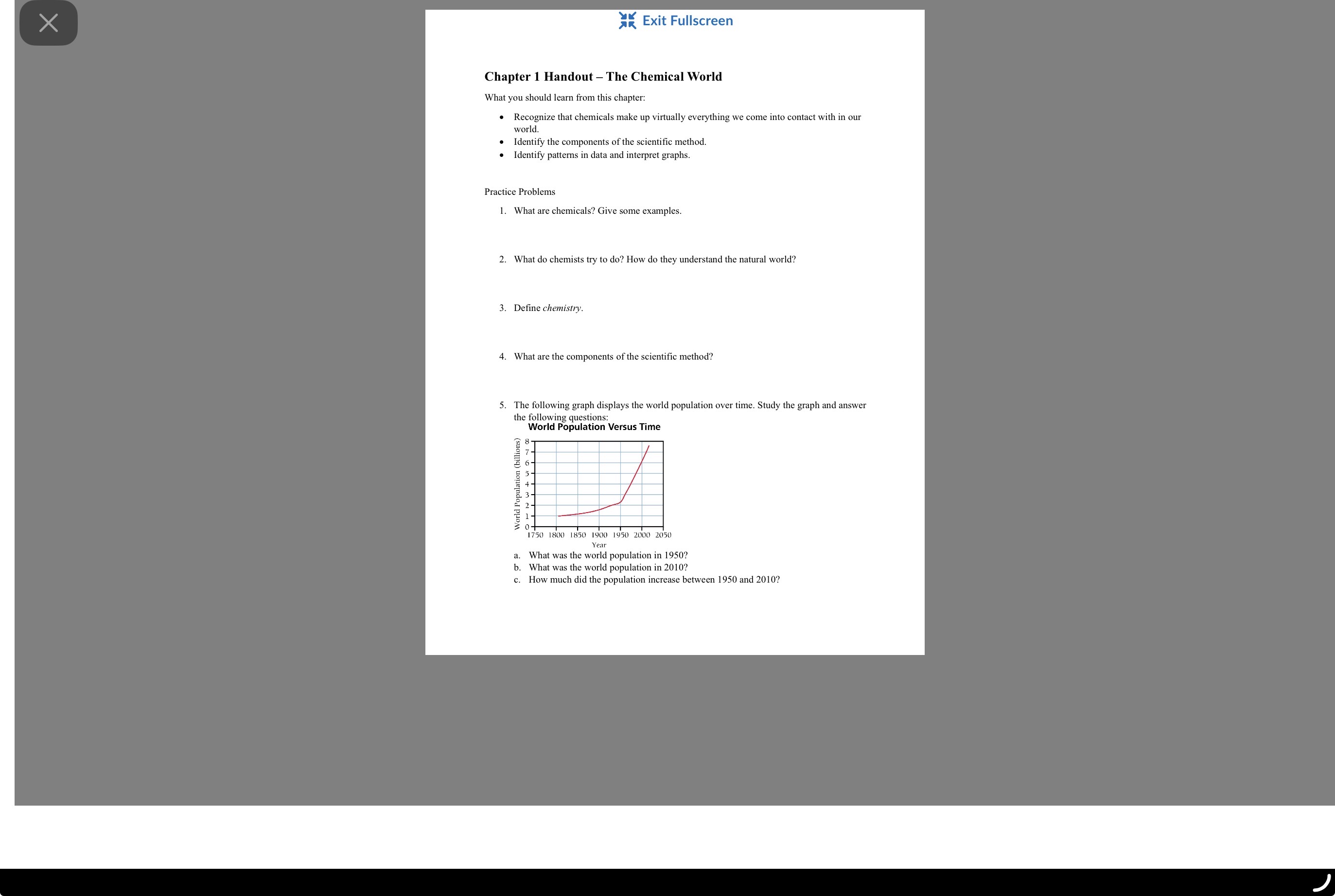
a. What was the world population in 1950?
b. What was the world population in 2010?
c. How much did the population increase between 1950 and 2010?
Background
Topic: Data Interpretation and Graph Analysis
This question is testing your ability to read and interpret data from a graph, a skill important in chemistry for analyzing experimental results.
Key Terms:
Graph: A visual representation of data.
Population: The number of individuals in a group, here referring to world population.
Increase: The difference between two values over time.
Step-by-Step Guidance
Examine the graph and locate the years 1950 and 2010 on the x-axis.
Read the corresponding population values from the y-axis for each year.
To find the increase, subtract the population in 1950 from the population in 2010.
Make sure to use the correct units (billions) as shown on the graph.
Try solving on your own before revealing the answer!
Final Answer:
a. The world population in 1950 was about 2.5 billion.
b. The world population in 2010 was about 7 billion.
c. The population increased by about 4.5 billion between 1950 and 2010.
These values are estimated from the graph, which shows a rapid increase in world population over this period.
