 Indietro
Chapter 2: The Metric System – Structured Study Notes for Introductory Chemistry
Guida di studio - Note intelligenti
 Appunti personalizzati basati sui tuoi materiali, ampliati con definizioni chiave, esempi e contesto.
The Metric System
Introduction to the Metric System
The metric system is a universal measuring system developed for scientific and everyday use. It offers simplicity by using a single base unit for each type of measurement and is widely adopted internationally, especially in scientific contexts.
Origin: Developed by a French committee to replace the English system.
Advantages: Decimal-based, easy conversions, and standardized units.
Base Units: Each physical quantity has a single base unit.
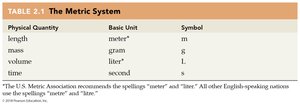
Metric System Basic Units
The metric system uses specific base units for length, mass, volume, and time. These units are fundamental to scientific measurement.
Length: meter (m)
Mass: gram (g)
Volume: liter (L)
Time: second (s)
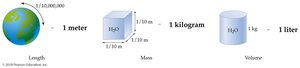
Original Metric Unit Definitions
The original definitions of metric units were based on natural phenomena:
Meter: 1/10,000,000 of the distance from the North Pole to the equator.
Kilogram: Mass of a cube of water measuring 0.1 m on each side.
Liter: Volume of 1 kg of water at 4 °C.
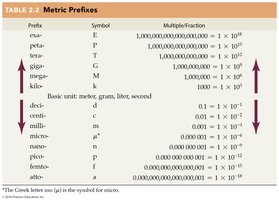
Metric Prefixes and Symbols
Metric Prefixes
Metric prefixes are used to enlarge or reduce the basic units by powers of ten. This allows for easy expression of very large or very small quantities.
Kilo- (k): 1,000 times the base unit
Centi- (c): 1/100 times the base unit
Milli- (m): 1/1,000 times the base unit
Micro- (μ): 1/1,000,000 times the base unit
Nano- (n): 1/1,000,000,000 times the base unit
Metric Symbols
Metric units are abbreviated using symbols. The prefix symbol is placed before the base unit symbol.
Kilometer: km
Milligram: mg
Microliter: μL
Nanosecond: ns
Metric and English Unit Conversions
Unit Equations and Conversion Factors
A unit equation relates two quantities that are equal. Conversion factors are ratios of equivalent quantities used to convert between units.
Example: 1 kilometer = 1000 meters ()
Example: 100 centimeters = 1 meter ()
Unit Analysis Method (Dimensional Analysis)
The unit analysis method is a systematic approach to solving conversion problems by multiplying by unit factors.
Step 1: Write down the unit asked for in the answer.
Step 2: Write down the given value.
Step 3: Apply unit factor(s) to convert the unit in the given value to the unit in the answer.

Metric–Metric Conversion Example
To convert 325 mg to grams:
Given: 325 mg
Conversion factor:
Calculation:
Two-Step Metric–Metric Conversion Example
Convert 125 dL to mL:
Step 1: Convert dL to L ()
Step 2: Convert L to mL ()
Calculation:
Metric–English Conversions
Conversions between metric and English units are common in the United States. Use unit factors to convert between systems.
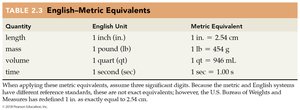
Length: 1 inch = 2.54 cm
Mass: 1 pound = 454 g
Volume: 1 quart = 946 mL
Metric–English Conversion Example
Convert 26.2 miles to kilometers using :
Calculation:

Compound Units and Dimensional Analysis
Compound Units
Compound units are ratios of two units, such as speed (meters per second). Convert one unit at a time using unit factors.
Example: Convert 105 km/h to m/s:
Step 1:
Step 2:
Calculation:
The Percent Concept
Percentages in Chemistry
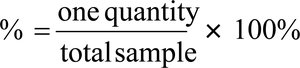
A percent expresses the amount of a single quantity compared to an entire sample. It is a ratio of parts per 100 parts.
Formula:
Percent Calculation Example
Calculate the percent of copper in bronze (79.2 g copper, 10.8 g tin):
Total mass:
Percent copper:
Percent Unit Factors
Percentages can be used as unit factors for conversions. For example, if a rock is 4.70% iron, then 4.70 g iron per 100 g sample.
Calculation:

Volume Concepts
Volume by Calculation
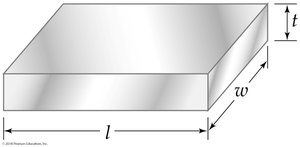
The volume of an object is calculated by multiplying its length, width, and thickness. All measurements must be in the same units.
Formula:
Example:
Volumes of Solids, Liquids, and Gases
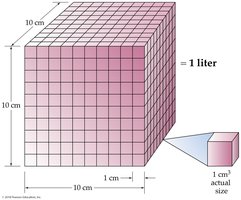
The liter is the basic unit of volume in the metric system. One liter is defined as the volume occupied by a cube that is 10 cm on each side.
1 liter:
1 cm3 = 1 mL
Volume by Displacement
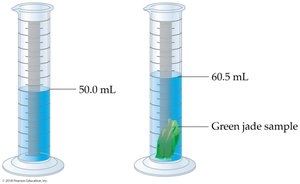
For irregularly shaped solids, volume is determined by measuring the amount of water displaced. This method is also used for gases if they are not soluble in water.
Procedure: Measure initial water volume, add object, measure new volume, subtract to find displaced volume.
Example: Volume of jade = 60.5 mL - 50.0 mL = 10.5 mL
Density Concepts
Definition of Density
Density is a measure of how much mass is contained in a given volume. It is a fundamental property used to identify substances.
Formula:
Units: g/mL (liquids), g/cm3 (solids), g/L (gases)
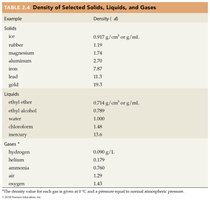
Densities of Common Substances
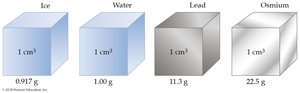
Different substances have characteristic densities. These values are useful for identification and comparison.
Substance | Density |
|---|---|
Ice | 0.917 g/cm3 |
Water | 1.00 g/cm3 |
Lead | 11.3 g/cm3 |
Osmium | 22.5 g/cm3 |
Estimating Density
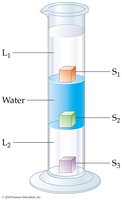
Density can be estimated by comparing objects in a liquid. Objects with lower density than the liquid will float, while those with higher density will sink.
Example: S1 floats above water, S2 sinks below water but floats above L2.
Calculating Density
To calculate density, divide the mass by the volume.
Example: Platinum nugget:
Density as a Unit Factor
Density can be used as a conversion factor between mass and volume.
Example: Battery acid:
Temperature and Heat Concepts
Temperature Scales
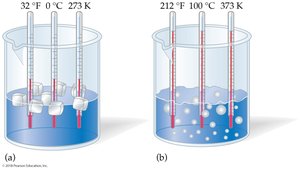
Temperature measures the average kinetic energy of particles. The three main scales are Fahrenheit, Celsius, and Kelvin.
Fahrenheit: Water freezes at 32 °F, boils at 212 °F
Celsius: Water freezes at 0 °C, boils at 100 °C
Kelvin: Water freezes at 273 K, boils at 373 K
Temperature Conversions
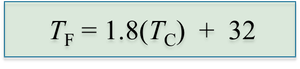
Convert between temperature scales using equations:
Celsius to Kelvin:
Celsius to Fahrenheit:
Heat vs. Temperature
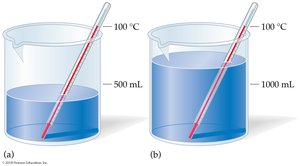
Heat is the total energy of a substance, while temperature is the average energy of its particles. The amount of heat depends on both temperature and mass.
Example: Two beakers at 100 °C, but one has twice the water and thus twice the heat.
Specific Heat
Specific heat is the amount of heat required to raise the temperature of one gram of a substance by one degree Celsius.
Formula:
Units: cal/g°C or J/g°C

Chapter Summary
The metric system uses base units and prefixes for measurement.
Unit factors and dimensional analysis are essential for conversions.
Percentages, volume, density, temperature, and heat are key concepts in scientific measurement.
Specific heat quantifies the energy required to change temperature.
