 Indietro
Chapter 5: Molecules and Compounds – Structured Study Notes
Guida di studio - Note intelligenti
 Appunti personalizzati basati sui tuoi materiali, ampliati con definizioni chiave, esempi e contesto.
Molecules and Compounds
Elements and Compounds: Fundamental Definitions
In chemistry, matter is classified as either elements or compounds. Elements are pure substances consisting of only one type of atom, while compounds are pure substances composed of two or more elements chemically combined in fixed ratios.
Element: A substance that cannot be broken down into simpler substances by chemical means.
Compound: A substance formed when two or more elements are chemically bonded together in a fixed ratio.
Mixture: A combination of two or more substances in variable proportions, not chemically bonded.
Classifying Matter: Pure Substances vs. Mixtures
Matter can be classified based on its composition. Pure substances contain only one type of atom or molecule, while mixtures contain two or more substances combined physically.
Homogeneous Mixture: Uniform composition throughout (e.g., salt water).
Heterogeneous Mixture: Non-uniform composition (e.g., sand and water).
Example: Mixture vs. Compound
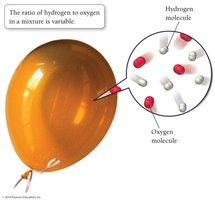
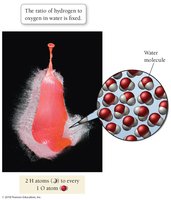
A balloon filled with a mixture of hydrogen and oxygen has variable ratios of each gas, while a balloon filled with water contains molecules with a fixed ratio of hydrogen to oxygen (2:1).
Law of Constant Composition and Law of Multiple Proportions
The Law of Constant Composition states that all samples of a given compound have the same proportions of their constituent elements. The Law of Multiple Proportions states that if two elements form more than one compound, the ratios of the masses of the second element that combine with a fixed mass of the first element are always ratios of small whole numbers.
Law of Constant Composition: Water (H2O) always contains 2 hydrogen atoms for every 1 oxygen atom.
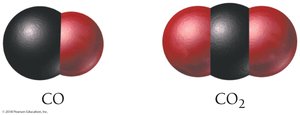
Law of Multiple Proportions: Carbon monoxide (CO) and carbon dioxide (CO2) show different ratios of oxygen to carbon.
Types of Elements
Atomic and Molecular Elements
Elements can exist as single atoms (atomic elements) or as molecules (molecular elements). Molecular elements are composed of two or more atoms bonded together.
Atomic Elements: Exist as individual atoms (e.g., Na, Ne, C).
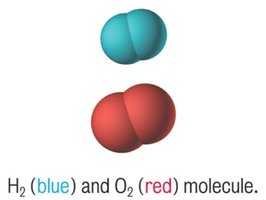
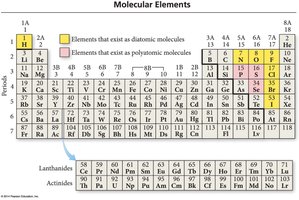
Molecular Elements: Exist as molecules. There are seven diatomic elements: H2, N2, O2, F2, Cl2, Br2, I2. Polyatomic elements include P4 and S8.
Types of Compounds
Molecular Compounds
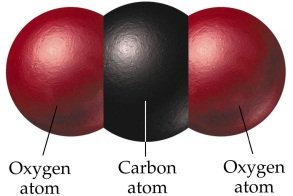
Molecular compounds are usually composed of two or more covalently bonded nonmetals. Their basic units are molecules.
Example: Water (H2O), Carbon dioxide (CO2)
Ionic Compounds
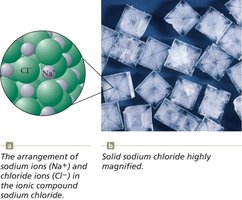
Ionic compounds are composed of cations (positive ions, usually metals or NH4+) and anions (negative ions, usually nonmetals) held together by ionic bonds. The formula reflects the smallest whole-number ratio of ions.
Example: Sodium chloride (NaCl) consists of Na+ and Cl- ions in a 1:1 ratio.
Formula Rule: The sum of the charges of cations and anions must equal zero.
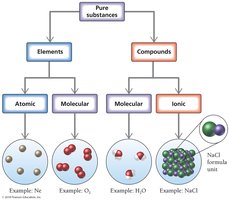
Classification of Pure Substances
Atomic, Molecular, and Ionic Substances
Pure substances can be classified as atomic elements, molecular elements, molecular compounds, or ionic compounds.
Atomic Element: Example: Ne
Molecular Element: Example: O2
Molecular Compound: Example: H2O
Ionic Compound: Example: NaCl
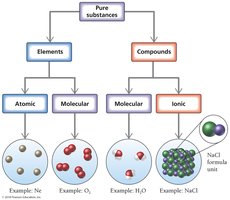
Ions: Cations and Anions
Monatomic and Polyatomic Ions
An ion is an atom or group of atoms with a net positive or negative charge. Monatomic ions contain only one atom, while polyatomic ions contain more than one atom.
Cation: Ion with a positive charge (e.g., Na+, Ca2+)
Anion: Ion with a negative charge (e.g., Cl-, O2-)
Polyatomic Ion: Group of atoms acting as a unit with a charge (e.g., NO3-, NH4+)
Representing Compounds with Polyatomic Ions
When a compound contains groups of atoms acting as a unit, parentheses and subscripts are used to indicate the number of each group.
Example: Mg(NO3)2 contains one Mg2+ ion and two NO3- groups.
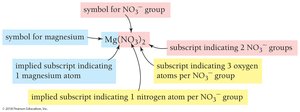
Nomenclature: Naming Compounds
Prefixes for Number of Atoms
Prefixes are used to indicate the number of atoms in molecular compounds:
mono- (1), di- (2), tri- (3), tetra- (4), penta- (5), hexa- (6), hepta- (7), octa- (8), nona- (9), deca- (10)
Naming Binary Molecular Compounds
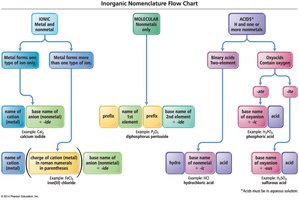
Binary molecular compounds consist of two nonmetals. The naming convention uses prefixes and the suffix -ide.
Example: CO2 is carbon dioxide, SF6 is sulfur hexafluoride, N2O4 is dinitrogen tetroxide.
Exception: If there is only one atom of the first element, the prefix mono- is omitted.

Naming Ionic Compounds
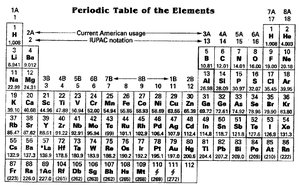
Ionic compounds are named based on the cation and anion present. If the metal has a fixed charge, its name is used directly. If the metal has variable charges (often transition metals), the charge is indicated in Roman numerals.
Type I: Metal with invariant charge (e.g., Na+, Ca2+)
Type II: Metal with variable charge (e.g., Fe2+, Fe3+)

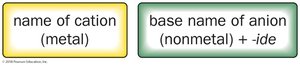
Naming Ionic Compounds Containing Polyatomic Ions
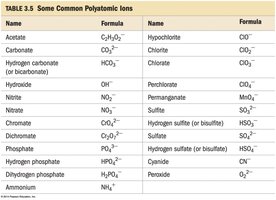
Polyatomic ions are named according to their composition. Oxyanions (anions containing oxygen) use the suffixes -ate and -ite, and sometimes prefixes hypo- and per- for series with more than two ions.
-ate: More oxygen atoms (e.g., NO3- is nitrate)
-ite: Fewer oxygen atoms (e.g., NO2- is nitrite)
hypo-: Less than -ite
per-: More than -ate
Naming Acids
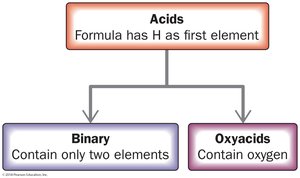
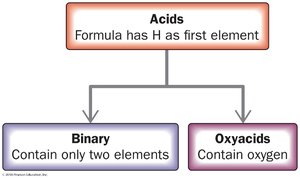
Acids are molecular compounds that release H+ ions when dissolved in water. They are categorized as binary acids (containing hydrogen and a nonmetal) or oxyacids (containing hydrogen, a nonmetal, and oxygen).
Binary Acids: Named as hydro-(element)-ic acid (e.g., HCl(aq): hydrochloric acid)
Oxyacids: Named as (element)-ic or (element)-ous acid, depending on the number of oxygen atoms (e.g., H2SO4: sulfuric acid, H2SO3: sulfurous acid)
Writing Formulas for Ionic Compounds and Acids
Rules for Writing Formulas
When writing formulas for ionic compounds and acids, the sum of the charges of the positive ions (cations) must equal the sum of the charges of the negative ions (anions).
Example: Magnesium oxide (MgO), Potassium sulfide (K2S), Lead(II) nitrate (Pb(NO3)2), Manganese(II) phosphate (Mn3(PO4)2), Hydroiodic acid (HI), Phosphorous acid (H3PO3)
Summary Table: Common Polyatomic Ions
The following table lists some common polyatomic ions, their names, and formulas.
Name | Formula | Name | Formula |
|---|---|---|---|
Acetate | C2H3O2- | Hypochlorite | ClO- |
Carbonate | CO32- | Chlorate | ClO3- |
Hydrogen carbonate | HCO3- | Perchlorate | ClO4- |
Hydroxide | OH- | Permanganate | MnO4- |
Nitrate | NO3- | Sulfate | SO42- |
Chlorite | ClO2- | Sulfite | SO32- |
Dichromate | Cr2O72- | Hydrogen sulfate | HSO4- |
Phosphate | PO43- | Cyanide | CN- |
Hydrogen phosphate | HPO42- | Peroxide | O22- |
Dihydrogen phosphate | H2PO4- | Ammonium | NH4+ |
