 Indietro
Chapter 8: Quantities in Chemical Reactions – Study Guide
Guida di studio - Note intelligenti
 Appunti personalizzati basati sui tuoi materiali, ampliati con definizioni chiave, esempi e contesto.
Quantities in Chemical Reactions
Global Warming and Greenhouse Gases
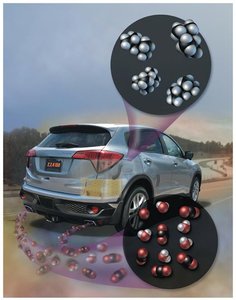
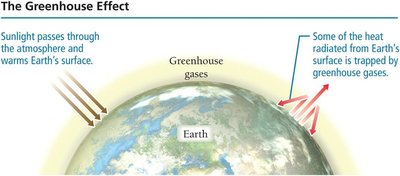
Combustion of fossil fuels, such as octane, produces water and carbon dioxide. Carbon dioxide is a major greenhouse gas implicated in global warming. Greenhouse gases allow sunlight to enter the atmosphere but trap heat, raising Earth's temperature as their concentration increases. Since 1880, atmospheric CO2 levels have risen by 38%, and Earth's average temperature has increased by about 1.9°F.
Stoichiometry: Relationships Between Ingredients
Stoichiometry is the numerical relationship between chemical quantities in a balanced chemical equation. It allows prediction of product amounts based on reactant quantities and vice versa. The balanced equation for octane combustion is:
16 mol CO2 are produced for every 2 mol of octane burned.
Stoichiometry is essential for estimating global CO2 production from fossil fuel consumption.
Mole-to-Mole Conversions
Balanced chemical equations provide a "recipe" for how reactants combine to form products. For example, hydrogen and nitrogen combine to form ammonia:
Ratio: 3 mol H2 : 1 mol N2 : 2 mol NH3
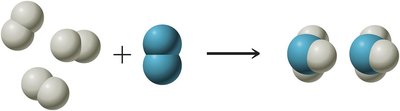
These ratios are used for mole-to-mole conversions between reactants and products.
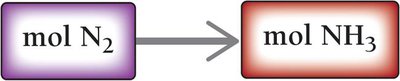
Example: If you have 3 mol of N2 and excess H2, you can make 6 mol of NH3 using the ratio from the balanced equation.
Mass-to-Mass Conversions
Chemical equations provide conversion factors between moles of reactants and products. Mass-to-mass conversions require converting grams to moles, using the balanced equation to relate moles, and then converting moles back to grams.

Example: What mass of CO2 is emitted by an automobile per 5.0 × 10² g pure octane used?
Convert grams of octane to moles
Use the mole ratio from the balanced equation
Convert moles of CO2 to grams
Limiting Reactant, Theoretical Yield, and Percent Yield
In reactions, the limiting reactant is the one that is completely consumed and limits the amount of product formed. The theoretical yield is the maximum amount of product possible based on the limiting reactant. The actual yield is the amount actually produced, and percent yield is calculated as:
Example using a pancake recipe: If flour allows for 15 pancakes, eggs for 25, and baking powder for 40, flour is the limiting reactant and 15 pancakes is the theoretical yield.
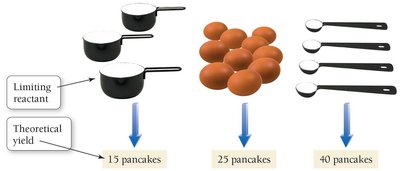
If only 11 pancakes are made, percent yield is .
Limiting Reactant Problems: Moles
To determine the limiting reactant and theoretical yield, compare the amounts of product each reactant can produce. The smallest amount determines the limiting reactant.
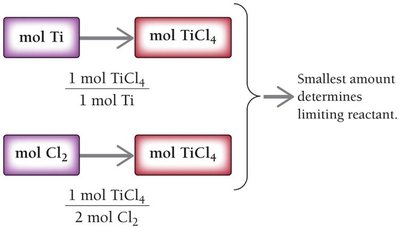
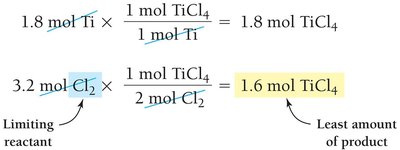
Example: 1.8 mol Ti and 3.2 mol Cl2 produce 1.6 mol TiCl4 (Cl2 is limiting).
Limiting Reactant Problems: Mass
When starting with masses, convert to moles, use the balanced equation, and convert back to mass. The smallest product mass determines the limiting reactant.
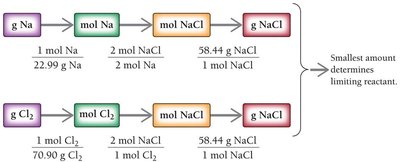
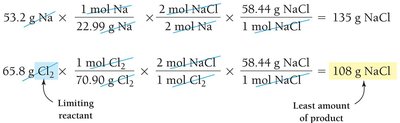
Example: 53.2 g Na and 65.8 g Cl2 produce 108 g NaCl (Cl2 is limiting).
Limiting Reactant Problems: Complex Example
For reactions with multiple reactants, use solution maps to determine limiting reactant, theoretical yield, and percent yield.
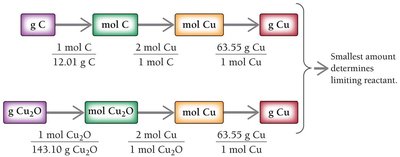
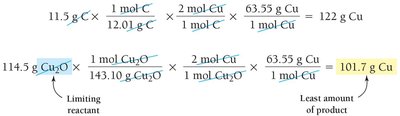
Example: 11.5 g CuO and 114.5 g C produce 101.7 g Cu (CuO is limiting). If actual yield is 87.4 g Cu, percent yield is .
Enthalpy: Heat Evolved or Absorbed in a Reaction
Enthalpy of reaction () quantifies the thermal energy emitted or absorbed under constant pressure. Reactions can be:
Exothermic: Emit thermal energy ( is negative)
Endothermic: Absorb thermal energy ( is positive)
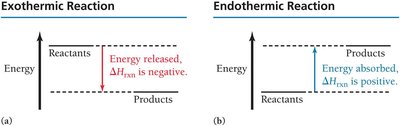
Example: Combustion of methane ( kJ) is exothermic. Formation of nitrogen monoxide ( kJ) is endothermic.
Stoichiometry of Enthalpy ()
The amount of heat exchanged depends on the amount of reactants. is specified for the stoichiometric amounts in the balanced equation.
Example: Combustion of propane (): ; kJ
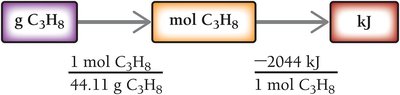
To calculate heat emitted for a given mass of propane, convert grams to moles, then use as a conversion factor.
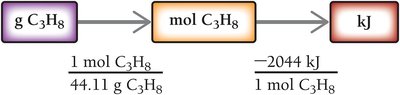
Example: 1.18 × 10⁴ g propane emits 5.47 × 10⁵ kJ.
Everyday Chemistry: Bunsen Burners
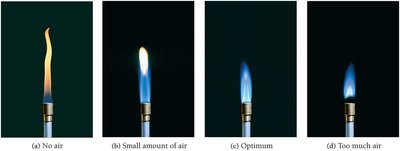
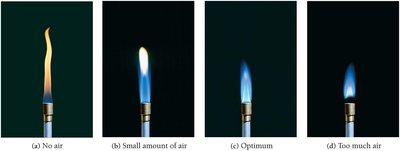
Bunsen burners allow adjustment of air (oxygen) mixed with methane. With no air, the flame is yellow and smoky. Increasing air makes the flame bluer and hotter. Optimum adjustment produces a sharp, inner blue triangle, hot enough to melt glass. Too much air cools or extinguishes the flame.
Review and Learning Objectives
Stoichiometry provides quantitative relationships between reactants and products.
Limiting reactant determines the maximum product yield.
Theoretical yield is based on limiting reactant; actual yield is measured experimentally.
Percent yield quantifies efficiency of a reaction.
Enthalpy of reaction () measures heat released or absorbed.
Be able to perform mole-to-mole and mass-to-mass conversions, calculate limiting reactant, theoretical yield, percent yield, and thermal energy changes.
