Indietro
Chemical Equilibrium: Principles, Constants, and Applications
Guida di studio - Note intelligenti
 Appunti personalizzati basati sui tuoi materiali, ampliati con definizioni chiave, esempi e contesto.
Chemical Equilibrium
The Concept of Equilibrium
Chemical equilibrium occurs when the rates of the forward and reverse reactions in a closed system are equal, resulting in no net change in the concentrations of reactants and products over time. This state is dynamic, meaning that both reactions continue to occur, but their effects cancel each other out.
Dynamic Equilibrium: Both forward and reverse reactions proceed at equal rates.
No Net Change: Concentrations of all species remain constant at equilibrium.
Establishment: Equilibrium can be reached from any starting mixture of reactants and products.
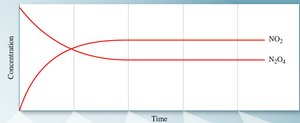
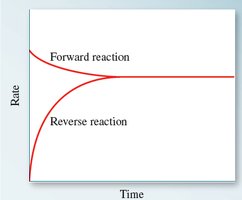
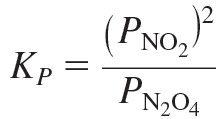
Example: The equilibrium between dinitrogen tetroxide and nitrogen dioxide:
N2O4(g) ↔ 2 NO2(g)
Mathematical Description of Equilibrium
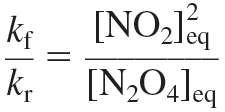
At equilibrium, the rate of the forward reaction equals the rate of the reverse reaction. This can be expressed mathematically as:
Rate Equivalence:
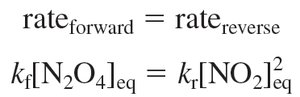
Relationship of Rate Constants:
The Equilibrium Constant (Kc)
Definition and Expression
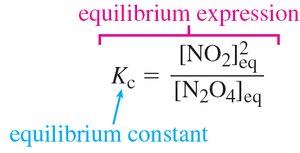
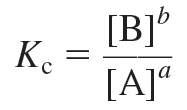
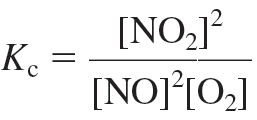
The equilibrium constant, Kc, quantifies the ratio of product to reactant concentrations at equilibrium, each raised to the power of their stoichiometric coefficients. It is unitless and specific to a given reaction at a particular temperature.
General Form:
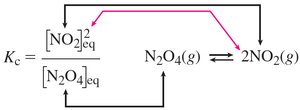
Omission: Pure solids, pure liquids, and solvents (if dilute) are omitted from the equilibrium expression.
Magnitude and Interpretation of Kc
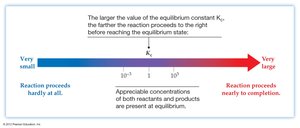
The value of Kc indicates the extent to which a reaction proceeds:
Large Kc (>103): Reaction favors products; proceeds nearly to completion.
Small Kc (<10-3): Reaction favors reactants; little product is formed.
Intermediate Kc: Appreciable amounts of both reactants and products are present at equilibrium.
Writing and Manipulating Equilibrium Expressions
To write an equilibrium expression:
Write the balanced chemical equation.
Place the concentrations of products in the numerator and reactants in the denominator.
Raise each concentration to the power of its coefficient in the equation.
Example: For the reaction aA ↔ bB:
Heterogeneous Equilibria
Equilibria Involving Multiple Phases
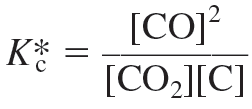
Heterogeneous equilibria involve reactants and products in different phases (e.g., solids, liquids, gases). Only the concentrations of gases and aqueous species appear in the equilibrium expression; pure solids and liquids are omitted.
Example: CaCO3(s) ↔ CaO(s) + CO2(g)
Equilibrium expression:
The Equilibrium Constant Kp for Gaseous Reactions
Equilibrium Expressions Using Partial Pressures
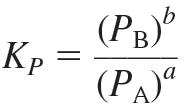
For reactions involving gases, the equilibrium constant can also be expressed in terms of partial pressures (Kp):
Relationship between Kc and Kp:
where Δn is the change in moles of gas (products - reactants), R is the gas constant, and T is temperature in Kelvin.
Manipulating Equilibrium Expressions
Rules for Manipulation
When chemical equations are reversed, multiplied, or added, the equilibrium constant expression changes accordingly:
Reversing the equation: Take the reciprocal of K.
Multiplying the equation by n: Raise K to the nth power.
Adding equations: Multiply the K values.
Reaction Quotient (Q) and Predicting Direction
Definition of Q
The reaction quotient, Q, is calculated using the same form as the equilibrium constant but with initial (not necessarily equilibrium) concentrations. Comparing Q to K predicts the direction the reaction will proceed to reach equilibrium:
Q < K: Reaction proceeds forward (toward products).
Q = K: System is at equilibrium.
Q > K: Reaction proceeds in reverse (toward reactants).

Calculating Equilibrium Concentrations
ICE Tables and Problem Solving Steps
To solve equilibrium problems, use an ICE table (Initial, Change, Equilibrium) to organize data and solve for unknown concentrations:
Write the balanced equation.
Set up the ICE table.
Express equilibrium concentrations in terms of x.
Substitute into the equilibrium expression and solve for x.
Calculate equilibrium concentrations.
Check your results.
Le Châtelier’s Principle
Response to Disturbances
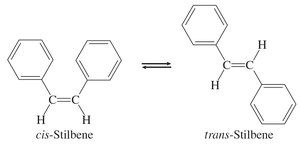
Le Châtelier’s Principle states that if a system at equilibrium is disturbed, it will shift in the direction that minimizes the disturbance. Types of disturbances include changes in concentration, pressure/volume, and temperature.
Concentration: Adding a reactant or product shifts equilibrium to consume the added substance; removing shifts to replenish it.
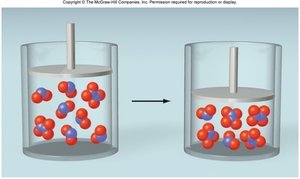
Pressure/Volume: For gaseous equilibria, decreasing volume (increasing pressure) shifts equilibrium toward the side with fewer moles of gas.
Temperature: For endothermic reactions, adding heat shifts equilibrium toward products; for exothermic, toward reactants.

Catalysts and Equilibrium
Effect of Catalysts
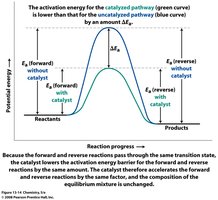
A catalyst increases the rate of both the forward and reverse reactions equally by lowering the activation energy. However, it does not affect the position of equilibrium or the value of the equilibrium constant.