 Indietro
Classifying Substances: Molecules, Ions, and Compounds in Chemistry
Guida di studio - Note intelligenti
 Appunti personalizzati basati sui tuoi materiali, ampliati con definizioni chiave, esempi e contesto.
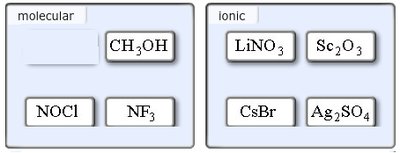
Q1. Classify the following substances as molecular or ionic compounds.
Background
Topic: Types of Chemical Compounds
This question tests your understanding of the difference between molecular (covalent) and ionic compounds. Molecular compounds are formed by nonmetals sharing electrons, while ionic compounds are formed by the transfer of electrons between metals and nonmetals, resulting in ions.
Key Terms and Concepts:
Molecular Compound: Composed of two or more nonmetals bonded covalently.
Ionic Compound: Composed of metals and nonmetals; consists of cations and anions held together by electrostatic forces.
How to Identify: Look for metals (ionic) or only nonmetals (molecular) in the formula.
Step-by-Step Guidance
Examine each formula and identify whether it contains a metal (group 1, 2, or transition metals) or only nonmetals.
If the compound contains only nonmetals (e.g., C, H, O, N, F, Cl), it is molecular.
If the compound contains a metal and a nonmetal, it is ionic.
Sort each formula into the correct category based on your analysis.
Double-check for polyatomic ions (e.g., SO42-, NO3-)—these are often part of ionic compounds.
Try solving on your own before revealing the answer!
Final Answer:
Molecular: CH3OH, NOCl, NF3
Ionic: Ag2SO4, CsBr, Sc2O3, LiNO3
Compounds with only nonmetals are molecular, while those with metals and polyatomic ions are ionic.
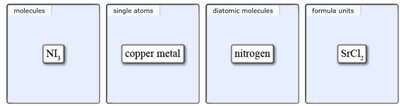
Q2. Match each substance to its basic unit: molecules, single atoms, diatomic molecules, or formula units.
Background
Topic: Chemical Substances and Their Basic Units
This question tests your ability to identify the fundamental particle or unit that makes up a substance: molecules (covalent compounds), single atoms (metals or noble gases), diatomic molecules (elements that exist as pairs), or formula units (ionic compounds).
Key Terms and Concepts:
Molecule: Discrete group of atoms covalently bonded (e.g., CO2, H2O).
Single Atom: Elemental metals or noble gases in their standard state (e.g., copper, helium).
Diatomic Molecule: Elements that naturally exist as two-atom molecules (e.g., N2, O2).
Formula Unit: Simplest ratio of ions in an ionic compound (e.g., NaCl, SrCl2).
Step-by-Step Guidance
Identify if the substance is an element or a compound.
If it is a compound, determine if it is molecular (covalent) or ionic.
If it is an element, check if it is a metal (single atom), a noble gas (single atom), or a diatomic nonmetal (e.g., N2, O2).
Assign each substance to the correct category: molecules, single atoms, diatomic molecules, or formula units.
Try solving on your own before revealing the answer!
Final Answer:
Molecules: NI3
Single atoms: copper metal
Diatomic molecules: nitrogen
Formula units: SrCl2
Molecular compounds are made of molecules, metals are single atoms, diatomic elements exist as pairs, and ionic compounds are represented by formula units.
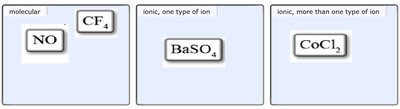
Q3. Classify each compound as molecular, ionic (one type of ion), or ionic (more than one type of ion).
Background
Topic: Types of Compounds and Ion Formation
This question tests your ability to distinguish between molecular compounds, ionic compounds with metals that form only one type of ion (Type I), and ionic compounds with metals that can form more than one type of ion (Type II, usually transition metals).
Key Terms and Concepts:
Molecular Compound: Nonmetals only.
Ionic Compound (Type I): Metal forms only one possible charge (e.g., Group 1, 2 metals).
Ionic Compound (Type II): Metal can form more than one charge (usually transition metals).
Step-by-Step Guidance
Identify the elements in each compound and determine if they are metals or nonmetals.
If only nonmetals are present, the compound is molecular.
If a metal is present, check if it is a Group 1 or 2 metal (Type I) or a transition metal (Type II).
Assign each compound to the correct category based on your analysis.
Try solving on your own before revealing the answer!
Final Answer:
Molecular: NO, CF4
Ionic, one type of ion: BaSO4
Ionic, more than one type of ion: CoCl2
Molecular compounds contain only nonmetals, Type I ionic compounds have metals with a fixed charge, and Type II ionic compounds have metals with variable charges (often transition metals).
