 Indietro
Covalent Bonding, Polarity, and Molecular Structure: Study Notes for Introductory Chemistry
Guida di studio - Note intelligenti
 Appunti personalizzati basati sui tuoi materiali, ampliati con definizioni chiave, esempi e contesto.
Covalent Bonding and Molecular Structure
Covalent Bonds
Covalent bonds are a fundamental type of chemical bond where two atoms share one or more pairs of electrons. This sharing allows each atom to achieve a stable electron configuration, often following the octet rule.
Source of Attraction: The mutual attraction between the positively charged nuclei and the shared negatively charged electrons.
- attraction between nuclei and electrons
Types of Covalent Bonds: Single (one pair shared), double (two pairs shared), and triple (three pairs shared) bonds.
Lone Pairs: Non-bonding pairs of electrons that can influence molecular shape and reactivity.
Example: In a water molecule (H2O), each hydrogen shares one electron with oxygen, forming two single covalent bonds.
Polarity
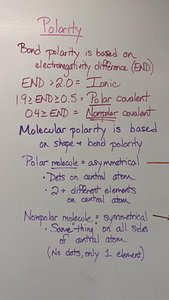
Polarity in chemistry refers to the distribution of electrical charge over the atoms joined by the bond. It is determined by the difference in electronegativity (END) between the bonded atoms.
Bond Polarity: Based on the electronegativity difference (END) between two atoms.
Classification by END:
Electronegativity Difference (END) | Bond Type |
|---|---|
> 2.0 | Ionic |
1.9 ≥ END > 0.5 | Polar Covalent |
0.4 ≥ END | Nonpolar Covalent |
Molecular Polarity: Determined by both bond polarity and molecular geometry (shape).
Polar Molecules: Asymmetrical shape, often with different atoms or lone pairs on the central atom.
Nonpolar Molecules: Symmetrical shape, same thing on all sides of the central atom, or only one element present.
Example: Carbon dioxide (CO2) has polar bonds but is a nonpolar molecule due to its linear, symmetrical shape.
Intermolecular Forces (IMFs)
Intermolecular forces are attractions between molecules, influencing physical properties like boiling and melting points.
Types of IMFs:
London Dispersion Forces: Present in all molecules, especially nonpolar ones; caused by temporary dipoles.
Dipole-Dipole Forces: Occur between polar molecules due to permanent dipoles.
Hydrogen Bonding: A strong type of dipole-dipole force, occurs when H is bonded to N, O, or F.
Source of Attraction: Differences in charge distribution within or between molecules.
Example: Water exhibits hydrogen bonding, leading to its high boiling point compared to similar-sized molecules.
Naming Covalent Compounds
Covalent compounds are named using prefixes to indicate the number of each type of atom present. Special rules apply to avoid awkward combinations.
Prefixes: mono-, di-, tri-, tetra-, penta-, hexa-, hepta-, octa-, nona-, deca-.
Special Rules: Avoid double vowels (e.g., monoxide, not monooxide); the prefix 'mono-' is often omitted for the first element.
Example: CO2 is named carbon dioxide, not monocarbon dioxide.
Lewis Structures
Lewis structures are diagrams that show the arrangement of electrons in a molecule. They help predict molecular shape, reactivity, and formal charge.
Drawing Lewis Structures: Show all valence electrons as dots; shared pairs as lines (bonds).
Resonance Structures: Multiple valid Lewis structures for a molecule; actual structure is a hybrid.
Formal Charge: Used to determine the most stable Lewis structure. Calculated as:
Central Atom: Usually the least electronegative element (except hydrogen).
Example: In nitrate ion (NO3-), resonance structures distribute the negative charge over the three oxygens.
VSEPR Theory and Molecular Shape
Valence Shell Electron Pair Repulsion (VSEPR) theory predicts the 3D shape of molecules based on electron pair repulsion around the central atom.
Basis: Electron pairs (bonding and lone pairs) repel each other and arrange as far apart as possible.
Common Shapes: Linear, trigonal planar, tetrahedral, trigonal bipyramidal, octahedral.
Matching Lewis Structures to Shapes: Use the number of bonding and lone pairs to determine geometry.
Example: Methane (CH4) is tetrahedral; water (H2O) is bent due to two lone pairs on oxygen.
Mass Spectrometry and Structure
Mass spectrometry (Mass Spec) is an analytical technique used to determine the structure of molecules by measuring the mass-to-charge ratio of fragments.
Connecting Peaks to Structure: Peaks correspond to fragments; the highest peak (base peak) is the most abundant fragment.
Central Atom and Connectivity: Analysis of fragments helps deduce which atoms are central and how atoms are connected.
Example: The molecular ion peak (M+) gives the molar mass of the compound.
Summary of Assessment Structure
Multiple Choice: Covalent bonding, polarity, IMFs, VSEPR, Mass Spec.
Polarity Questions: Use electronegativity to determine bond and molecular polarity.
Shapes: Match Lewis structures to molecular shapes.
Free Response: Lewis structures, naming, formulas, explanations of molecular polarity and mass spectrometry.
