Indietro
Exam III Study Guide: Chemical Composition, Reactions, and Stoichiometry
Guida di studio - Note intelligenti
 Appunti personalizzati basati sui tuoi materiali, ampliati con definizioni chiave, esempi e contesto.
Chemical Composition and Calculations
Mass, Moles, and Particles
Understanding the relationships between mass, moles, and particles is fundamental in chemistry. The mole is a standard unit for counting atoms, molecules, or ions, and is linked to mass and number of particles through Avogadro's number.
Mole: One mole contains particles (atoms, molecules, ions, or formula units).
Mass-Mole Conversion: Use the molar mass (g/mol) to convert between mass and moles.
Particle-Mole Conversion: Use Avogadro's number to convert between moles and number of particles.
Formula:
Mass to moles:
Moles to particles:
Example: Calculate the number of molecules in 18 g of water (): Molar mass of $\text{H}_2\text{O}$ = 18 g/mol. mol. molecules.
Mass Percent and Empirical/Molecular Formulas
Mass percent composition describes the percentage by mass of each element in a compound. Empirical formulas show the simplest whole-number ratio of elements, while molecular formulas show the actual number of atoms in a molecule.
Mass Percent Formula:
Empirical Formula: Determined from mass or percent data by converting to moles and finding the simplest ratio.
Molecular Formula: Determined using the empirical formula and molar mass: where
Example: If a compound is 40% C, 6.7% H, and 53.3% O by mass, find its empirical formula. Step 1: Assume 100 g sample: 40 g C, 6.7 g H, 53.3 g O. Step 2: Convert to moles: C: mol H: mol O: mol Step 3: Simplest ratio: C:H:O = 1:2:1 → Empirical formula = CH2O
Unit Conversions
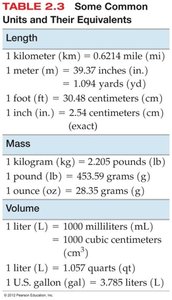
Unit conversions are essential for quantitative chemistry. Common conversions involve length, mass, and volume.
Length: 1 meter = 39.37 inches; 1 kilometer = 0.6214 mile
Mass: 1 kilogram = 2.205 pounds; 1 pound = 453.59 grams
Volume: 1 liter = 1000 milliliters; 1 U.S. gallon = 3.785 liters
Chemical Reactions and Equations
Balancing Chemical Equations
Balancing chemical equations ensures the conservation of mass and atoms. Each side of the equation must have the same number of atoms for each element.
Steps:
Write the unbalanced equation.
Count atoms of each element on both sides.
Add coefficients to balance atoms.
Check your work.
Example:
Solubility Rules
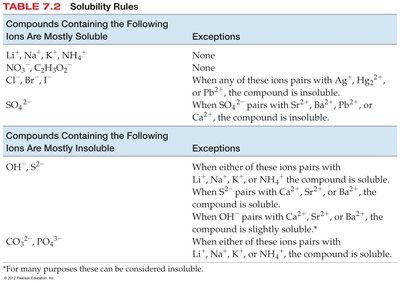
Solubility rules help predict whether an ionic compound will dissolve in water. These rules are based on the ions present in the compound.
Mostly Soluble Ions: Li+, Na+, K+, NH4+, NO3-, C2H3O2-, Cl-, Br-, I-, SO42-
Exceptions: Ag+, Hg22+, Pb2+ with Cl-, Br-, I-; Sr2+, Ba2+, Pb2+, Ca2+ with SO42-
Mostly Insoluble Ions: OH-, S2-, CO32-, PO43-
Exceptions: Li+, Na+, K+, NH4+ make these soluble; Ca2+, Sr2+, Ba2+ with S2- are soluble; Ca2+, Sr2+, Ba2+ with OH- are slightly soluble.
Electrolytes and Non-Electrolytes
Electrolytes are substances that dissociate into ions when dissolved in water, conducting electricity. Non-electrolytes do not dissociate and do not conduct electricity.
Electrolytes: Ionic compounds, strong acids, and strong bases.
Non-Electrolytes: Most molecular compounds (except acids and bases).
Example: NaCl is an electrolyte; sugar (C12H22O11) is a non-electrolyte.
Types of Chemical Reactions
Chemical reactions are classified based on the rearrangement of atoms and molecules. Common types include combination, decomposition, single replacement, and double replacement.
Combination (Synthesis): Two or more substances combine to form one product.
Decomposition: One substance breaks down into two or more products.
Single Replacement: One element replaces another in a compound.
Double Replacement: Two compounds exchange ions to form new compounds.
Example: Combustion of hydrocarbons produces CO2 and H2O.
Writing Complete, Ionic, and Net Ionic Equations
For reactions in aqueous solution, equations can be written in three forms: complete, ionic, and net ionic. Net ionic equations show only the species that change during the reaction.
Complete Equation: Shows all reactants and products.
Ionic Equation: Shows all strong electrolytes as ions.
Net Ionic Equation: Shows only the ions and molecules directly involved in the reaction.
Example: Precipitation reaction between AgNO3 and NaCl: Complete: Ionic: Net Ionic:
Strong Acids
Strong acids completely dissociate in water. The six strong acids are:
HCl (hydrochloric acid)
HBr (hydrobromic acid)
HI (hydroiodic acid)
HNO3 (nitric acid)
HClO4 (perchloric acid)
H2SO4 (sulfuric acid)
Stoichiometry and Reaction Quantities
Stoichiometry Calculations
Stoichiometry involves calculating the quantities of reactants and products in a chemical reaction using balanced equations.
Steps:
Write the balanced equation.
Convert given quantities to moles.
Use mole ratios from the equation to find moles of desired substance.
Convert moles to mass or particles as needed.
Example: How many grams of CO2 are produced from 10 g of C3H8?
Balanced equation:
Moles C3H8: mol
Mole ratio: 1 mol C3H8 produces 3 mol CO2
Moles CO2: mol
Mass CO2: g
Limiting Reactant, Theoretical Yield, and Percent Yield
The limiting reactant is the reactant that is completely consumed first, limiting the amount of product formed. Theoretical yield is the maximum amount of product possible, and percent yield measures the efficiency of the reaction.
Limiting Reactant: Compare mole ratios to determine which reactant is used up first.
Theoretical Yield: Calculated from the limiting reactant.
Percent Yield Formula:
Example: If the theoretical yield is 30 g and the actual yield is 25 g, percent yield is
Enthalpy Calculations
Enthalpy () is the heat content of a system. In chemical reactions, enthalpy changes indicate whether a reaction is exothermic (releases heat) or endothermic (absorbs heat).
Formula:
Example: If a reaction releases 100 kJ, kJ (exothermic).
Reference Tables and Tools
Periodic Table of the Elements
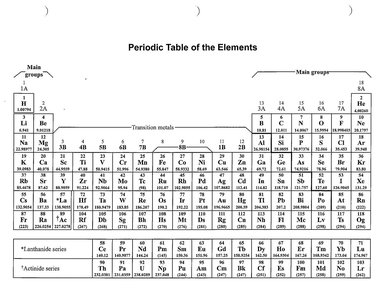
The periodic table organizes elements by atomic number and properties. It is essential for determining element symbols, atomic masses, and group classifications.
Solubility Table
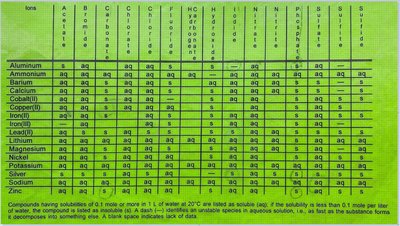
Solubility tables provide detailed information about the solubility of various ionic compounds in water, helping to predict precipitation reactions.