 Indietro
Honors Chemistry Syllabus and Course Structure – Study Guide
Guida di studio - Note intelligenti
 Appunti personalizzati basati sui tuoi materiali, ampliati con definizioni chiave, esempi e contesto.
Course Overview
Introduction to Chemistry
Chemistry is the scientific study of the composition, structure, properties, and changes of matter. This course introduces students to foundational concepts in chemistry, laboratory safety, and scientific inquiry, preparing them for further studies in the chemical sciences.
Definition: Chemistry explores substances, their properties, how they interact, combine, and change to form new substances.
Applications: Chemistry is essential in fields such as medicine, engineering, environmental science, and materials science.
Course Structure and Major Topics
Semester One Topics
Unit 1: Safety, Density, Conservation of Mass
Unit 2: Gases – Combined Gas Law, Particle Motion/Relationships
Unit 3: Matter and Energy – Thermochemistry, Calorimetry, Energy Change
Unit 4: Atoms & Periodic Table – Parts of Atom, Periodic Trends, Light
Unit 5: Molecules & Compounds – Forming & Naming Ionic & Covalent Compounds
Unit 6: Moles – Molar Mass & Particle Conversions, Molarity, Dilutions
Semester Two Topics
Unit 7: Chemical Reactions – Equations, Types of Reactions, Predictions
Unit 8: Stoichiometry – Mole Ratios, Percent Yield, Limiting Reagents
Unit 9: Chemical Bonding – Lewis Structures, VSEPR Shapes, Intermolecular Forces
Unit 10: Molarity – Solutions, Concentrations, Colligative Properties
Unit 11: Acids & Bases – Molarity, Dilutions, pH, Arrhenius/Bronsted-Lowry Acids
Unit 12: Kinetics – Reaction Rates, Equilibrium, Reversibility
Unit 13: Nuclear Chemistry – Radioactive Particles, Processes, Decay
Unit 14: Climate Chemistry – Atmospheric Gases, Ocean pH, Greenhouse Effect
Additional info: These topics align closely with standard introductory chemistry curricula, covering foundational concepts and laboratory skills.
Course Materials and Expectations
Required Materials
Notebook/Journal
Pocket Folder
Charged Chromebook
Pen or Pencil
Calculator
2-3 Expo Markers
Student Responsibilities
Complete all homework and classwork assignments on time.
Participate actively in class discussions and group work.
Follow laboratory safety protocols at all times.
Make up missed work promptly after excused absences.
Maintain academic integrity and avoid plagiarism or cheating.
Grading and Assessment
Point Distribution
Category | Percentage |
|---|---|
Assessments (Tests & Quizzes) | 50% |
Coursework (Classwork & Homework) | 30% |
Final Exam | 20% |
All work should be neat, calculations clearly shown, and answers fully explained.
Laboratory Safety
Essential Safety Practices
Wear closed-toed shoes, long pants, lab goggles, and a lab apron during laboratory activities.
Follow all safety contract provisions strictly.
Failure to wear proper attire results in non-participation and a zero for the assignment.
Academic Integrity and AI Policy
Academic Honesty
Cheating, plagiarism, and unauthorized use of AI tools are strictly prohibited.
Examples of academic dishonesty include copying work, sharing answers, and using AI outside approved guidelines.
Consequences for dishonesty range from a zero on the assignment to course failure and disciplinary action.
AI Tools in the Classroom
AI may be used only when explicitly approved by the teacher for educational purposes.
Students must critically evaluate AI-generated output for validity and reliability.
Unauthorized use of AI is considered academic dishonesty.
Attendance and Schoolwide Expectations
Attendance Policy
Consistent attendance is essential for academic success.
Students are allowed 9 excused absences without a doctor's note; further absences may be unexcused.
Chronic truancy or excessive absences may result in disciplinary action or withdrawal from school.
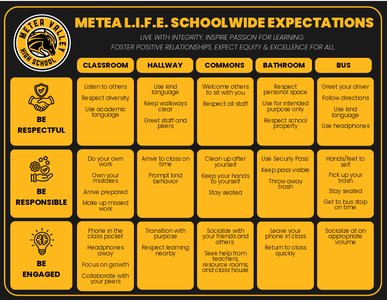
Behavioral Expectations
Be Respectful: Listen to others, use kind language, and respect property.
Be Responsible: Be on time, prepared, and make wise decisions.
Be Engaged: Participate actively, focus on growth, and collaborate with peers.
Electronic Devices Policy
Cell phones and personal devices must be stored in designated holders during class.
Chromebooks are used only when instructed by the teacher.
Violations of the device policy result in escalating consequences, including parent contact and dean referral.
Summary Table: Major Chemistry Units
Unit | Main Topics |
|---|---|
1 | Safety, Density, Conservation of Mass |
2 | Gases, Combined Gas Law, Particle Motion |
3 | Matter & Energy, Thermochemistry, Calorimetry |
4 | Atoms, Periodic Table, Periodic Trends, Light |
5 | Molecules & Compounds, Ionic & Covalent Naming |
6 | Moles, Molar Mass, Molarity, Dilutions |
7 | Chemical Reactions, Equations, Types, Predictions |
8 | Stoichiometry, Mole Ratios, Percent Yield, Limiting Reagents |
9 | Chemical Bonding, Lewis Structures, VSEPR, Intermolecular Forces |
10 | Solutions, Concentrations, Colligative Properties |
11 | Acids & Bases, pH, Arrhenius/B-L Definitions |
12 | Kinetics, Reaction Rates, Equilibrium |
13 | Nuclear Chemistry, Radioactivity, Decay |
14 | Climate Chemistry, Atmospheric Gases, Ocean pH, Greenhouse Effect |
Additional info: This syllabus provides a comprehensive overview of the topics and expectations for an introductory chemistry course, aligning with standard college-level introductory chemistry curricula.
