 Indietro
Introduction to Chemistry: Foundations, Methods, and Measurement
Guida di studio - Note intelligenti
 Appunti personalizzati basati sui tuoi materiali, ampliati con definizioni chiave, esempi e contesto.
Chapter 1: Introduction to Chemistry
Evolution of Chemistry
The origins of chemistry can be traced back to ancient civilizations, particularly the Greeks, who believed that all matter was composed of four basic elements: air, fire, water, and earth. This early model attempted to explain the diversity of substances in the natural world as combinations of these elements.
Air: Associated with gases and the atmosphere.
Fire: Represented energy and transformation.
Water: Linked to liquids and fluidity.
Earth: Connected to solids and stability.
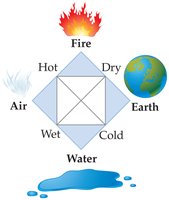
Additional info: Modern chemistry has since replaced this model with atomic theory, but the four-element concept illustrates early attempts to classify matter.
Modern Chemistry
Chemistry is the science that studies the composition, structure, properties, and changes of matter. It is often called the "central science" because it connects physical sciences with life and applied sciences.
Organic chemistry: Study of carbon-containing compounds.
Inorganic chemistry: Study of substances not classified as organic.
Biochemistry: Study of chemical processes in living organisms.
Green chemistry: Focuses on designing products and processes that minimize environmental impact.
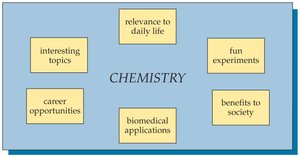
Applications: Chemistry is essential for understanding biological processes, developing new materials, and addressing environmental challenges.
The Scientific Method
Definition and Steps
The scientific method is a systematic approach to investigating natural phenomena. It involves making observations, forming hypotheses, conducting experiments, analyzing data, and drawing conclusions. This method ensures that scientific knowledge is based on evidence and logical reasoning.
Observation: Gathering information about a phenomenon.
Question: Asking why or how something occurs.
Hypothesis: Proposing a tentative explanation that can be tested.
Experiment: Testing the hypothesis under controlled conditions.
Analysis: Interpreting the results of the experiment.
Conclusion: Determining whether the hypothesis is supported or refuted.
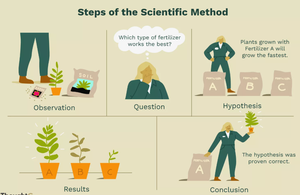
Example: If a plant is not growing well, a hypothesis might be that it needs fertilizer. By testing different fertilizers and observing growth, one can analyze results and draw conclusions about the hypothesis.
Theory vs. Law
In science, a theory is a well-substantiated explanation of some aspect of the natural world, while a law is a statement that describes a consistent relationship observed in nature.
Theory: Explains why phenomena occur (e.g., kinetic theory of gases).
Law: Describes what happens, often mathematically (e.g., Boyle's Law).
A law does not become a theory, and a theory does not become a law; they serve different purposes in science.
Example: Boyle's Law and Kinetic Theory
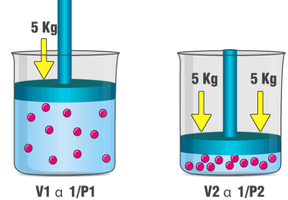
Boyle's Law states that at constant temperature, the pressure of a gas is inversely proportional to its volume:
The kinetic theory of gases explains this law by describing how gas particles move and collide with container walls. When volume decreases, collisions increase, raising pressure.
Measurement in Chemistry
Significant Figures
Significant figures are all the digits in a measurement that are known with certainty plus one final digit that is estimated. They reflect the precision of a measurement.
All nonzero digits are significant (e.g., 243.3 has 4 significant figures).
Zeroes between nonzero digits are significant (e.g., 1002 has 4 significant figures).
Leading zeroes are not significant (e.g., 0.0023 has 2 significant figures).
Trailing zeroes are significant if there is a decimal point (e.g., 1.030 has 4 significant figures).
Rounding rules:
If the digit to be dropped is less than 5, drop it (e.g., 62.312 → 62.3).
If the digit to be dropped is greater than 5, increase the last retained digit by 1 (e.g., 62.782 → 62.8).
If the digit to be dropped is 5 followed by nonzero digits, increase the last retained digit by 1 (e.g., 62.556 → 62.6).
If the digit to be dropped is exactly 5, increase the last retained digit by 1 if it is odd, or leave it if even (e.g., 62.550 → 62.6; 62.450 → 62.4).
Significant Figures in Calculations
Addition/Subtraction: The answer is rounded to the least significant decimal place among the numbers used.
Multiplication/Division: The answer is rounded to the same number of significant figures as the measurement with the fewest significant figures.
Example (Multiplication): (rounded to 3 significant figures)
Example (Addition): (rounded to the ones place)
Additional info: Always carry extra digits through calculations and round only at the end to avoid rounding errors.
Scientific Notation
Scientific notation is a method for expressing very large or very small numbers in the form:
where a (the coefficient) is at least 1 but less than 10, and n is an integer (the power of 10).
Move the decimal point to create a coefficient between 1 and 10.
Count the number of places moved to determine the exponent.
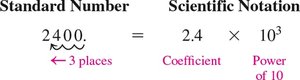
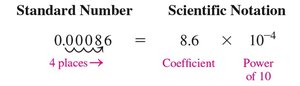
Examples:
Standard Format | Scientific Notation |
|---|---|
12,800,000 m | m |
68 kg | kg |
0.0000003 cm | cm |
Significant figures in scientific notation: Only the digits in the coefficient are counted as significant figures.
