 Indietro
Matter and Energy: Classification of Matter
Guida di studio - Note intelligenti
 Appunti personalizzati basati sui tuoi materiali, ampliati con definizioni chiave, esempi e contesto.
Chapter 3: Matter and Energy
Classification of Matter
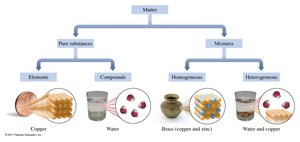
Matter is the material that makes up all things in the universe. It is anything that has mass and occupies space. Understanding how matter is classified is fundamental to chemistry, as it helps us distinguish between different types of substances and mixtures.
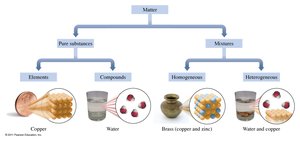
Pure Substances
A pure substance is a type of matter with a fixed or definite composition. Pure substances can be further classified as elements or compounds.
Element: A substance composed of only one type of atom. Examples include copper (Cu), lead (Pb), and aluminum (Al). If a material is listed on the periodic table, it is an element.
Compound: A substance composed of two or more elements combined in a fixed ratio. Examples include salt (NaCl), table sugar (C12H22O11), and water (H2O).
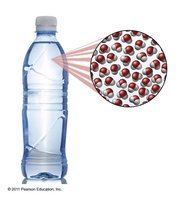
Example: The compound water consists of H2O molecules, each made from two hydrogen atoms and one oxygen atom.
Compounds and Their Elements
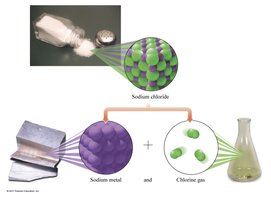
Compounds are formed from elements in specific ratios. For example, table salt (NaCl) is a compound containing the elements sodium and chlorine. Compounds can be broken down into their constituent elements by chemical means.
Decomposition: The process of breaking down a compound into its elements. For example, decomposing NaCl produces sodium metal and chlorine gas.
Mixtures
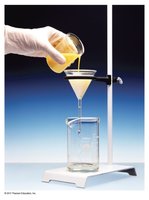
A mixture is a type of matter that consists of two or more substances that are physically mixed, but not chemically combined. Mixtures can be separated by physical methods such as filtration, distillation, or evaporation.
Physical separation: Methods like filtration can separate components of a mixture based on their physical properties.
Types of Mixtures
Mixtures are classified as homogeneous or heterogeneous based on their composition.
Homogeneous Mixtures
In a homogeneous mixture, the composition is uniform throughout the sample, and the different parts of the mixture are not distinguishable. Examples include brass (a mixture of copper and zinc) and sugar water.
Heterogeneous Mixtures
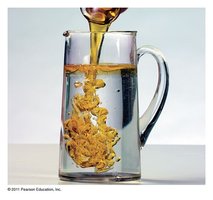
In a heterogeneous mixture, the composition varies from one part of the mixture to another, and the different parts are visible. Examples include pasta and tomato sauce, peach pie, and oil in water.
Summary Table: Classification of Matter
Type | Description | Examples |
|---|---|---|
Element | One type of atom | Copper (Cu), Helium (He) |
Compound | Two or more elements in a fixed ratio | Water (H2O), Salt (NaCl) |
Homogeneous Mixture | Uniform composition throughout | Brass, Sugar water, Air |
Heterogeneous Mixture | Non-uniform composition, visible parts | Pasta and tomato sauce, Peach pie, Oil and water |
Key Terms and Definitions
Matter: Anything that has mass and occupies space.
Pure Substance: Matter with a fixed composition; includes elements and compounds.
Element: A pure substance made of only one kind of atom.
Compound: A pure substance made of two or more elements chemically combined in a fixed ratio.
Mixture: Matter composed of two or more substances physically mixed, not chemically combined.
Homogeneous Mixture: A mixture with uniform composition throughout.
Heterogeneous Mixture: A mixture with non-uniform composition and visible parts.
Examples and Applications
Element: Helium in a balloon is a pure element.
Compound: Water in a bottle is a compound made of hydrogen and oxygen.
Homogeneous Mixture: Air is a homogeneous mixture of gases.
Heterogeneous Mixture: Salad is a heterogeneous mixture of vegetables.
Formulas and Equations
Water:
Salt:
Table Sugar:
Additional info: Academic context was added to clarify definitions, provide examples, and expand explanations for completeness and exam preparation.
