 Indietro
Reactions in Aqueous Solutions and Solution Chemistry
Guida di studio - Note intelligenti
 Appunti personalizzati basati sui tuoi materiali, ampliati con definizioni chiave, esempi e contesto.
Types of Matter
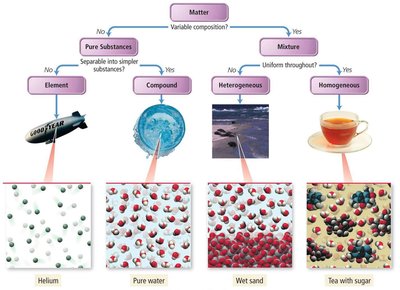
Classification of Matter
Matter can be classified based on its composition and uniformity. Understanding these classifications is fundamental to chemistry, as it helps in identifying substances and predicting their behavior in chemical reactions.
Pure Substances: Have a constant composition and distinct chemical properties. They can be further divided into:
Elements: Substances that cannot be broken down into simpler substances by chemical means (e.g., Helium).
Compounds: Substances composed of two or more elements chemically combined in fixed proportions (e.g., Pure water).
Mixtures: Combinations of two or more substances where each retains its own properties. Mixtures can be:
Heterogeneous: Not uniform throughout (e.g., Wet sand).
Homogeneous (Solutions): Uniform throughout (e.g., Tea with sugar).
Solutions
Definition and Examples
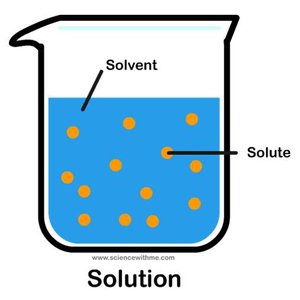
A solution is a homogeneous mixture of two or more substances. The composition of solutions can vary, and they are characterized by the presence of a solute dissolved in a solvent. For example, the salinity of water in different lakes and seas varies due to different amounts of dissolved salts.
Solute: The substance that is dissolved (e.g., salt).
Solvent: The substance that does the dissolving (e.g., water).
Homogeneous mixture: The composition is uniform throughout the sample.
Concentration of Solutions
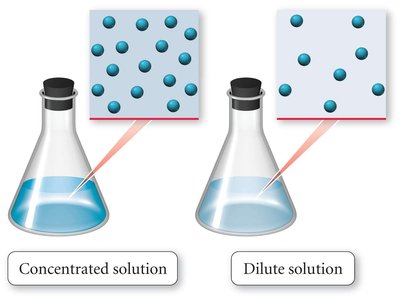
The concentration of a solution describes the amount of solute present in a given quantity of solvent or solution. It can be expressed in several ways:
Mass Percent (m/m):
Volume Percent (v/v):
Molarity (M):
Preparation of Solutions
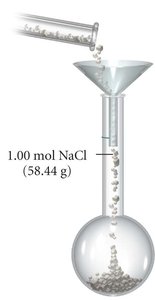
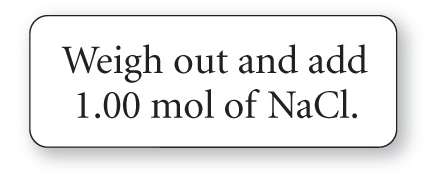
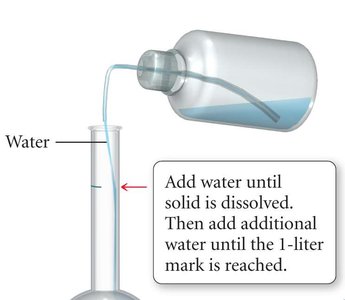
To prepare a solution of a specific molarity, a known amount of solute is dissolved in a solvent and diluted to a precise final volume. For example, to make 1.00 L of a 1.00 M NaCl solution, dissolve 58.44 g of NaCl in water and dilute to 1.00 L.
Weigh out the required mass of solute.
Add to a volumetric flask and dissolve in some solvent.
Fill to the calibration mark with solvent.
Dilution of Solutions
Concept and Calculation
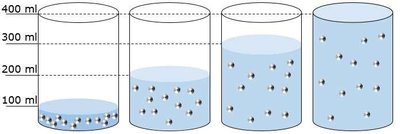
Dilution is the process of reducing the concentration of a solution by adding more solvent. The amount of solute remains constant before and after dilution. The relationship is given by:
Where and are the molarity and volume of the concentrated (stock) solution, and and are those of the diluted solution.
Stoichiometry of Reactions in Solution
Solution Stoichiometry
Stoichiometry in solutions involves using the molarity and volume of reactants to determine the amounts of products formed or reactants required. Balanced chemical equations are essential for these calculations.
Use the coefficients from the balanced equation to relate moles of reactants and products.
Convert between volume and moles using molarity:
Example: What volume of 0.150 M KCl is required to completely react with 0.150 L of 0.175 M Pb(NO3)2?
Balanced equation:
Calculate moles of Pb(NO3)2 and use stoichiometry to find moles (and then volume) of KCl needed.
Properties of Solutions: Dissolving and Electrolytes
Process of Dissolving
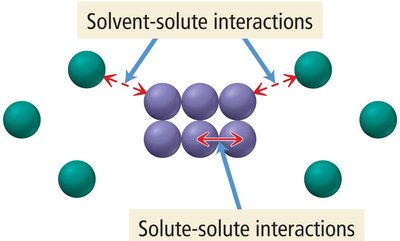
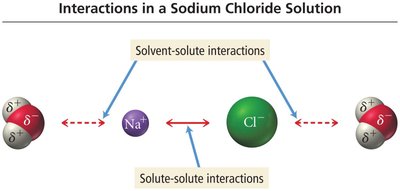
When a solute dissolves in a solvent, the attractive forces between solute particles and between solvent particles must be overcome, and new solute-solvent interactions are formed. If these new interactions are strong enough, the solute will dissolve.
Electrolytes and Nonelectrolytes
Substances that dissolve in water can be classified based on their ability to conduct electricity:
Electrolytes: Dissolve to produce ions and conduct electricity (e.g., NaCl).
Nonelectrolytes: Dissolve as molecules and do not conduct electricity (e.g., sugar).
Strong electrolytes (e.g., soluble ionic compounds, strong acids) dissociate completely, while weak electrolytes (e.g., weak acids) only partially ionize.
Solubility and Precipitation Reactions
Solubility Rules
Solubility rules help predict whether an ionic compound will dissolve in water. Compounds containing Group 1A metals and ammonium are generally soluble, while many carbonates and phosphates are insoluble.
Precipitation Reactions
When solutions of two soluble ionic compounds are mixed, an insoluble product (precipitate) may form. The reaction can be predicted using solubility rules and written as:
Molecular Equation: Shows all reactants and products as compounds.
Ionic Equation: Shows all strong electrolytes as ions.
Net Ionic Equation: Shows only the species that actually change during the reaction (removing spectator ions).
Example:
