 Indietro
Stoichiometry and Mass Relationships in Chemical Reactions
Guida di studio - Note intelligenti
 Appunti personalizzati basati sui tuoi materiali, ampliati con definizioni chiave, esempi e contesto.
Mass Relationships in Chemical Reactions
Microscopic and Macroscopic Interpretation of Chemical Equations
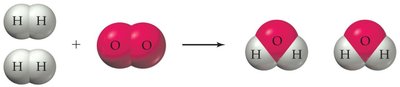
Chemical equations can be interpreted at both the microscopic (molecular) and macroscopic (mole) levels. The microscopic view involves counting individual molecules, while the macroscopic view uses moles, which relate to measurable quantities.
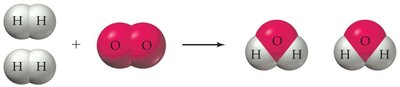
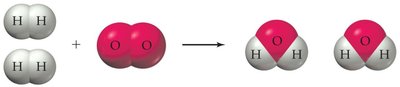
Microscopic Interpretation: For every 2 molecules of hydrogen gas (H2) that react with 1 molecule of oxygen gas (O2), 2 molecules of water (H2O) are produced.
Macroscopic Interpretation: For every 2 moles of hydrogen gas that react with 1 mole of oxygen gas, 2 moles of water are produced.
Balanced Equation:
Counting Molecules: If you know the number of molecules (or moles) of one reactant or product, you can calculate the amounts of all other substances involved.
Counting by Mass: The Concept of Moles
Counting individual atoms or molecules is impractical for large quantities. Chemists use mass and the concept of the mole to relate measurable quantities to numbers of particles.
Mole: A mole is defined as particles (Avogadro's number).
Molar Mass: The mass of one mole of a substance, expressed in grams per mole (g/mol), is numerically equal to the atomic or molecular mass in amu.
Example: 1 mole of carbon atoms weighs 12.01 g and contains atoms.
Mass-to-Mole and Mole-to-Atom Calculations
Conversions between mass, moles, and number of atoms are fundamental in chemistry.
Mass to Moles:
Moles to Atoms:
Example: Calculate the number of atoms in 2.45 mol of copper:
Molecular Formulas and Molar Mass
Molecular Formula
The molecular formula specifies the number of each type of atom in a molecule. Subscripts indicate the quantity of each element.
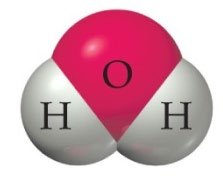
Example: Water (H2O) contains 2 hydrogen atoms and 1 oxygen atom per molecule.
Example: Hydrogen peroxide (H2O2) contains 2 hydrogen atoms and 2 oxygen atoms per molecule.

Molar Mass of Compounds
The molar mass of a compound is the sum of the molar masses of its constituent atoms.
Formula:
Example: For water:
Chemical Reactions and Equations
Writing and Balancing Chemical Equations
Chemical equations represent the reactants and products in a reaction, including their physical states and relative quantities. Balancing equations ensures the Law of Conservation of Mass is obeyed.
Balanced Equation: Equal numbers of each atom on both sides.
Example: Combustion of methane:
Physical States: (g) = gas, (l) = liquid, (s) = solid, (aq) = aqueous
Energy Symbols: indicates heat is required.
Stoichiometry: Quantitative Relationships in Reactions
Stoichiometry is the calculation of reactant and product quantities in chemical reactions, based on balanced equations.
Stoichiometric Coefficients: Indicate the ratio of moles of each substance.
Example:
Conversion Factors: Use mole ratios to convert between substances.
Stoichiometric Calculations
Grams to Moles to Moles to Grams
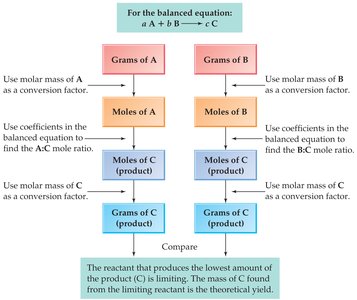
To relate masses of reactants and products, use the following steps:
Convert grams of substance A to moles using its molar mass.
Use the balanced equation to convert moles of A to moles of B.
Convert moles of B to grams using its molar mass.
Limiting Reactant and Theoretical Yield
The limiting reactant determines the maximum amount of product that can be formed. The theoretical yield is the calculated maximum product, while the actual yield is what is obtained experimentally.
Limiting Reactant: The reactant that is completely consumed first.
Excess Reactant: The reactant that remains after the reaction is complete.
Theoretical Yield: The maximum amount of product possible from the limiting reactant.
Percent Yield:

Metric System and Unit Conversions
Metric Prefixes and Conversion Factors
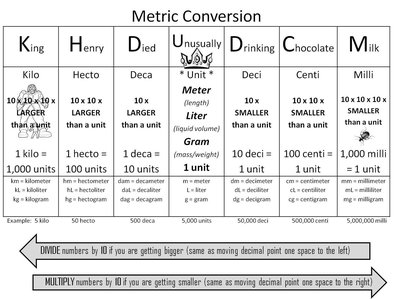
The metric system uses prefixes to indicate multiples or fractions of units. Understanding these conversions is essential for accurate chemical calculations.
Prefix | Symbol | Factor |
|---|---|---|
Kilo | k | 1,000 |
Hecto | h | 100 |
Deca | da | 10 |
Unit | - | 1 |
Deci | d | 0.1 |
Centi | c | 0.01 |
Milli | m | 0.001 |

Summary Table: Molar Masses of Common Elements
Element | Atomic Mass (amu) | Molar Mass (g/mol) |
|---|---|---|
Hydrogen | 1.01 | 1.01 |
Carbon | 12.01 | 12.01 |
Oxygen | 16.00 | 16.00 |
Chlorine | 35.45 | 35.45 |
Copper | 63.55 | 63.55 |
Key Equations
Additional info:
These notes cover the essential concepts of stoichiometry, mass relationships, chemical equations, limiting reactants, theoretical and percent yield, and metric conversions, all of which are foundational topics in an Introduction to Chemistry course.
