 Indietro
The Language of Chemistry: Classification and Nomenclature of Inorganic Compounds
Guida di studio - Note intelligenti
 Appunti personalizzati basati sui tuoi materiali, ampliati con definizioni chiave, esempi e contesto.
Language of Chemistry
Introduction to Chemical Nomenclature
Chemical nomenclature is the systematic method of naming chemical compounds as established by the International Union of Pure and Applied Chemistry (IUPAC). Understanding the classification and naming of compounds is essential for clear scientific communication.
Classification of Compounds
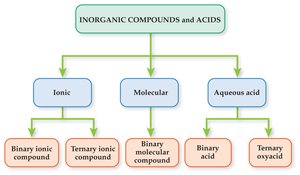
Main Classes of Inorganic Compounds
Inorganic compounds are generally classified based on their composition and the types of elements present. Most inorganic compounds do not contain carbon, with exceptions such as carbon dioxide (CO2) and carbonates (CO32–).
Binary Ionic Compounds: Composed of a metal and a nonmetal.
Ternary Ionic Compounds: Contain three elements, typically a metal, a nonmetal, and oxygen.
Binary Molecular Compounds: Composed of two nonmetals.
Binary Acids: Aqueous solutions of hydrogen and a nonmetal.
Ternary Oxyacids: Aqueous solutions containing hydrogen, oxygen, and another nonmetal.
Ionic Compounds
Binary and Ternary Ionic Compounds
Binary ionic compounds consist of two elements: a metal and a nonmetal (e.g., NaCl, AlCl3). Ternary ionic compounds contain three elements, often including a polyatomic ion (e.g., KNO3, Al(NO3)3).
Molecular Compounds
Binary Molecular Compounds
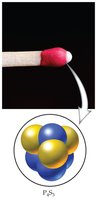
Binary molecular compounds are composed of two nonmetals. Examples include ammonia (NH3) and water (H2O).
Aqueous Acids
Binary Acids and Ternary Oxyacids
A binary acid is an aqueous solution of hydrogen and a nonmetal (e.g., HCl(aq)). A ternary oxyacid contains hydrogen, oxygen, and another nonmetal (e.g., HNO3(aq)).
Classifying Ions
Cations and Anions
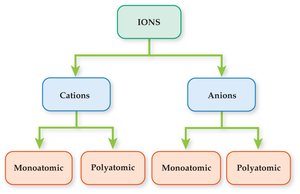
An ion is an atom or group of atoms with a charge. Cations are positively charged, while anions are negatively charged. Polyatomic ions are groups of atoms with a charge.
Monoatomic and Polyatomic Ions
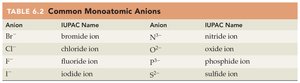
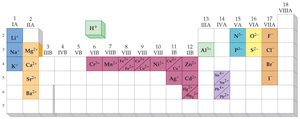
Common Monoatomic Ions
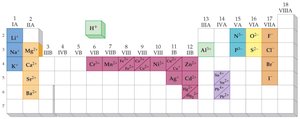
Monoatomic ions are single atoms with a charge. Metals typically form cations by losing electrons, while nonmetals form anions by gaining electrons. The charge of a metal ion from representative elements is usually equal to its group number, while the charge of a nonmetal anion is the group number minus eight.
Common Polyatomic Ions
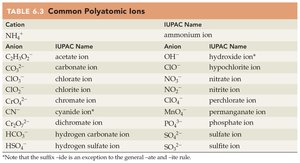
Polyatomic ions are composed of two or more atoms covalently bonded, carrying a net charge. Many polyatomic anions contain oxygen and are called oxyanions. The suffix –ate indicates a higher number of oxygens, while –ite indicates one fewer oxygen atom. Some common polyatomic ions include nitrate (NO3–), sulfate (SO42–), and acetate (C2H3O2–).
Writing Chemical Formulas
Formulas of Ionic Compounds
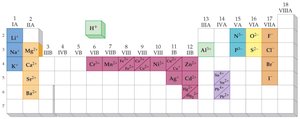
An ionic compound is electrically neutral; the total positive charge must equal the total negative charge. If the charges are not equal, subscripts are used to balance the charges. For example:
K+ and Br– combine to form KBr.
Ba2+ and Cl– combine to form BaCl2.
Naming Ionic Compounds
Binary Ionic Compounds
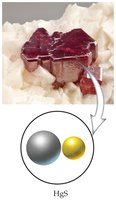
Binary ionic compounds are named by stating the cation first, followed by the anion with the suffix –ide. If the metal can form more than one ion, its charge is indicated by a Roman numeral (Stock system) or by the Latin suffixes –ous (lower charge) and –ic (higher charge).
Ternary Ionic Compounds
Ternary ionic compounds are named similarly, with the cation first and the polyatomic anion second. For example, KClO2 is potassium chlorite.
Naming Binary Molecular Compounds
Greek Prefixes and Naming Rules
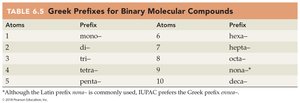
Binary molecular compounds use Greek prefixes to indicate the number of each atom. The first element is named first, and the second element ends with –ide. The prefix mono– is omitted for the first element if only one atom is present.
Naming Acids
Binary Acids
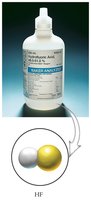
Binary acids are named with the prefix hydro– and the suffix –ic acid (e.g., HF(aq) is hydrofluoric acid).
Ternary Oxyacids
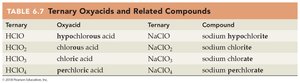
Ternary oxyacids are named based on the oxyanion present. If the anion ends in –ate, the acid ends in –ic acid (e.g., HNO3 is nitric acid). If the anion ends in –ite, the acid ends in –ous acid (e.g., HNO2 is nitrous acid).
Summary Table: Greek Prefixes for Binary Molecular Compounds
Atoms | Prefix | Atoms | Prefix |
|---|---|---|---|
1 | mono– | 6 | hexa– |
2 | di– | 7 | hepta– |
3 | tri– | 8 | octa– |
4 | tetra– | 9 | nona– |
5 | penta– | 10 | deca– |
Summary Table: Ternary Oxyacids and Related Compounds
Ternary | Oxyacid | Ternary | Compound |
|---|---|---|---|
HClO | hypochlorous acid | NaClO | sodium hypochlorite |
HClO2 | chlorous acid | NaClO2 | sodium chlorite |
HClO3 | chloric acid | NaClO3 | sodium chlorate |
HClO4 | perchloric acid | NaClO4 | sodium perchlorate |
Chapter Summary
Most inorganic compounds do not contain carbon.
Binary ionic compounds: metal + nonmetal.
Ternary ionic compounds: metal + nonmetal + oxygen.
Binary molecular compounds: two nonmetals.
Acids: hydrogen + nonmetal or oxyanion.
Cations are named as the element plus "ion"; variable charges are indicated with Roman numerals or Latin suffixes.
Ionic compounds: cation first, anion second, with –ide suffix for anions.
Molecular compounds: use Greek prefixes and –ide suffix for the second element.
Binary acids: hydro– prefix and –ic acid suffix.
Ternary oxyacids: –ate to –ic acid, –ite to –ous acid.
