 Indietro
Chapter 12 Study Guide- Part B
Guida di studio - Note intelligenti
 Appunti personalizzati basati sui tuoi materiali, ampliati con definizioni chiave, esempi e contesto.
Aggregate Expenditure and Output in the Short Run
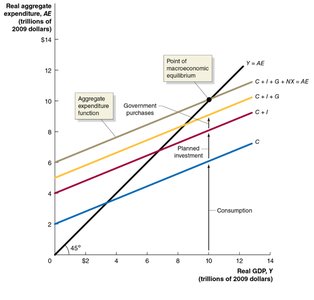
Macroeconomic Equilibrium
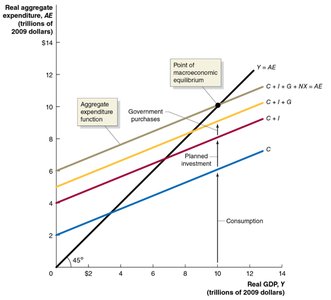
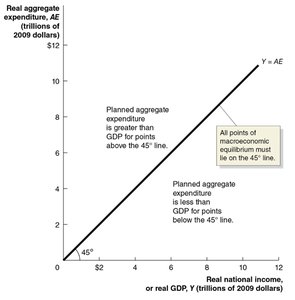
Macroeconomic equilibrium in the short run occurs where planned aggregate expenditure (AE) equals real GDP. This is graphically represented by the intersection of the AE line with the 45° line, which shows all points where AE equals real GDP. The AE model is fundamental for understanding how changes in spending affect output and income in the economy.
Macroeconomic Equilibrium: Occurs at the intersection of the AE line and the 45° line.
45° Line: Represents all points where AE equals real GDP; only points on this line can be equilibrium.
Aggregate Expenditure Line: Constructed by stacking investment (I), government purchases (G), and net exports (NX) on top of the consumption function (C).
Autonomous Expenditure: Any change in C, I, G, or NX not caused by current income shifts the AE line and changes equilibrium real GDP.
Example: If government purchases increase, the AE line shifts upward, raising equilibrium real GDP.
Effects of Policy Changes on Aggregate Expenditure
Changes in fiscal and monetary policy can shift the AE line, affecting equilibrium real GDP. Expansionary monetary policy (e.g., a decrease in interest rates) increases investment and consumption, shifting AE upward. Contractionary fiscal policy (e.g., a decrease in government purchases or an increase in taxes) shifts AE downward, reducing real GDP.
Expansionary Monetary Policy: Lower interest rates increase investment and consumption, shifting AE up.
Contractionary Fiscal Policy: Lower government purchases or higher taxes shift AE down.
Increase in Expected Future Income: Raises consumption, shifting AE up and increasing real GDP.
Example: A decrease in interest rates by the Federal Reserve leads to higher investment, shifting AE upward and increasing equilibrium real GDP.
The Multiplier Effect
The multiplier effect describes how an initial change in autonomous expenditure leads to a larger change in equilibrium real GDP. This occurs because the initial increase in spending induces further rounds of consumption, amplifying the impact on output.
Multiplier Effect: The process by which a change in autonomous expenditure leads to a larger change in real GDP.
Marginal Propensity to Consume (MPC): The fraction of additional income that is spent on consumption.
Multiplier Formula:
Change in Real GDP:
Example: If U.S. net exports rise by $100 billion and MPC = 0.8, the change in equilibrium real GDP is:
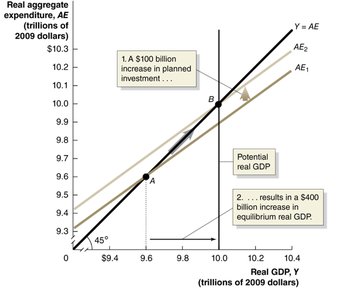
Summary of Multiplier Effect:
The multiplier effect occurs for both increases and decreases in planned aggregate expenditure.
The economy is sensitive to changes in autonomous expenditure because the multiplier is greater than 1.
The larger the MPC, the larger the multiplier.
Real-world complications (e.g., changes in imports, inflation, interest rates, taxes) may reduce the actual multiplier below the theoretical value.
Business Cycle and Inventory Changes
Economists analyze the business cycle by examining changes in real GDP, which are influenced by changes in total spending and the multiplier effect. Inventory changes, whether planned or unplanned, can significantly affect GDP. A reduction in inventories (inventory drawdown) signifies decreased production and contributes to GDP decline.
Inventory Drawdown: Reduction in inventories, indicating decreased current production and contributing to GDP decline.
Planned vs. Unplanned Inventory Changes: Planned increases in inventory may signal future sales expectations, while unplanned increases indicate lower-than-expected sales, affecting the business cycle.
Example: During the 2007-2009 recession, falling sales across many industries reflected a broader decline in spending, not just in residential construction, due to the multiplier effect.
Additional info: The notes omit some real-world complications, such as the effects of imports, inflation, interest rates, and income taxes, which can dampen the multiplier effect. The theoretical multiplier calculated from MPC is often higher than the actual multiplier observed in the economy.
