 Indietro
Chapter 1: What Is Economics? (Macroeconomics Study Notes)
Guida di studio - Note intelligenti
 Appunti personalizzati basati sui tuoi materiali, ampliati con definizioni chiave, esempi e contesto.
What Is Economics?
Central Ideas: Scarcity, Choices, and Incentives
Economics is the study of how societies manage scarce resources to satisfy unlimited wants. The discipline originates from the Greek word oikonomos, meaning "managing the household." Two fundamental concepts are:
Scarcity: Resources are limited, so choices must be made about their allocation.
Choices and Incentives: Individuals and societies respond to incentives, weighing costs and benefits when making decisions.
Economics is a social science that quantifies and measures phenomena, extending beyond financial markets to include social issues such as education, health, and urban development.
Microeconomics vs. Macroeconomics
Scope and Example Questions
Economics is divided into two main branches:
Microeconomics: Studies choices made by individuals and businesses, and how these choices interact in markets and influence government policy. Example: "Would a tax on online shopping affect Amazon?"
Macroeconomics: Examines the performance of national and global economies. Example: "Can the Federal Reserve reduce unemployment by lowering interest rates?"
Two Big Economic Questions
Production, Efficiency, and Equity
Economists seek to answer two major questions:
What is produced? How? For whom? This involves understanding production, expenditure, and income. Positive statements describe facts objectively.
When do markets work well? When do they fail? This concerns whether private and social interests align, leading to normative statements about what should be. Key issues include efficiency and fairness.
Efficiency: Defined by Pareto (1906) as a situation where no one can be made better off without making someone else worse off.
Equity: Refers to the fairness of income distribution. Policy tools include taxes, minimum wage, and public education.
What Is Produced?
Goods and Services
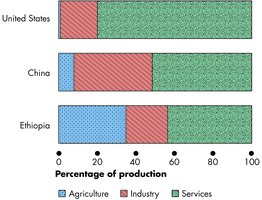
Economies produce goods and services to satisfy human wants and needs. The composition of production varies across countries, reflecting different stages of economic development.
Goods: Tangible items such as food, clothing, and machinery.
Services: Intangible activities like education, healthcare, and banking.
How Is It Produced?
Factors of Production
Production uses various inputs, known as factors of production, to create goods and services. These are grouped into four categories:
Capital: Tools, machines, and buildings used in production.
Labor: Human effort and time devoted to work. Human capital refers to skills and knowledge acquired through education and experience.
Land: Natural resources, often called "gifts of nature."
Entrepreneurship: The ability to identify business opportunities and organize the other factors.
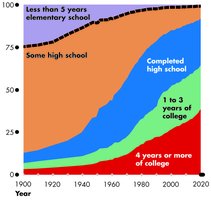
Human capital is crucial for increasing productivity. Education, training, and health all contribute to human capital.
For Whom Does the Economy Produce?
Distribution of Income
Goods and services are distributed to those who can purchase them, which depends on income earned from production:
Land earns rent.
Labor earns wages.
Capital earns interest.
Entrepreneurship earns profit.
Income inequality arises from differences in ownership of land, capital, and human capital.
Private and Social Interests: Efficiency
Pareto Efficiency
Pareto efficiency is a foundational concept in economics. A Pareto improvement is a change that benefits at least one person without harming anyone else. If such improvements are possible, the situation is inefficient. A situation is efficient if no further Pareto improvements can be made.

Are Market Outcomes Efficient?
Market Successes and Failures
Markets often generate efficient outcomes, as described by Adam Smith (1776). Firms are incentivized to supply high-quality, competitively priced goods, and prices guide consumers to make choices based on scarcity and abundance. However, markets can fail due to:
Monopolies: Single sellers restrict supply and raise prices.
Externalities: Costs or benefits that affect third parties, such as pollution.
Efficiency: Necessary but Not Sufficient for Desirability
Efficiency vs. Equity
While efficiency is necessary for a desirable outcome, it is not sufficient. Efficient situations can be highly unequal, with one person receiving most of the income. The term "efficiency" is sometimes used as a proxy for maximizing total income, but this is imprecise.
Inequality: Lorenz Curve and Gini Index
Measuring Income Distribution
Inequality is measured using tools such as the Lorenz Curve and Gini Index:
Lorenz Curve: Plots the cumulative share of income earned by the cumulative share of people from lower income.
Gini Index: Quantifies inequality; a value of 0 represents perfect equality, while 1 represents maximum inequality.

Concept | Description |
|---|---|
Lorenz Curve | Graphical representation of income distribution |
Gini Index | Numerical measure of inequality (0 = perfect equality, 1 = maximum inequality) |
Economic Way of Thinking
Rational Decision-Making
Economists use models and quantitative analysis to understand and predict behavior. Rational decision-making involves comparing marginal benefits and marginal costs.
Economics Majors in the Labor Market
Careers in Economics
Economics graduates pursue careers in diverse fields, including finance, government, education, and consulting. The skills developed in economics—analytical thinking, quantitative reasoning, and understanding incentives—are highly valued in the labor market.
Additional info: Expanded explanations and context were added to ensure completeness and academic quality.
