 Indietro
ECO 2013 Principles of Macroeconomics – Syllabus and Study Guide
Guida di studio - Note intelligenti
 Appunti personalizzati basati sui tuoi materiali, ampliati con definizioni chiave, esempi e contesto.
Course Overview
Introduction to Macroeconomics
This course provides a comprehensive introduction to macroeconomics, focusing on the aggregate behavior of economies. Students will explore how decision-making under scarcity impacts national and global economic outcomes, and will analyze key macroeconomic theories and evidence.
Macroeconomics studies the performance, structure, and behavior of the entire economy rather than individual markets.
Topics include national income determination, monetary and fiscal policy, economic growth, and international trade.
Emphasis on quantitative analysis and interpretation of economic data.

Course Structure and Materials
Required Textbooks and Resources
The primary textbook for this course is Macroeconomics by Glenn Hubbard and Anthony Patrick O'Brien (9th Edition, Pearson, 2024). All course materials are provided through FGCU's First Day Ready program, ensuring access to both physical and digital resources.
Textbook ISBN: 9780138102494
Digital materials integrated into Canvas
Courseware access via publisher links or access codes

Learning Outcomes
Core Competencies
Upon successful completion, students will:
Recognize decision-making in environments of scarcity
Analyze aggregate economic measurements and their relationship to economic performance
Understand the components and relationships within national income accounts
Evaluate fiscal and monetary policy impacts
Identify and assess theories of long-term economic growth
Perform and interpret quantitative economic calculations
Assessment and Grading
Grading Scale
Grades are assigned based on the following scale:
A: 92.50% and up
A-: 89.50% – 92.49%
B+: 86.50% – 89.49%
B: 82.50% – 86.49%
B-: 79.50% – 82.49%
C+: 76.50% – 79.49%
C: 69.50% – 76.49%
D+: 66.50% – 69.49%
D: 62.50% – 66.49%
D-: 59.50% – 62.49%
F: 0.00% – 59.49%
Grade Categories and Weights
Assessment is divided into quizzes, exams, and a cumulative final exam. The weights are as follows:
Grading Tool | Weight |
|---|---|
Quizzes 1–5 (or homework) | 15% |
Exam 1 | 15% |
Exam 2 | 15% |
Exam 3 | 15% |
Exam 4 | 15% |
Final Exam (Cumulative) | 25% |
Schedule of Assignments and Exams
Quiz and Exam Alignment
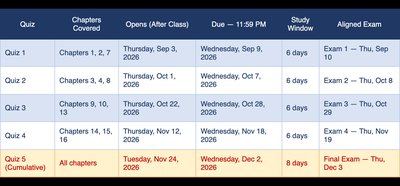
Quizzes and exams are scheduled to align with specific chapters and topics. The study window for each quiz is typically 6 days, with the final cumulative quiz having an 8-day window.
Quiz | Chapters Covered | Opens | Due | Study Window | Aligned Exam |
|---|---|---|---|---|---|
Quiz 1 | Chapters 1, 2, 7 | Thursday, Sep 3, 2026 | Wednesday, Sep 9, 2026 | 6 days | Exam 1 – Thu, Sep 10 |
Quiz 2 | Chapters 3, 4, 8 | Thursday, Oct 1, 2026 | Wednesday, Oct 7, 2026 | 6 days | Exam 2 – Thu, Oct 8 |
Quiz 3 | Chapters 9, 10, 13 | Thursday, Oct 22, 2026 | Wednesday, Oct 28, 2026 | 6 days | Exam 3 – Thu, Oct 29 |
Quiz 4 | Chapters 14, 15, 16 | Thursday, Nov 12, 2026 | Wednesday, Nov 18, 2026 | 6 days | Exam 4 – Thu, Nov 19 |
Quiz 5 (Cumulative) | All chapters | Tuesday, Nov 24, 2026 | Wednesday, Dec 2, 2026 | 8 days | Final Exam – Thu, Dec 3 |
Course Topics and Weekly Schedule
Major Topics Covered
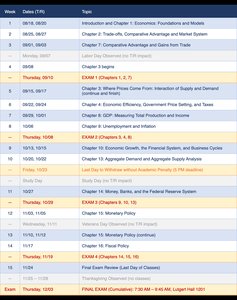
The course covers foundational and advanced macroeconomic topics, including:
Introduction to Economics: Foundations and Models
Trade-offs, Comparative Advantage, and Market System
Economic Efficiency, Government, and Trade
Supply and Demand, Price Controls, and Taxes
GDP Measurement and Growth
Unemployment and Inflation
Aggregate Demand and Supply Analysis
Financial System and Business Cycles
Monetary Policy and the Federal Reserve System
Fiscal Policy
Each week is structured to build upon previous concepts, culminating in a cumulative final exam.
Policies and Expectations
Attendance and Participation
Regular attendance is required and tracked. Attendance impacts extra credit eligibility. FGCU mandates confirmation of attendance for all students within the first week.
Complete the Confirmation of Attendance Survey in Canvas
Notify the instructor in advance for excused absences
Exam and Assignment Policies
No outside aids (AI, phones, calculators, notes, books) allowed during exams
No make-up exams or quizzes except for documented excused absences
Arrive on time; late arrivals may result in a zero grade
Adaptive Services accommodations must be registered by the end of the second week
General Education Information
Purpose and Skills Developed
This course is part of FGCU’s General Education Program, designed to foster inquiry, creativity, and integration of knowledge across disciplines. Students will develop skills in quantitative reasoning, critical thinking, and effective communication.
Enhances academic, career, and personal growth
Prepares students for responsible citizenship and adaptability
Additional Information
Important Dates
Labor Day: Monday, September 7th – No classes
Study Day: Tuesday, October 27th – No classes
Veteran's Day: Wednesday, November 11th – No classes
Thanksgiving Holiday: November 25th–28th – No classes
Last day of classes: Tuesday, November 24th
Final Exam: Thursday, December 3rd
Extra Credit
Extra credit opportunities may be offered at the instructor’s discretion and are available to all students. No extra credit after the last regular class day.
AI Use Statement
This course is AI-FREE. No generative AI tools are permitted on any assignment. All work must be completed independently.
University Policies
FGCU policies regarding academic integrity, accessibility, and other core syllabus statements apply. Review these online for full details.
