 Indietro
Firms, the Stock Market, and Corporate Governance: Study Notes for Macroeconomics
Guida di studio - Note intelligenti
 Appunti personalizzati basati sui tuoi materiali, ampliati con definizioni chiave, esempi e contesto.
Firms, the Stock Market, and Corporate Governance
Introduction
This chapter explores the structure, financing, and governance of firms, focusing on their role in the macroeconomy. Understanding how firms are organized, how they raise funds, and how they are governed is essential for analyzing their impact on economic activity and growth.
Types of Firms
Major Legal Forms of Firms in the United States
Sole Proprietorship: Owned by a single individual, not organized as a corporation. The owner has unlimited liability.
Partnership: Owned jointly by two or more persons, not organized as a corporation. Partners share unlimited liability.
Corporation: A legal entity separate from its owners, providing limited liability protection. Owners (shareholders) are not personally liable beyond their investment.
Limited liability makes it easier for corporations to raise funds and for individuals to invest, but corporations are more expensive to organize and may face double taxation (corporate profits and dividends).

Liability Distinctions
Unlimited Liability: Applies to sole proprietorships and partnerships; owners are personally responsible for all debts.
Limited Liability: Applies to corporations; owners can only lose their investment, not personal assets.
Recent Trends in Firm Formation
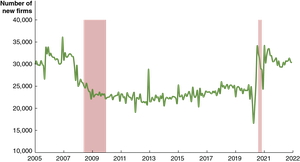
After the Great Recession (2007–2009), new firm formation slowed, declining further during the Covid-19 pandemic. However, a surge in new business formation occurred post-pandemic, as some new firms replaced failed ones and others were started by displaced workers.
Corporate Structure and Governance
Separation of Ownership and Control
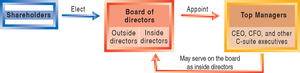
In corporations, ownership (shareholders) is separated from control (managers). Shareholders elect a board of directors, which appoints top managers (e.g., CEO) to run the firm.
The Principal-Agent Problem
Principal-Agent Problem: Occurs when managers (agents) pursue their own interests rather than those of shareholders (principals).
Corporate Governance: The system of rules, practices, and processes by which a firm is directed and controlled, aiming to align managers' interests with those of shareholders.
Solutions: Compensation in the form of stock or stock options to align incentives, though perfect alignment is rarely achieved.
Multinational Corporations
Operate in multiple countries to avoid tariffs, access raw materials or low-cost labor, reduce exchange rate risk, and respond to competition.
How Firms Raise Funds
Internal and External Financing
Retained Earnings: Profits reinvested in the firm.
Recruiting Additional Owners: Increases financial capital.
Borrowing: From banks or other lenders.
Indirect Finance
Funds flow from savers to borrowers through financial intermediaries (e.g., banks).
Direct Finance
Firms raise funds directly from investors by issuing financial securities in financial markets.
Bonds: Promise to repay a fixed amount with interest (coupon payments).
Stocks: Represent partial ownership; shareholders may receive dividends.
Bond Ratings and Default Risk
Credit-rating agencies (Moody’s, S&P, Fitch) assess the risk of default.
Higher default risk requires higher coupon payments to attract investors.
Mutual Funds and Exchange-Traded Funds (ETFs)
Mutual Funds: Actively managed, shares bought/sold through the fund company.
ETFs: Passively managed, traded directly between investors.
Stock and Bond Markets
Provide liquidity and information about firms’ prospects.
Stock prices reflect expectations of future profits; bond prices reflect coupon payments and default risk.
Stock Market Indexes
Indexes (e.g., S&P 500) track average stock prices, indicating overall market trends.

Risk and Return
Higher returns are generally associated with higher risk.
Stocks are riskier than bonds; small companies are riskier than large ones.
Stock Price Fluctuations: The Case of Peloton
Peloton’s market value fluctuated based on expectations of future profits, especially during the Covid-19 pandemic. Share prices can be volatile, reflecting changing investor sentiment.

Using Financial Statements to Evaluate a Corporation
Key Financial Statements
Income Statement: Shows revenues, costs, and profit over a period (usually a year).
Balance Sheet: Summarizes assets, liabilities, and net worth at a specific point in time.
Accounting Profit vs. Economic Profit
Accounting Profit: Net income = Revenue – Explicit costs (operating expenses and taxes).
Economic Profit: Considers both explicit and implicit costs (opportunity costs).
Importance of Accurate Financial Statements
Accurate statements are essential for investors and efficient resource allocation.
Inaccurate statements can mislead investors and harm economic growth.
Regulation and Oversight
Sarbanes-Oxley Act (2002): Requires CEOs to certify financial statements and disclose auditor conflicts of interest.
Dodd-Frank Act (2010): Reforms financial system regulation, creates oversight bodies.
Example: Tesla’s Income Statement (2022)
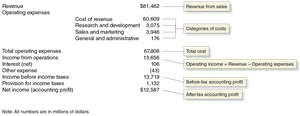
Tesla’s income statement details revenue, operating expenses, and net income, illustrating how firms report financial performance.
Appendix: Using Present Value
Present Value Concept
The present value (PV) of future funds is the amount those funds are worth today, given a specific interest rate. This concept is crucial for valuing financial assets like bonds and stocks.
Present Value Formula:
Future: Amount to be received in n years
i: Interest rate
n: Number of years
Present Value of a Series of Payments
To find the present value of multiple future payments, sum the present value of each payment:
Valuing Bonds and Stocks
Bonds: Price equals the present value of all future coupon payments and the principal repayment.
Stocks: Price equals the present value of all expected future dividends. If dividends grow at a constant rate, the price can be calculated as:
P: Price of the stock
D: Dividend payment
i: Required rate of return
g: Growth rate of dividends
Appendix: Income Statements and Balance Sheets
Income Statement
Shows revenue, costs, and profit for a period.
Net income (after-tax profit) is the bottom line.
Balance Sheet
Summarizes assets, liabilities, and stockholders’ equity at a point in time.
Balance sheet equation:
Net worth (stockholders’ equity) = Assets – Liabilities
Uses of Financial Statements
Allow investors, lenders, regulators, and managers to evaluate profitability and operational efficiency.
Standardized rules facilitate comparison across firms and industries.
