 Indietro
GDP: Measuring the Economy – Key Concepts in Macroeconomic Output and Income
Guida di studio - Note intelligenti
 Appunti personalizzati basati sui tuoi materiali, ampliati con definizioni chiave, esempi e contesto.
Gross Domestic Product (GDP): Measuring the Economy
Definition and Importance of GDP
Gross Domestic Product (GDP) is the total market value of all newly produced final goods and services made within a country in one year. It is the primary measure of a nation’s economic output and is compiled in the United States by the Bureau of Economic Analysis (BEA) and the US Census Bureau.
GDP per capita is used to capture the average income per person in a country. Rankings by total GDP and GDP per capita can differ significantly, and there is no clear relationship between country size and development.
GDP is a central indicator for comparing economic performance across countries and over time.
The Fundamental Identity of National Accounting
The core principle of national accounting is that total production, total income, and total expenditure are always equal:
Production = Income: The value of all goods and services produced equals the sum of all incomes (wages, corporate profits, proprietors’ income, etc.).
Income = Expenditure: The value produced (Y) is the sum of spending on consumption (C), investment (I), government purchases (G), and net exports (NX):
Components and Calculation of GDP
Production Approach
GDP is the market value of all newly produced, final goods and services made in a country in a year. Key considerations include:
Market Value: GDP is measured by the price of goods and services. Home production and the underground economy are generally not included due to lack of data.
Newly Produced: Only goods and services produced within the current year are counted. Sales of used goods are excluded, except for the value added by intermediaries in the current year.
Final Goods and Services: Only final goods are counted to avoid double counting. Intermediate goods are excluded unless they are added to inventories (inventory investment).
Example: In a simplified economy, the sum of added values at each production stage equals the value of final sales. For instance, if a farmer, miller, and baker each add value, GDP is the sum of their added values, which equals the final sale price to consumers.
Additional Considerations
Intermediate Goods: Used as inputs in the production of other goods and not counted separately in GDP.
Capital Goods: Machinery and equipment are considered final goods because they provide services over multiple years.
Inventories: Increases in inventories are counted as investment.
Domestic Production: GDP includes all production within a country, regardless of the producer’s nationality.
Gross National Product (GNP): GNP = GDP + Net Factor Payments from abroad (NFP). NFP is the income earned by nationals abroad minus income earned by foreigners domestically.
Example: US GDP and GNP are similar, but in countries with many citizens working abroad (e.g., Turkey), GNP can be much higher than GDP.
Expenditure Approach
GDP can also be measured by summing expenditures on final goods and services:
Consumption (C): About two-thirds of GDP; includes durable goods, nondurables, and services.
Investment (I): Volatile, typically 13–20% of GDP; includes business and residential investment, and inventories. Gross investment includes depreciation.
Government Purchases (G): 15–20% of GDP; includes spending on goods and services, but not transfer payments (e.g., Social Security).
Net Exports (NX): Exports minus imports; often negative in the US.
Income Approach
GDP can also be calculated by summing all incomes earned in the production of goods and services:
About two-thirds of GDP is labor income (wages, salaries), and one-third is capital income (profits, rents, interest).
Recent debates focus on the rising share of capital income and its implications for inequality.
The Circular Flow of Income
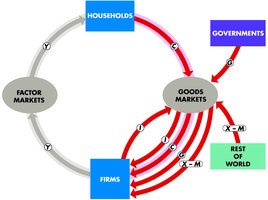
The circular flow model illustrates the movement of income and expenditure between households, firms, governments, and the rest of the world. Households provide factors of production to firms and receive income, which is then spent on goods and services. Governments and foreign sectors also participate in the flow of goods, services, and income.
Adjusting GDP for Inflation: Nominal vs. Real Variables
Measuring and Adjusting for Inflation
To compare economic output over time, it is necessary to adjust for changes in the price level (inflation). This is done using price indices such as the Consumer Price Index (CPI), chained CPI, GDP deflator, Personal Consumption Expenditures (PCE), and Producer Price Index (PPI).
The CPI is based on a representative basket of goods and services, updated periodically. The base period (1982–84) is set to 100.
Core CPI excludes volatile food and energy prices. Housing costs are represented by rents, not house prices.
Nominal GDP is measured in current prices, while Real GDP is adjusted for inflation using a price index.
Formula for Real GDP:
Yearly Rate of Inflation
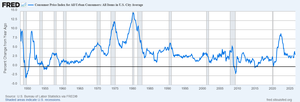
The yearly rate of inflation is tracked using indices like the CPI. The graph below shows the historical trend of inflation in the United States since 1947.
Purchasing Power Parity (PPP)
Purchasing Power Parity (PPP) is a method for comparing the purchasing power of different countries’ currencies by evaluating the cost of a standard basket of goods in each country. PPP adjustments are used to compare living standards and economic productivity across nations more accurately than using exchange rates alone.
Shortcomings of GDP and GDP per Capita
While GDP and GDP per capita are important indicators of economic wellbeing, they have several limitations:
Environmental Impact: GDP does not account for pollution or natural resource depletion, which can reduce future wellbeing.
Value of Leisure: Time spent on leisure, home production, and non-market activities is not included in GDP.
Income Distribution: GDP per capita is an average and may not reflect the living standard of a typical person, especially in countries with high income inequality. The median income may be a better measure in such cases.
Example: Drilling oil increases current GDP but depletes resources, reducing future potential GDP. Similarly, unpaid household work increases wellbeing but is not captured in GDP statistics.
