 Indietro
Introduction to Economics and Macroeconomics: Core Concepts and Questions
Guida di studio - Note intelligenti
 Appunti personalizzati basati sui tuoi materiali, ampliati con definizioni chiave, esempi e contesto.
Chapter 1: What Is Economics?
Introduction to Economics
Economics is the study of how societies manage scarce resources to satisfy unlimited wants. The term originates from the Greek word oikonomos, meaning 'household manager.' Economics is a social science that seeks to measure and quantify human behavior, focusing on choices and incentives.
Scarcity: Resources are limited, so individuals and societies must make choices about how to allocate them.
Choices and Incentives: Decisions are influenced by the costs and benefits of different options.
Scope: Economics covers not only markets, stocks, and taxes, but also social issues such as education, health, urban development, and crime.

Microeconomics vs. Macroeconomics
Economics is divided into two main branches:
Microeconomics: Studies the choices of individuals and businesses, and how these choices interact in markets and influence government policy. Example questions: Why are people streaming more movies? Would a tax on online shopping affect Amazon?
Macroeconomics: Examines the performance of national and global economies. Example questions: Why do some economies grow faster than others? Can the Federal Reserve reduce unemployment by lowering interest rates?
Two Big Economic Questions
What is produced? How? For whom? This involves understanding production, expenditure, and income. Economists use positive statements to objectively describe how things are, without judgment.
When do markets work well? When do they fail? This leads to normative statements, which involve judgments about what should be. Key considerations include efficiency (Pareto efficiency) and equity (fairness in income distribution).
What Is Produced?
Goods and Services
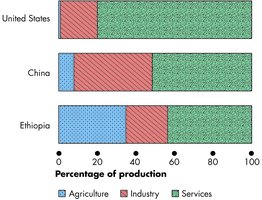
Economies produce goods and services to satisfy human wants and needs. The composition of production varies across countries, typically divided into agriculture, industry, and services.
How Is It Produced?
Factors of Production
Production uses various inputs, known as factors of production, to create goods and services. These are grouped into four categories:
Capital: Tools, machines, and buildings used in production.
Labor: Human effort and time devoted to work. Human capital (skills, education, health) increases labor productivity.
Land: Natural resources or 'gifts of nature.'
Entrepreneurship: The ability to identify business opportunities and organize the other factors of production.
Some authors may simplify or expand these categories depending on context.
Human Capital
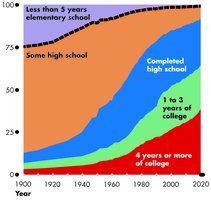
Human capital refers to the skills, education, and health that make workers more productive. Formal education, on-the-job training, and work experience all contribute to human capital.
For Whom Does the Economy Produce?
Distribution of Income
Goods and services are distributed to those who can buy them, which depends on income. Income is generated by the ownership of factors of production:
Land: Earns rent.
Labor: Earns wages, which vary with human capital.
Capital: Earns interest.
Entrepreneurship: Earns profit.
Wealth and income inequality arise from unequal ownership of land, capital, and human capital.
Private and Social Interests: Efficiency
Pareto Efficiency
Pareto efficiency, named after Vilfredo Pareto, is a situation where it is impossible to make one person better off without making someone else worse off. A Pareto improvement benefits at least one person without harming anyone else. If such improvements are possible, the situation is inefficient.

Market Efficiency and Market Failure
Markets can generate efficient outcomes, as described by Adam Smith. Prices guide consumers and producers, aligning private and social interests. However, markets sometimes fail due to:
Monopolies: Single sellers restrict supply and raise prices.
Externalities: Costs or benefits not reflected in market prices, such as pollution.
Efficiency vs. Equity
While Pareto efficiency is necessary for desirability, it is not sufficient. An efficient outcome can still be highly unequal. Economists distinguish between the 'size of the pie' (total income) and how it is divided (distribution).
Inequality: Lorenz Curve and Gini Index
Measuring Inequality
The Lorenz curve graphically represents income distribution, while the Gini index quantifies inequality. A perfectly equal distribution follows the 45-degree line; the greater the area between the Lorenz curve and this line, the higher the inequality.

Additional Topics
The Economic Way of Thinking
Economists use models and data to analyze choices, incentives, and outcomes. They apply these tools to a wide range of issues, from markets to social policy.
Economics Majors in the Labor Market
Studying economics provides analytical and quantitative skills valued in many careers, including business, government, and research.
