 Indietro
Introduction to Macroeconomics: Fundamental Concepts and Factors of Production
Guida di studio - Note intelligenti
 Appunti personalizzati basati sui tuoi materiali, ampliati con definizioni chiave, esempi e contesto.
The Nature of Economics
Learning Objectives
This module introduces the foundational concepts of economics, focusing on the reasons for studying economics, the definition and meaning of scarcity, opportunity cost, factors of production, and the distinction between microeconomics and macroeconomics. It also addresses the central economic questions that guide analysis and policy.
Why Study Economics: 3 Reasons & The Power of Economic Analysis
Motivations for Studying Economics
Economics is studied for several key reasons, each highlighting its importance in understanding and addressing real-world issues:
Money: Economics analyzes money as a central unit and priority concern for individuals and societies.
Urgent Problems: Knowledge of economics is essential for addressing pressing issues facing countries and the world, such as trade policies and global challenges.
Systematic Thinking: Economics fosters a systematic and logical approach to problem-solving, enabling individuals to make informed decisions.
Definition of Economics & The Meaning of Scarcity
What is Economics?
Economics is a social science that studies how individuals, businesses, governments, and societies make choices when using their scarce resources to produce, distribute, and consume goods and services to satisfy unlimited wants. The discipline examines the allocation of resources that have alternative uses.
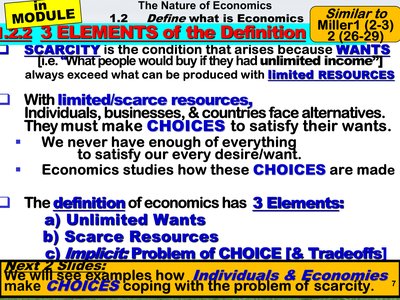
Three Elements of the Definition
Unlimited Wants: Human desires for goods and services are boundless.
Scarce Resources: Resources available for production are limited.
Implicit Problem of Choice & Tradeoffs: Choices must be made because not all wants can be satisfied, leading to trade-offs.
Scarcity is the condition that arises because wants always exceed what can be produced with limited resources. Economics studies how these choices are made.
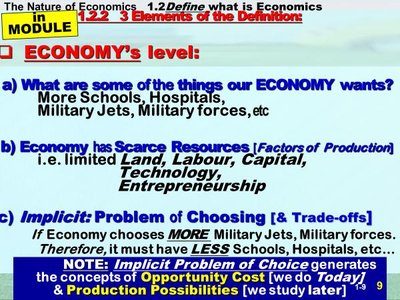
Economy's Level: Wants, Scarce Resources, and Trade-offs
Economy Wants: Examples include schools, hospitals, military jets, and forces.
Scarce Resources: Limited factors of production such as land, labour, capital, technology, and entrepreneurship.
Implicit Problem of Choosing: Choosing more of one item (e.g., military jets) means having less of another (e.g., schools).
The implicit problem of choice generates the concepts of opportunity cost and production possibilities.
Opportunity Cost, Factors of Production & Production Possibilities
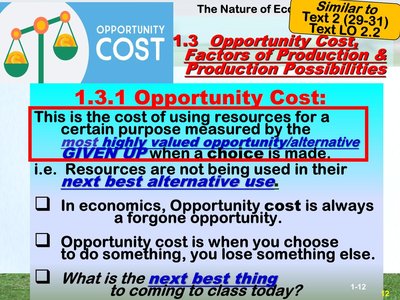
Opportunity Cost
Opportunity cost is the cost of using resources for a certain purpose, measured by the most highly valued opportunity or alternative given up when a choice is made. It represents the value of the next best alternative not chosen.
In economics, opportunity cost is always a forgone opportunity.
When you choose to do something, you lose the chance to do something else.
Example: The opportunity cost of coming to class is what you could have done instead.
Factors of Production
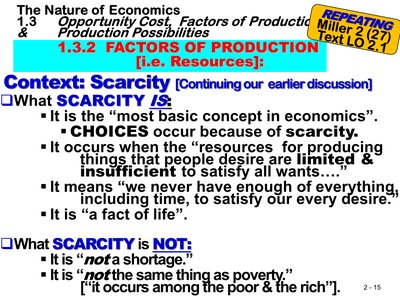
Scarcity is the most basic concept in economics, leading to choices and trade-offs. It occurs when resources for producing goods and services are limited and insufficient to satisfy all wants. Scarcity is not a shortage or poverty; it is a universal fact of life.
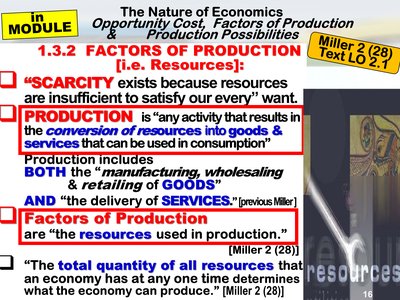
Production: Any activity that converts resources into goods and services for consumption.
Factors of Production: The resources used in production, including land, labour, capital, technology, and entrepreneurship.
The total quantity of all resources at any time determines what the economy can produce.
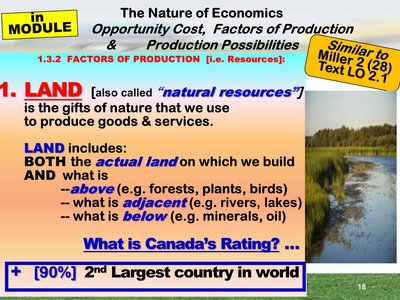
Land (Natural Resources)
Land refers to the gifts of nature used to produce goods and services. It includes:
The actual land on which we build
What is above (forests, plants, birds)
What is adjacent (rivers, lakes)
What is below (minerals, oil)
Canada is rated as the 2nd largest country in the world, with significant land resources.
Labour (Including Human Capital)
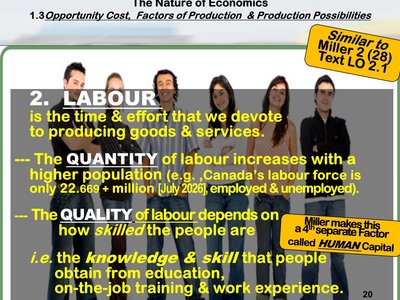
Labour is the time and effort devoted to producing goods and services. The quantity of labour increases with population, while the quality depends on how skilled people are. Human capital refers to the knowledge and skills obtained from education, training, and work experience.
Canada's labour force is over 22 million (as of July 2026).
Quality of labour is determined by education and experience.
Additional info:
Further factors of production include physical capital, technology, and entrepreneurship, which are discussed in later slides and lectures.
Production possibilities and opportunity cost are foundational concepts for understanding economic models and resource allocation.
