 Indietro
Macroeconomics Study Guide: Monetary Policy, Fiscal Policy, Bonds, and Time Value of Money
Guida di studio - Note intelligenti
 Appunti personalizzati basati sui tuoi materiali, ampliati con definizioni chiave, esempi e contesto.
Monetary Policy and the Federal Reserve
Overview of Monetary Policy
Monetary policy refers to the actions taken by a central bank, such as the Federal Reserve (Fed), to manage the money supply and interest rates in order to influence economic activity. The Fed uses several tools to achieve its goals of stable prices, maximum employment, and moderate long-term interest rates.
Interest Rates: The Fed can raise or lower interest rates to influence borrowing, spending, and investment.
Open Market Operations (OMO): Buying and selling government securities to adjust reserve levels and influence short-term interest rates.
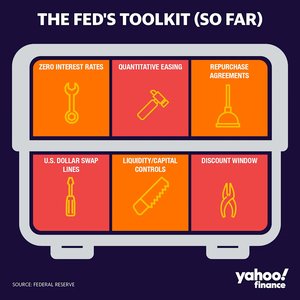
Quantitative Easing: Large-scale asset purchases to inject liquidity into the economy.
Repurchase Agreements (Repos): Short-term loans where securities are sold and repurchased, used to manage liquidity.
Discount Window: Facility for banks to borrow reserves directly from the Fed.
U.S. Dollar Swap Lines: Agreements with foreign central banks to provide dollar liquidity.
Liquidity/Capital Controls: Measures to ensure financial stability and adequate capital in the banking system.
Interest Rates and Bond Prices
Inverse Relationship: When interest rates rise, bond prices fall; when interest rates fall, bond prices rise.
Yield to Maturity (YTM): The annual return an investor earns if a bond is held until maturity, calculated based on current price, coupon payments, and time to maturity.
Bond Pricing Formula:
Bond Quotes: Bonds are quoted as a percentage of par value (e.g., 93 means 93% of $10,000 = $9,300).
Fiscal Policy
Essentials of Fiscal Policy
Fiscal policy is the use of government spending and taxation to influence the economy. The federal government can change its spending or taxes to affect total demand, employment, economic growth, and the federal budget.
Expansionary Fiscal Policy: Increase government spending or cut taxes to stimulate economic activity, especially during a recession.
Contractionary Fiscal Policy: Decrease government spending or increase taxes to reduce demand, which may help cool an overheated economy or inflation.
Government Spending and Taxes
Major Categories of Spending: Social Security, Medicare and Medicaid, National Defense, Other spending (education, transportation, scientific research, public safety, income support, interest on government debt).
Mandatory vs. Discretionary Spending: Mandatory spending is governed by eligibility rules (e.g., Social Security, Medicare). Discretionary spending is provided through annual appropriations (e.g., defense, education).
Main Sources of Tax Revenue: Individual income taxes, payroll taxes, corporate income taxes, excise taxes, customs duties, and fees.
Budget Deficit, Surplus, and National Debt
Budget Deficit: Occurs when government spending exceeds revenue in a fiscal year.
Budget Surplus: Occurs when revenue exceeds spending.
National Debt: The accumulated amount the federal government owes from past borrowing.
Bonds and Fixed Income Securities
Bond Basics
Bond: A loan made to a borrower (issuer) that will be repaid with interest.
Par Value: The face value of the bond, paid back at maturity.
Coupon: The annual interest payment, usually a percentage of par value.
Yield to Maturity (YTM): The rate of return if the bond is held to maturity.
Fixed Income Security: Slang term for bonds, as they provide fixed payments.
Bond Pricing and Yield Calculations
Price Calculation: Present value of all future cash flows (coupon payments and par value).
Example: For a \text{Price} = \sum_{t=1}^{20} \frac{\
Gain/Loss Formula:
Time Value of Money (TVM)
TVM Concepts and Formulas
The time value of money is the concept that money available today is worth more than the same amount in the future due to its earning potential.
Future Value (FV): The value of an investment after a certain period, given a specific interest rate.
Present Value (PV): The amount you must invest today to reach a future goal.
Compound Interest: Interest calculated on the initial principal and also on the accumulated interest of previous periods.
Simple Interest (for Repos):
Federal Reserve and Banking System
Fed's Relationship with Banks
Required Reserve Ratio (R/R): The percentage of deposits banks must hold as reserves.
Excess Reserves: Reserves held by banks above the required minimum.
Federal Funds Rate: The interest rate at which banks lend reserves to each other overnight.
Interest on Reserve Balances (IORB): The rate the Fed pays banks for holding reserves.
Discount Rate: The rate charged by the Fed for loans to banks via the discount window.
Aggregate Demand and Aggregate Supply
AD and SRAS Curves
Aggregate Demand (AD): Downward sloping; movements along the curve are caused by changes in the price level. Shifts occur due to changes in consumption, investment, government purchases, net exports.
Short-Run Aggregate Supply (SRAS): Upward sloping; movements along the curve are caused by changes in the price level. Shifts occur due to changes in input prices, productivity, expectations, supply shocks.
Practice Questions and Applications
Sample Calculations and Scenarios
TVM Example: How much must you deposit today to have \text{PV} = \frac{50,000}{(1+0.09)^{13}}$
Bond Example: You buy a $10,000 par, 25-year, 6% coupon bond when its yield is 6.5% and sell it 6 years from now when quoted at 93. What is the buyer's YTM?
Repo Example: Disney needs a 5-day loan of \text{Interest} = 100,000,000 \times 0.05 \times \frac{5}{360}$
Required Reserve Ratio Example: A bank has
Key Terms and Definitions
Bond: Debt security issued by corporations or governments.
Coupon: Periodic interest payment on a bond.
Yield to Maturity (YTM): Total return anticipated if the bond is held to maturity.
Fiscal Policy: Government decisions on spending and taxation.
Monetary Policy: Central bank actions to manage money supply and interest rates.
Aggregate Demand (AD): Total demand for goods and services in the economy.
Short-Run Aggregate Supply (SRAS): Total supply of goods and services in the short run.
Required Reserve Ratio (R/R): Minimum fraction of deposits banks must hold as reserves.
Federal Funds Rate: Rate at which banks lend reserves to each other overnight.
Interest on Reserve Balances (IORB): Rate paid by the Fed to banks for holding reserves.
Summary Table: Fed's Toolkit
Tool | Description |
|---|---|
Zero Interest Rates | Lowering policy rates to stimulate borrowing and spending |
Quantitative Easing | Large-scale asset purchases to inject liquidity |
Repurchase Agreements | Short-term loans using securities as collateral |
U.S. Dollar Swap Lines | Providing dollar liquidity to foreign central banks |
Liquidity/Capital Controls | Ensuring financial stability and adequate capital |
Discount Window | Direct lending facility for banks |
