 Indietro
Measuring GDP and Its Limitations: Concepts, Methods, and Applications
Guida di studio - Note intelligenti
 Appunti personalizzati basati sui tuoi materiali, ampliati con definizioni chiave, esempi e contesto.
Gross Domestic Product (GDP): Definition and Core Concepts
What is GDP?
Gross Domestic Product (GDP) is the market value of all final goods and services produced within a country during a specific period, typically one year. It is the most widely used measure of a nation's economic activity and output.
Market Value: All goods and services are valued at market prices, allowing for aggregation into a single monetary measure.
Final Goods and Services: Only goods and services purchased by their ultimate users are counted. Intermediate goods (used as inputs in production) are excluded to avoid double-counting.
Geographic Scope: Only production within a country's borders is included, regardless of the producer's nationality.
Time Frame: Only goods and services produced within the specified period are counted. Used goods are excluded, as their value was already included when first sold as new.
Example: A Japanese automaker assembling cars in the US contributes to US GDP, while a US firm producing in Europe contributes to European GDP.
The Circular Flow Model
Basic Structure
The Circular Flow Model illustrates the continuous movement of money, resources, and goods/services in an economy. It demonstrates that total production, total income, and total expenditure are always equal.
Households and Firms: Households provide labor to firms and receive income (wages), which they spend on goods and services produced by firms.
Money Flow: Firms pay households for labor; households spend income on firms' products.
Goods and Labor Flow: Goods and services flow from firms to households; labor flows from households to firms.
Expanded Model: Additional Sectors
Government: Collects taxes and provides public services and benefits.
Rest of the World: Imports (spending on foreign goods) and exports (foreign spending on domestic goods).
Financial System: Channels household savings into investments by firms and government.
Three Approaches to Calculating GDP
Because production, income, and expenditure are always equal, GDP can be measured in three ways:
1. Expenditure Approach
Measures total spending on final goods and services:
Formula:
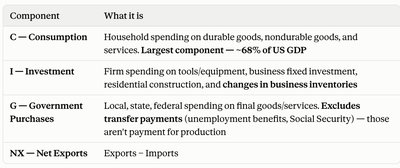
C (Consumption): Household spending on goods and services (largest component, ~68% of US GDP).
I (Investment): Firm spending on capital goods, residential construction, and inventory changes.
G (Government Purchases): Government spending on goods and services (excludes transfer payments).
NX (Net Exports): Exports minus imports.
Component | What it is |
|---|---|
C — Consumption | Household spending on durable goods, nondurable goods, and services. Largest component — ~68% of US GDP |
I — Investment | Firm spending on tools/equipment, business fixed investment, residential construction, and changes in business inventories |
G — Government Purchases | Local, state, federal spending on final goods/services. Excludes transfer payments (unemployment benefits, Social Security) |
NX — Net Exports | Exports – Imports |
2. Value Added (Production) Approach
Measures the value added at each stage of production, summing the difference between a firm's output and the cost of intermediate goods.
Stage | Firm | Buys | Wages Paid | Sells For |
|---|---|---|---|---|
1 | Bennett Lumber | $0 (raw materials) | $300 | $400 |
2 | McCreary Modern | $400 (lumber) | $500 | $1,000 |
3 | Crate & Barrel | $1,000 (couch) | $200 | $1,500 |
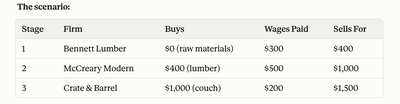
Value Added Calculation: For each firm, subtract the cost of intermediate goods from the value of output. Sum across all firms for total GDP.
Example: Bennett Lumber adds $400, McCreary Modern adds $600, Crate & Barrel adds $500; total GDP = $1,500.
3. Income Approach
Measures total income earned by households and firms in the economy, including wages, interest, rent, and profit:
Formula:
w: Wages
i: Interest
r: Rent
p: Profit
Example: For each firm, sum wages and profits; total across all firms equals GDP.
GDP Limitations
Shortcomings as a Measure of Production
Household Production: Non-market activities (childcare, home repairs) are not counted.
Underground Economy: Informal or illegal transactions are omitted.
Shortcomings as a Measure of Well-being
Leisure Time: More work increases GDP but may reduce quality of life.
Environmental Quality: Pollution and resource depletion are not subtracted from GDP.
Social Conditions: Spending on security increases GDP but may reflect societal problems.
Income Distribution: GDP does not indicate how evenly income is distributed.
Alternative Measures
Happy Planet Index: Considers life satisfaction, life expectancy, and sustainability.
Gridiron Index: Tracks discretionary spending as a behavioral signal of economic health.
Nominal vs. Real GDP & The GDP Deflator
Nominal vs. Real GDP
Nominal GDP: Values output using current-year prices; does not account for inflation.
Real GDP: Values output using base-year prices; isolates changes in actual production.
Product | 2015 | 2025 | ||
|---|---|---|---|---|
Quantity | Price | Quantity | Price | |
Eggs (dozen) | 100,000 | $2.50 | 95,000 | $5.00 |
Eye exams | 100 | $80.00 | 110 | $100.00 |
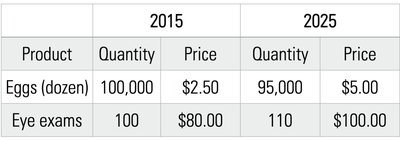
Example Calculation: Nominal GDP in 2015 = (100,000 × $2.50) + (100 × $80) = $258,000. Nominal GDP in 2025 = (95,000 × $5.00) + (110 × $100) = $486,000.
Real GDP in 2025 (using 2015 prices) = (95,000 × $2.50) + (110 × $80) = $246,300.
If real GDP falls, actual production has decreased, even if nominal GDP rises due to higher prices.
The GDP Deflator
The GDP Deflator measures the overall change in prices (inflation) in the economy. It is calculated as:

Base Year: The deflator is always 100 in the base year.
Interpretation: A deflator of 197 means prices are 97% higher than in the base year.
Calculating the Rate of Price Increase
The rate of increase in the price level (inflation rate) is calculated as:

Alternatives to GDP in National Accounting
Gross National Product (GNP): Measures output produced by a country's citizens and firms worldwide.
National Income: GDP minus depreciation (wear and tear on capital).
Personal Income: Total income received by households.
Disposable Income: Personal income after taxes; the amount households can spend or save.
Additional info: The tables and formulas provided reinforce the calculation methods and conceptual distinctions between GDP measures, as well as the limitations and alternative indicators relevant for macroeconomic analysis.
