 Indietro
Monitoring the Value of Production: GDP (Gross Domestic Product)
Guida di studio - Note intelligenti
 Appunti personalizzati basati sui tuoi materiali, ampliati con definizioni chiave, esempi e contesto.
Monitoring the Value of Production: GDP
Introduction to Macroeconomic Measurement
Macroeconomics seeks to measure the total production of goods and services in a country over a specific period. This is more complex than measuring a single market, as it requires combining the value of diverse goods and services into one comprehensive statistic: Gross Domestic Product (GDP).
Gross Domestic Product (GDP)
Definition and Importance
GDP is the market value of all final goods and services produced within a country in a given time period.
It is the most common measure of a country's productivity and wealth.
Breaking Down the Definition of GDP
Market Value: The prices at which items are traded in markets. To measure total production, we sum the dollar value of all goods and services, not just their quantities.
Final Goods: Only goods purchased by their final users are counted. Intermediate goods (used as inputs for final goods) are excluded to avoid double counting.
Domestic Production: Only goods produced within a country's borders are included in its GDP.
Time Period: GDP is measured over a specific interval, typically a quarter or a year.
Final vs. Intermediate Goods
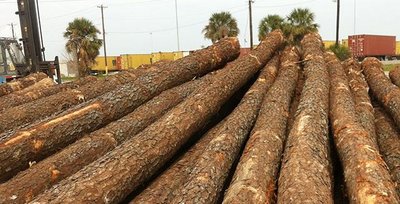
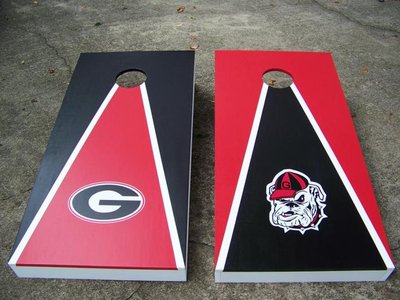
To avoid double counting, only the value of final goods is included in GDP. For example, if a lumberjack sells logs to a company, which then makes plywood, and another person uses the plywood to make a cornhole board, only the value of the final cornhole board is counted in GDP.
Domestic Production
GDP includes only goods and services produced within the country, regardless of the nationality of the producer.


Time Period
GDP is measured for a specific period, such as a quarter or a year, to track economic performance over time.
The Circular Flow of Expenditure and Income
Understanding Economic Flows
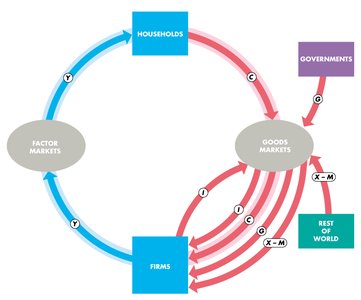
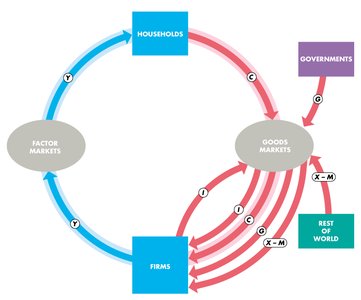
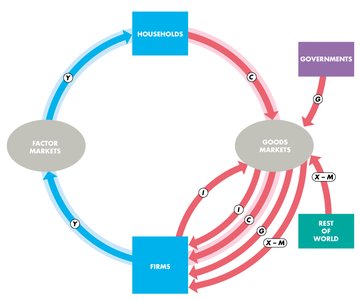
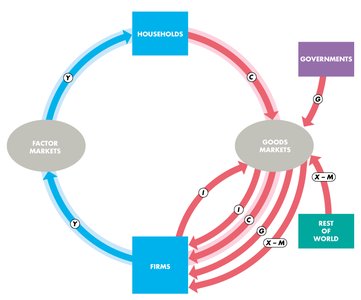
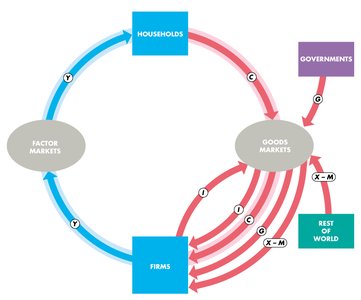
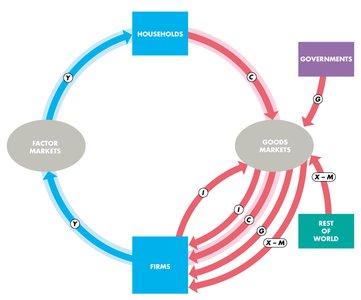
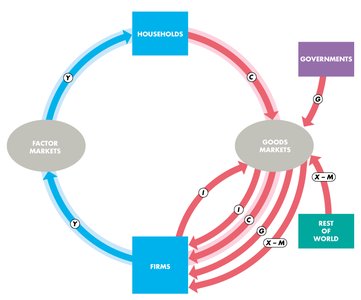
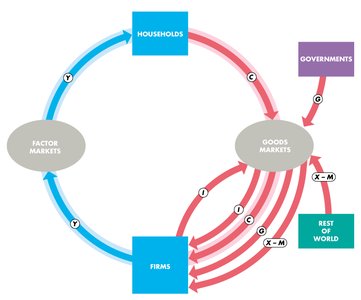
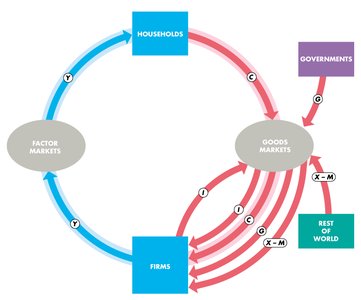
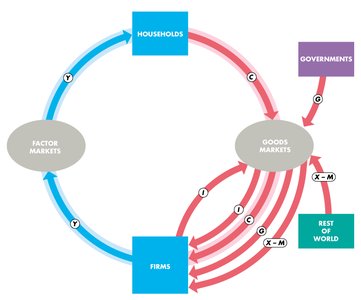
The circular flow model illustrates how money moves through the economy between households, firms, governments, and the rest of the world. Payments for goods and services (expenditures) flow to firms, while income flows to households through factor markets.
Types of Expenditure
Consumption Expenditure (C): Payments from households to firms for goods and services. This is the largest component of GDP.
Investment (I): Payments from firms to firms for capital goods (e.g., machinery, buildings). Includes both new and replacement capital.
Government Expenditure (G): Payments from governments to firms for goods and services (e.g., infrastructure, defense). Taxes are not included.
Net Exports (X - M): Payments from the rest of the world for exports minus payments for imports.
Investment: Gross vs. Net
Gross Investment: Total spending on new and replacement capital.
Net Investment: Gross investment minus depreciation (the loss of value due to wear and tear).
Formula:
Government Expenditure
Includes spending on goods and services by all levels of government.
Does not include transfer payments (e.g., social security, unemployment benefits) or taxes.
Net Exports
Exports (X): Goods and services sold to other countries.
Imports (M): Goods and services purchased from other countries.
Net Exports:
Income Approach
GDP can also be measured by summing all incomes earned by households from firms, including wages, interest, profits, and rent.
GDP Calculation: Expenditure and Income Approaches
Expenditure Approach:
Income Approach: (aggregate income)
Both approaches should yield the same GDP value.
Mathematical Note
The GDP equation can be rearranged to solve for any missing variable if the others are known. For example:
Nominal GDP and Real GDP
Comparing GDP Over Time
Nominal GDP: The value of final goods and services produced in a given year, measured at current prices.
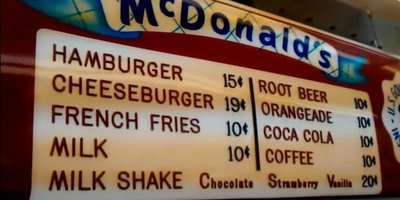
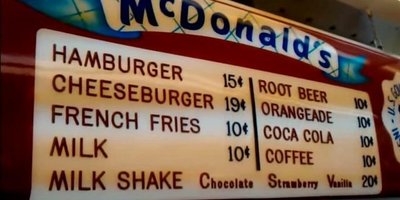
Real GDP: The value of final goods and services produced in a given year, measured at the prices of a reference base year. This allows for meaningful comparisons over time by removing the effects of price changes.
Calculating Real GDP
Use the quantities from the year being measured but the prices from the base year.
Real GDP Per Person
Real GDP per person:
This measures the average standard of living.
Potential GDP and the Business Cycle
Potential GDP: The highest level of GDP that can be sustained over the long run, given available resources.
Business Cycle: The fluctuations of real GDP around potential GDP, including expansions, peaks, recessions, and troughs.
Comparisons Across Countries
Problems with Using Real GDP for International Comparisons
Real GDP is measured in local currency, making direct comparisons difficult.
Exchange rates can distort comparisons due to differences in price levels between countries.
Purchasing Power Parity (PPP)
PPP-adjusted GDP: Measures the value of goods and services a country's residents can buy at US prices, correcting for differences in price levels.
This provides a more accurate comparison of living standards across countries.
Limitations of Real GDP
What GDP Misses
Household Production: Goods and services produced and consumed within households are not counted in GDP.
Underground Economic Activity: Transactions not reported to the government (e.g., cash jobs) are excluded.
Leisure: Time spent on leisure activities is not reflected in GDP, even though it contributes to well-being.
Environmental Quality: GDP does not account for negative externalities like pollution or positive factors like clean air and water.
New Goods: The introduction of entirely new goods can be difficult to measure using base year prices.
Alternative Measures of Well-Being
Other indicators, such as the Human Development Index, Green Net National Product, and Happiness Index, have been proposed to address GDP's limitations.
Despite its shortcomings, GDP remains the most widely used measure in macroeconomics.
