 Indietro
Trade-offs, Comparative Advantage, and the Market System – Study Notes
Guida di studio - Note intelligenti
 Appunti personalizzati basati sui tuoi materiali, ampliati con definizioni chiave, esempi e contesto.
Chapter 2: Trade-offs, Comparative Advantage, and the Market System
Scarcity and Trade-offs
Scarcity is a fundamental concept in economics, referring to the situation where unlimited wants exceed the limited resources available to fulfill those wants. This condition forces individuals, firms, and governments to make choices, leading to trade-offs in resource allocation.
Scarcity: The basic economic problem that arises because resources are limited while wants are unlimited.
Trade-off: The idea that, because of scarcity, producing more of one good or service means producing less of another.
Example: If Ford allocates more resources to producing electric vehicles (EVs), it must reduce resources for gasoline-powered vehicles.
Production Possibilities Frontier (PPF) and Opportunity Costs
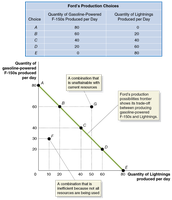
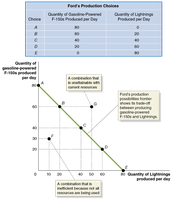
The Production Possibilities Frontier (PPF) is a model that illustrates the maximum attainable combinations of two goods that can be produced with available resources and technology. It is a positive economic tool, describing what is possible, not what should be.
PPF: A curve showing the maximum combinations of two products that can be produced with available resources and technology.
Opportunity Cost: The highest-valued alternative that must be given up to engage in an activity.
Efficiency: Points on the PPF are efficient; points inside are inefficient; points outside are unattainable.
Increasing Marginal Opportunity Costs
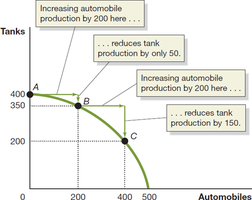
Opportunity costs are often increasing because resources are not equally suited to all tasks. As more resources are shifted to one good, the opportunity cost of producing additional units rises.
Law of Increasing Opportunity Costs: As production of a good increases, the opportunity cost of producing an additional unit rises.
Economic Growth and Shifts in the PPF
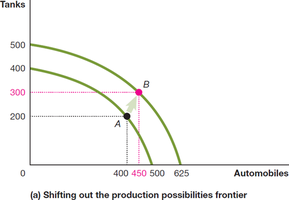
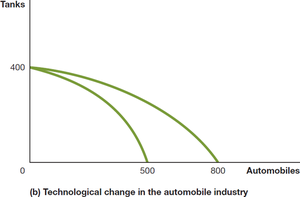
Economic growth occurs when an economy's capacity to produce goods and services increases, shifting the PPF outward. This can result from more resources or technological improvements.
Economic Growth: The ability of the economy to increase production over time.
Technological Change: Improvements in technology can shift the PPF outward for specific goods.
Application: PPF for Exam Grades
When allocating limited study time between two exams, the PPF is typically bowed outward, reflecting increasing opportunity costs—the first hours spent on a subject yield the greatest benefit.
Comparative Advantage and Trade
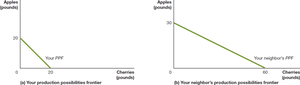
Comparative advantage explains the basis for trade. Even if one party is more productive in all activities (absolute advantage), both can benefit from trade by specializing in activities where they have a comparative advantage (lower opportunity cost).
Absolute Advantage: The ability to produce more of a good with the same resources than another producer.
Comparative Advantage: The ability to produce a good at a lower opportunity cost than another producer.
Specialization: Focusing on the production of goods for which one has a comparative advantage increases total output and allows for beneficial trade.
Gains from Trade
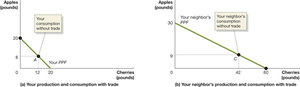
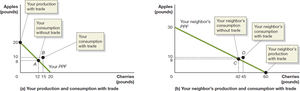
By specializing and trading, both parties can consume more than they could without trade. The gains from trade are based on comparative, not absolute, advantage.
Example: If you specialize in apples and your neighbor in cherries, and you trade, both can enjoy more of both goods.
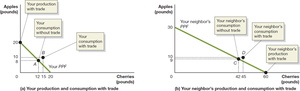
Opportunity Costs and the Basis for Trade
The opportunity cost of producing one good in terms of another determines comparative advantage. Specialization according to comparative advantage leads to increased overall efficiency and output.
Application: Comparative Advantage in Housework
Even if one person is better at all household tasks, both can benefit by specializing in the task where their opportunity cost is lowest.
The Market System
The market system is the institutional arrangement through which buyers and sellers interact to exchange goods and services. It relies on the interaction of households and firms in various markets.
Market: A group of buyers and sellers of a good or service and the institution or arrangement by which they come together to trade.
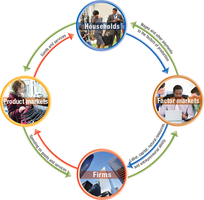
Households: Provide factors of production (labor, capital, natural resources, entrepreneurial ability).
Firms: Purchase factors of production and use them to produce goods and services.
The Four Factors of Production
Labor: All types of work.
Capital: Physical capital such as machinery, buildings, and tools.
Natural Resources: Raw materials like land, water, and minerals.
Entrepreneurial Ability: The skill to bring together the other factors to produce goods and services.
Factor and Product Markets
Factor Market: Where resources (labor, capital, etc.) are bought and sold.
Product Market: Where finished goods and services are bought and sold.
The Circular-Flow Diagram
The circular-flow diagram illustrates the flow of resources, goods, services, and money in an economy. Households provide factors of production to firms, and firms provide goods and services to households. Money flows in the opposite direction.
The Gains from Free Markets
Free markets, with minimal government intervention, have historically led to higher living standards compared to centrally planned economies. Adam Smith's concept of the "invisible hand" describes how self-interested actions in markets can lead to outcomes that benefit society as a whole.
Free Market: Few government restrictions on production, sale, or employment of resources.
Invisible Hand: The self-regulating nature of the marketplace in determining how resources are allocated.
The Market Mechanism
Markets use price signals to allocate resources efficiently. When consumer preferences change, prices adjust, signaling firms to alter production accordingly. This decentralized decision-making process is more adaptive than central planning.
How the Market Mobilizes Knowledge
Markets aggregate and utilize both general and local knowledge, allowing for rapid adaptation to changing conditions. Individual pursuit of profit helps disseminate information throughout the economy.
Application: How Do You Make an iPad?
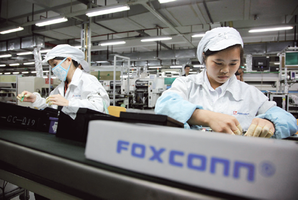
Complex products like the iPad are produced through the coordinated efforts of many firms, each acting in its own self-interest, guided by market signals rather than central direction.
The Role of the Entrepreneur in the Market System
Entrepreneurs organize the factors of production to create goods and services, often introducing innovations that drive economic growth. Their willingness to take risks is essential for progress.
The Legal Basis of a Successful Market System
While free markets are essential, a sound legal environment is necessary for markets to function well. This includes protection of private property, enforcement of contracts, and an independent court system.
Property Rights: The rights to use, buy, or sell property.
Contract Enforcement: Ensures that agreements are honored, facilitating transactions over time.
Application: What Is Socialism?
Socialism, as envisioned by Karl Marx, involves collective ownership of resources. In practice, countries adopting communism have implemented centrally planned economies. Social democratic systems, in contrast, advocate for significant government involvement in the economy, particularly in sectors like health care and education, without full state ownership of all resources.
