 Indietro
Understanding Marginal Opportunity Cost on a Production Possibilities Frontier
Guida di studio - Note intelligenti
 Appunti personalizzati basati sui tuoi materiali, ampliati con definizioni chiave, esempi e contesto.
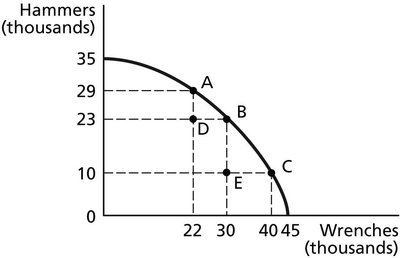
Q33. If the economy is currently producing at point A, what is the marginal opportunity cost of moving to point B?
Background
Topic: Production Possibilities Frontier (PPF) and Opportunity Cost
This question tests your understanding of how to calculate the marginal opportunity cost when moving between points on a PPF. The PPF shows the maximum possible output combinations of two goods that can be produced given available resources and technology.
Key Terms and Formulas
Marginal Opportunity Cost: The amount of one good that must be given up to produce an additional unit of another good.
Production Possibilities Frontier (PPF): A curve showing the maximum attainable combinations of two products that may be produced with available resources.
Formula:
Step-by-Step Guidance
Identify the coordinates for points A and B on the PPF. For example, point A might represent (22, 35) and point B (30, 29), where the first value is wrenches (thousands) and the second is hammers (thousands).
Calculate the change in the number of wrenches produced when moving from A to B: .
Calculate the change in the number of hammers produced when moving from A to B: .
Since producing more wrenches means producing fewer hammers, the opportunity cost is the decrease in hammers per increase in wrenches.
Set up the marginal opportunity cost formula: .
Try solving on your own before revealing the answer!
Final Answer: Marginal opportunity cost = -0.75 hammers per wrench
This means for each additional wrench produced, 0.75 hammers must be given up.
