 Indietro
Unemployment and Inflation: Key Concepts and Measurement
Guida di studio - Note intelligenti
 Appunti personalizzati basati sui tuoi materiali, ampliati con definizioni chiave, esempi e contesto.
Unemployment and Inflation
Misery Index
The Misery Index is a simple measure that combines the unemployment rate and the inflation rate to gauge the overall economic discomfort experienced by a population. It is calculated as:
Misery Index = Unemployment Rate + Inflation Rate
Example: In February 2020, the Misery Index was 5.8 (3.5% unemployment + 2.3% inflation).
Major Points: Unemployment
Unemployment is a critical indicator of economic health, measured and classified in several ways:
Actively Looking for a Job: Only individuals actively seeking employment are counted as unemployed.
Unemployment Rate Formula:
Official Measure Limitations:
Understates true unemployment due to discouraged workers and involuntary part-time workers.
Overstates true unemployment due to people falsely claiming to be job-seeking and jobs in the underground economy.
Types of Unemployment
Unemployment is classified into three main types, each with distinct causes and implications:
Frictional Unemployment: Short-term unemployment arising from the process of matching workers with jobs. It is caused by normal labor market turnover, such as people entering or exiting the labor force and businesses expanding or contracting.
Structural Unemployment: Unemployment resulting from a persistent mismatch between workers' skills and job requirements. Structural changes in the economy, such as technological advancements or international competition, are common causes.
Cyclical Unemployment: Unemployment caused by downturns in the business cycle, such as recessions.
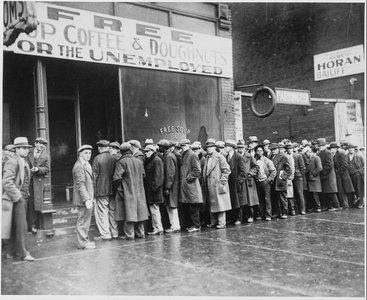
Visual Representation of Unemployment Types
Below are images that illustrate the three types of unemployment:
Frictional Unemployment: Individuals searching and networking for jobs, often qualified but between positions.

Structural Unemployment: Workers whose skills do not match available jobs, often requiring retraining or relocation.

Cyclical Unemployment: Large groups affected by economic downturns, such as layoffs during recessions.
Natural Rate of Unemployment
The Natural Rate of Unemployment is the unemployment rate at full employment, consisting of frictional and structural unemployment, but no cyclical unemployment. It is not zero, as some unemployment always exists due to normal labor market turnover and structural changes.
Can be influenced by public policies, such as unemployment compensation and labor laws.
Formula:
Measurement of Unemployment
Unemployment is measured using two main surveys:
Household Survey: Surveys about 60,000 households, assessing employment status of individuals aged 16 and over.
Establishment (Payroll) Survey: Samples about 300,000 business establishments, counting persons employed on company payrolls.
Calculating the Unemployment Rate
Formula:
Labor Force = Employed + Unemployed
Example for July 2026:
Measurement Problems
The official unemployment rate may understate or overstate true unemployment:
Understates: Discouraged workers and involuntary part-time workers are not fully captured.
Overstates: Individuals falsely claiming to be job-seeking and jobs in the underground economy.
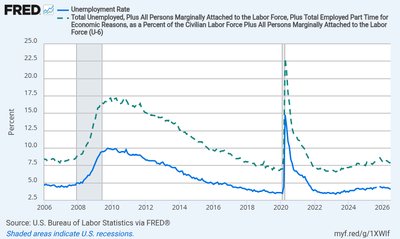
Broad Measure of Unemployment Rate
The broad measure (U-6) includes discouraged workers and part-time workers for economic reasons, often exceeding the official rate by several percentage points.
Employment-Population Ratio
The Employment-Population Ratio measures the percentage of the working-age population that has jobs. It is considered the best single indicator of the labor market.
Formula:
Drawback: Workers who drop out of the labor market are no longer counted as unemployed, which decreases the unemployment rate but does not change the employment-population ratio.
Labor Force Participation Rate
The Labor Force Participation Rate measures the percentage of the working-age population in the labor force.
Formula:
Unemployment Rates for Demographic Groups
Unemployment rates vary across demographic groups. For July 2026:
Group | Unemployment Rate (%) |
|---|---|
White | 3.6 |
Black | 6.3 |
Hispanic | 4.6 |
Asian | 4.0 |
Women | 3.9 |
Men | 4.2 |
Teenagers | 12.1 |
Black Teenagers | 18.8 |
Job Creation and Job Destruction
The U.S. economy creates and destroys millions of jobs every year. Net job changes reported monthly understate the gross number of jobs created and destroyed.
2021: 35 million jobs created, 29.9 million jobs destroyed, net 5.1 million.
Job creation and destruction result from changes in consumer tastes, technological progress, and entrepreneurial success or failure.
Government Policies Affecting Unemployment
Unemployment insurance payments allow time to search for a good job match and maintain income and spending, reducing the severity of recessions. However, if set too high or for too long, they can increase the natural rate of unemployment.
Advice for Job Seekers
Frictionally Unemployed: Keep searching, network, and you are qualified.
Structurally Unemployed: Learn new skills, retrain, or relocate.
Cyclically Unemployed: It's not your fault; file for unemployment benefits.

Summary Table: Types of Unemployment
Type | Cause | Duration | Example |
|---|---|---|---|
Frictional | Normal labor market turnover | Short-term | Recent graduates searching for jobs |
Structural | Mismatch of skills and jobs | Long-term | Workers displaced by technology |
Cyclical | Business cycle recession | Variable | Layoffs during economic downturn |
Key Formulas
Additional info: Academic context and examples were added to clarify measurement, types, and policy effects. Images were included only when directly relevant to the explanation of unemployment types and job search advice.
