 Indietro
Cost-Volume-Profit Analysis and Short-Term Decision Making in Managerial Accounting
Guida di studio - Note intelligenti
 Appunti personalizzati basati sui tuoi materiali, ampliati con definizioni chiave, esempi e contesto.
Cost-Volume-Profit (CVP) Analysis
Introduction to CVP Analysis
Cost-Volume-Profit (CVP) analysis is a fundamental tool in managerial accounting that helps managers understand the relationship between costs, sales volume, and profit. It is used to determine the sales volume needed to break even or achieve a target profit, and to analyze the impact of changing business conditions.
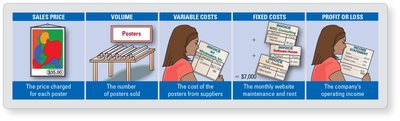
Key Components: Sales price, volume, variable costs, fixed costs, and profit or loss.
Applications: Decision-making regarding pricing, product mix, and cost structure.

CVP Assumptions
CVP analysis relies on several assumptions to simplify calculations and interpretations:
Sales price remains constant throughout the relevant range of volume.
Cost classification: Each cost is classified as either variable or fixed.
Inventory levels do not change during the analysis period.
Product mix remains constant.
Contribution Margin and Contribution Margin Ratio
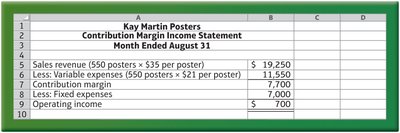
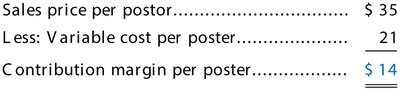
The contribution margin is the excess of sales revenue over variable expenses. The unit contribution margin is the excess of the selling price per unit over the variable cost per unit. The contribution margin ratio expresses the proportion of sales revenue that contributes to covering fixed costs and generating profit.
Formula for Unit Contribution Margin:
Formula for Contribution Margin Ratio:

Calculating Breakeven Point
The breakeven point is the sales level at which operating income is zero. At this point, total revenues equal total expenses. There are three main approaches to calculate the breakeven point:
Income Statement Approach
Shortcut Approach using Unit Contribution Margin
Shortcut Approach using Contribution Margin Ratio
Breakeven Formula (Units):



Target Profit Analysis
To determine the sales volume needed to achieve a target profit, CVP analysis can be applied using the unit contribution margin or the contribution margin ratio.
Target Profit Formula (Units):
Target Profit Formula (Sales Revenue):



Impact of Changing Business Conditions
CVP analysis is used to measure the impact of changing sales price, variable costs, and fixed costs on the breakeven point and profitability.
Changing Sales Price: Affects unit contribution margin and breakeven volume.
Changing Variable Costs: Higher variable costs reduce unit contribution margin, similar to lower sales prices.
Changing Fixed Costs: Alters breakeven point but does not affect unit contribution margin.

Sustainability and CVP
Reducing variable costs, such as decreasing the use of plastic, can help both the environment and profitability by making it easier to reach a target profit.
Short-Term Decision Making
Relevant Information for Short-Term Decisions
Short-term business decisions require managers to focus on relevant revenues, costs, and profits. The incremental analysis approach examines only how operating income would change under each alternative, ignoring irrelevant information.
Six Common Short-Term Decisions: Pricing, special orders, discontinuing products, product mix with constraints, outsourcing (make or buy), and selling as is or processing further.
Pitfalls: Avoid including sunk costs and using unit costs unless they are purely variable.
Approaches to Pricing
Pricing decisions depend on whether the company is a price-taker or price-setter. Two main approaches are used:
Cost-Plus Pricing: Total cost plus desired profit determines the price.
Target Costing: Market price minus desired profit determines the target total cost.
Special Order Decisions
A special order is a one-time order at a reduced sales price. Managers must consider excess capacity, incremental costs, and potential impact on regular sales.
Decision Rule: Accept the order if the incremental revenue exceeds the incremental costs.
Pitfall: Never compare special order price with absorption cost per unit; use contribution margin approach.
Discontinuing Products, Departments, or Stores
Managers must evaluate whether a product provides a positive contribution margin and if any fixed costs can be avoided by discontinuation.
Decision Rule: Discontinue if avoidable fixed costs exceed the contribution margin lost.
Pitfall: Do not base decisions on income statements that allocate common fixed expenses; use segment margin statements.
Product Mix Decisions with Constraints
When resources are constrained, managers must determine which products offer the highest contribution margin per unit of the constraint.
Formula:
Outsourcing (Make-or-Buy) Decisions
Outsourcing involves contracting an outside company to produce a product or perform a service. Managers compare variable costs per unit to outsourcing costs and consider avoidable fixed costs and alternative uses for freed capacity.
Benefits: Focus on core competencies, reduce risk, lower cost.
Drawbacks: Less control, management of relationships, potential layoffs.
Sell As Is or Process Further Decisions
Managers must compare the revenue and costs of selling a product as is versus processing it further.
Decision Rule: Process further if the incremental revenue exceeds the incremental cost.
Data Analytics in Managerial Accounting
Managers use four main types of data analytics to analyze business decisions:
Descriptive Analytics: Describe what has happened or is happening.
Diagnostic Analytics: Uncover the root cause of the current state.
Predictive Analytics: Forecast what will happen in the future.
Prescriptive Analytics: Determine what should be done.
The Comprehensive Budget
Purpose and Structure of Budgets
Budgets are planning documents that help managers achieve organizational goals. They consist of operating budgets (for daily operations) and financial budgets (for capital expenditures and cash management).
Participative Budgeting: Involves multiple levels of management, increasing motivation and accuracy.
Zero-Based Budgeting: Managers justify every dollar, starting from zero.
Operating Budgets
Operating budgets include sales, production, direct materials, direct labor, manufacturing overhead, and operating expenses budgets. These culminate in the budgeted income statement.
Financial Budgets
Financial budgets include capital expenditures, cash collections, cash payments, combined cash budget, and budgeted balance sheet.
Budgets for Merchandisers and Service Companies
Merchandising companies prepare a cost of goods sold, inventory, and purchases budget, while service companies focus on sales, operating expenses, and income statement budgets.
Big Data and Sales Forecasting
Managers use big data and various forecasting models (qualitative and quantitative) to make accurate sales projections and inform budgeting decisions.
Big Data Characteristics: Volume, velocity, variety, veracity, value, vulnerability.
Forecasting Methods: Qualitative (Delphi, panel consensus, market research) and quantitative (time series, causal models).
